TL;DR
Tide plans to expand its laundry market share through franchising, with a focus on careful franchisee selection and operational discipline. The company's growth strategy includes helping franchisees acquire and convert independent operators, with the goal of simplifying laundry for consumers.
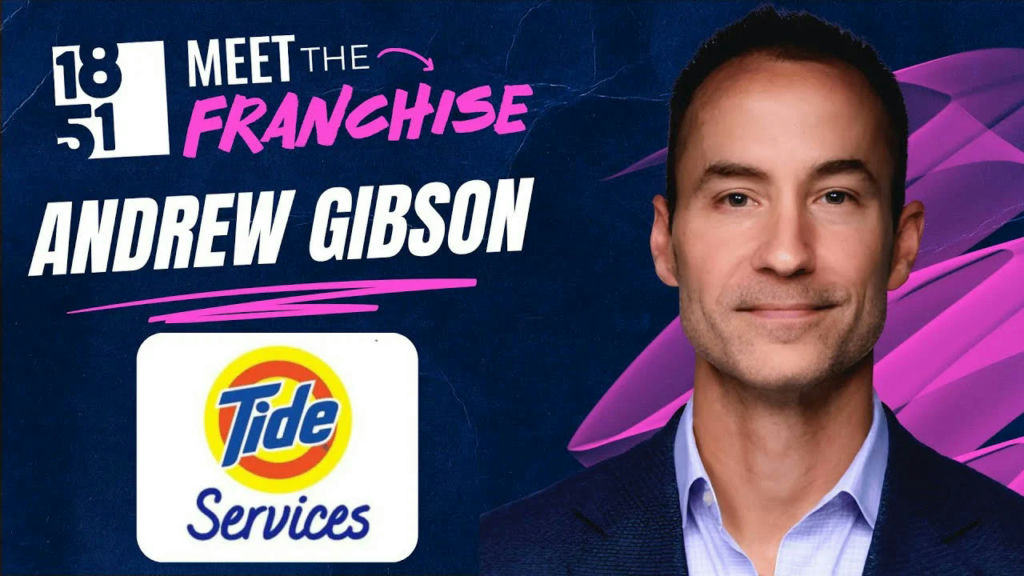
Tide’s name gives its franchise business an immediate advantage, but Andrew Gibson says brand recognition is only useful if the company protects the experience behind it. On a recent episode of the “Meet the Franchise” podcast with 1851 Franchise Publisher Nick Powills, the Tide Services president and CEO discussed how Tide Cleaners and Tide Laundromat are growing through careful franchisee selection, operational discipline and a broader vision for solving laundry needs outside the home.
“We're fortunate to start with the Tide brand when someone joins Tide Cleaners or Tide Laundromat,” Gibson said. “That carries over into franchisee selection. Every brand needs to be thoughtful about who it brings in.”
Financial qualifications matter, but Tide places significant emphasis on finding entrepreneurs who have the drive and commitment to build the brand in their local markets. The company looks for franchisees who understand the responsibility that comes with representing one of the most recognizable brands in consumer products.
Franchisee selection
The franchise spends considerable time learning how candidates handle problems, make decisions and interact with others. The goal is to identify operators who will be strong long-term brand stewards and capable of scaling multiple locations.
“You can have someone with $25 million in liquidity and 30 years of franchise experience and still have them be the wrong fit if they don't have the fire and energy to build the brand in their market,” Gibson said. “The day those doors open, they become the face of a multibillion-dollar brand. We take that responsibility very seriously.”
Unlike many service concepts, Tide benefits from strong consumer trust before a customer ever walks through the door. Once customers experience the company's convenience, technology and garment care standards, retention tends to be strong. Gibson compared the business more closely to finding a trusted barber than choosing a restaurant. Customers may not use dry-cleaning services daily, but once they find a provider they trust, they often remain loyal for years.
Growth strategy
Tide's growth strategy also includes helping franchisees acquire and convert independent operators. While existing dry-cleaning owners can become franchisees, the model often works best for operators who want to adopt Tide's systems, technology and brand support while expanding through acquisitions and conversions.
“We are the only out-of-home laundry brand that can clean all consumers' clothes,” Gibson said. “It doesn't have to be dry cleaning. It can be home laundry. It can be comforters. We're the only brand that can clean everything, powered by a national network of franchisees who are expert operators, all backed by the most trusted brand in the history of garment care.”
The CEO sees the highly fragmented dry-cleaning and laundry industries as a major growth opportunity for Tide Services. By combining Tide Cleaners and Tide Laundromat locations in more markets, the company aims to create a comprehensive laundry solution powered by franchisees, technology and the strength of the Tide brand. The long-term goal is to simplify laundry for consumers while continuing to help franchisees scale their businesses and dominate local markets.
“We also think that because we have Tide and we're backed by this amazing brand and chemistry company, the opportunity is much bigger than just $15 billion,” Gibson said. “What's interesting is there are people who actually like doing their laundry, but there are very few of them … When you have laundromats and cleaners, you have the ability to control operational excellence and the quality of the product. We think that's a really big deal.”
A transcript of Gibson's interview with Powills has been provided below. It has been edited for brevity, clarity and style.
A friend of mine was working on this thing called Tide Cleaners. At a lot of big companies, you don't necessarily want to go to some of the smaller startup-type ventures, but P&G has a great culture. They want to rotate people around and celebrate taking chances and big swings from an innovation standpoint.
At the time, Tide Cleaners had nine units. I thought, "Man, that seems like a ton of fun." It felt completely different. The autonomy was through the roof, and I got to work with entrepreneurs. That was 14 or 15 years ago.
I've also been fortunate enough that, through Tide Cleaners and now Tide Services, we've been able to build our own business inside Procter & Gamble, a multibillion-dollar company. I came in because I wanted to do something different and get back to what I enjoyed in college. In many ways, it's been two different phases of entrepreneurship and startup life.
Powills: How do you keep the entrepreneur inside you quiet? You said you were an entrepreneur in college, and obviously P&G's approach of letting you be entrepreneurial within the organization probably allows you to keep that creative energy alive. But how do you stop yourself from saying, "Why don't I just go do this on my own?"
Gibson: I tried for a while to silence it, and then I realized that's probably part of the gift. I think the restlessness is good. The restlessness of wanting to see something grow, the impatience that comes with that and never being satisfied with the status quo, that's valuable. The status quo is always resetting itself anyway.
I can't silence it, but I think that's okay because it keeps you moving. I find different ways to channel it. On good days, I channel it into getting a deal done with a franchisee. Maybe it's an acquisition conversion on our cleaners business. You can lose yourself in the deal, the project or the organizational restructure.
Gibson: Yeah, I think when it's at its best, that's exactly right. I also think there's potential for intimidation. Procter & Gamble is an $85 billion business. It has tens of thousands of employees around the world. It's nearly a 190-year-old company. Tide has been around for 80 years.
All of that can be impressive, but it can also be intimidating to people who want to become our franchise partners. As everybody knows, franchising is a marriage. You need a really strong relationship.
To your point, I think the restlessness helps create empathy. It helps me relate to what franchisees are doing. I have tremendous respect for entrepreneurs and franchisees. It doesn't even do it justice to say I respect them. They have everything on the line.
It helps bridge the gap between the corporate view and the realities of entrepreneurship. What's it take to get your SBA loan? What's it take to get your first certificate of occupancy? What's it take to go from one store to two stores to five stores? That part is a blast.
Powills: What I just heard was empathy, but also an understanding of all those different levers. Did that happen instantly when you got into franchising, or did it take time to understand all those mechanics?
Gibson: It always takes time. In franchising, you're effectively inheriting your predecessors' mistakes so you don't have to make them again. Before coming into franchising, I was working on the Old Spice brand. In that corporate environment, there's much more formulaic and rigorous thinking. You have highly accurate data, access to research and access to some of the best minds in the world.
There's a lot of that in franchising too, but especially at the stage we were in and in the dry-cleaning industry, it didn't have the same level of discipline and rigor. When I came in, I thought, "Okay, we're going to have a database approach and everything will work according to a process." Then you quickly realize that's not always the case. You build systems over time, but you also learn how to operate with incomplete data. You learn how to trust your instincts.
On the franchisee side, you also realize you're dealing with people. When someone signs a franchise agreement, they're on a high. Then they find real estate, and they're on another high. Then startup begins, and that's where empathy really comes in.
Honestly, becoming a parent has helped me become a better franchise business partner. You realize you can't judge people too much on their best days or their worst days. Entrepreneurship often feels like a series of difficult days, especially in the beginning. You have to learn how to filter through what's happening. How do I get to what's best for the brand and what's best for the franchisee? How do I take 10-plus years of experience and apply it to solving this problem?
Patience becomes incredibly important. Sometimes a franchisee may spend 30 minutes yelling at you, but if you listen closely, what you're really hearing is passion. They care deeply. They want to succeed.
That's something you learn over time in franchising. These are people with a fire to succeed, and thank goodness they have it because our brands don't exist without them. Our job is to cultivate the best of that energy. And maybe we need a goldfish memory for some of the yelling and screaming.
Gibson: Absolutely. Tide is unique in some ways, although every franchise brand can say that. Our uniqueness starts with the fact that Tide is a multibillion-dollar brand that’s been around for 80 years and has been the industry leader in garment care for most of that time.
We're fortunate to start with the Tide brand when someone joins Tide Cleaners or Tide Laundromat. That carries over into franchisee selection. Every brand needs to be thoughtful about who it brings in. Going back to your opening point, you bet on the jockey, not the horse.
You can have someone with $25 million in liquidity and 30 years of franchise experience and still have them be the wrong fit if they don't have the fire and energy to build the brand in their market. The day those doors open, they become the face of a multibillion-dollar brand. We take that responsibility very seriously.
We need franchisees who understand what it means to be brand stewards from day one. Building and protecting a $4 billion brand is a massive responsibility. We take calculated risks. We're thoughtfully urgent, but we're also careful. With roughly 230 units, we've proven the model works, but we still need great partners.
We sit down and break bread together. The night before Discovery Day, we'll have dinner with candidates. We let the conversation go where they want it to go, but if we had our preference, we'd spend most of the time learning who they are as people.
We want to hear how they've handled adversity. We want to understand how they make difficult decisions. We want to know how they deal with conflict. We're paying attention to everything, just as they should be paying attention to us. How do they treat the waitstaff? How do they interact with people? Those things may sound like soft skills, but they're very real when it comes to leadership and being the face of a brand.
Gibson: Yeah, you hit it. There are some similarities between dry cleaning, out-of-home laundry and food. The difference is what you're hitting on. With food concepts, humans have a physiological need to eat three or four times a day, and they have a strong desire not to eat the same thing every day or every time. You don't have a physiological need to dry clean.
However, once we get you, once you break up with your dry cleaner and try Tide, we know that if we get you in three times and we do it the right way — the Tide way — all three times, there's a strong chance you'll stay.
That means when you're pulling up, we're out in the drive-thru before you put the car in park. You've got a bright, smiling face greeting you. You get on our app, which is a 4.9-star app and best in the industry. You're able to see the convenience and quality.
Sure, there's no such thing as perfection. We have a seven-point inspection, and a lot of cleaners say they have one. But categorically, the quality of the garments that come back, combined with our own version of Tide that we use and great partners on the solvent side with GreenEarth, all of that matters. We don't even necessarily hide the playbook because it's so hard to replicate. We've got the scar tissue to show how hard it is to replicate our playbook.
But to your point, once we've got you, we've got you. I would say dry cleaning is more like getting your hair cut than it is like food from a franchise standpoint. Once you find a barber or stylist, you don't want to switch unless you're given a reason, like a bad haircut or a bad color job. Why would you switch?
For us, it's very similar. You build up that cohort of consumers, and it becomes an annuity stream. Dry cleaning, like any industry, is not simple. There's a lot you have to do, and there's a lot of nuance. If you drop off this blue shirt or you drop off a quarter zip at a cleaner, that's your possession. You're handing it over to somebody, and you expect it to come back better than how you dropped it off. You're going to notice small issues.
So while it sounds simple to say, "Just don't screw it up and people will keep coming back," you have to deliver every single time. In the dry-cleaning industry, you never clean the same garment twice, even if you literally clean the same garment twice. Little things happen over time. The elbows get worn out. More buttons start to crack because of how the consumer uses the garment.
That's the flip side. Doing it right every time takes a lot of systems and diligence. But when you do it, it's a great complement to food if you already have food in your portfolio. Even if you don't and you're just looking to get into franchising, people are going to pay attention when they drive by because they see the bull's-eye. That's one of the hardest things to break through: awareness and trust. Then you follow the playbook, and we think it's a great story for franchisees looking for scale.
If I'm calling out what is probably the most complex thing, it's that you may not want someone who is already in the industry. There may be select people who could fit, but if they're already in the industry, they likely have a way of doing things operationally that hasn't gotten them to the volumes that would make this a really strong sales lesson. So I imagine taking that model and cross-applying it to the business operator who is well-capitalized is the magic persona. Right or wrong?
Gibson: Both can work. Of the two out of 10 franchisees we have from the industry, we have learned a ton from them and from the industry overall. It is a very close-knit industry, and there is a lot to learn from it. So it has to be right on both sides. We're not everybody's cup of tea, and we don't think that's necessarily a good or bad thing. It just is.
If you're an operator today of a dry cleaner, there is power in partnering with Tide and potentially becoming a franchisee. It doesn't happen as often because they typically got where they are by doing things their own way. There's a big difference between an entrepreneur who franchises and one who doesn't. It might be a small difference, but it's significant enough that it plays out over time.
We certainly have franchisees who have taken their businesses and become franchisees after running their own brands for years, and sometimes for generations. But more often than not, it's what you said. It's someone who wants to come in, learn the playbook and potentially acquire a mom-and-pop operator who is looking for the next thing and wants to be fairly rewarded for what they built. We think it can work both ways. It just more often happens with someone who wants a fresh start and comes in to build their business through conversion.
Powills: Let's close on this. What's your vision now? Obviously, there are a lot of tailwinds, learnings, growth and strong performance. Where do you go from here?
Gibson: How you grow and where you're going have a lot to do with how you see the opportunity. There's an $8 billion dry-cleaning industry and another $6.5 billion or $7 billion laundry industry. Call it $14 billion or $15 billion, give or take. Those industries are hyper-fragmented, and that's an exciting proposition.
We also think that because we have Tide and we're backed by this amazing brand and chemistry company, the opportunity is much bigger than just $15 billion. What's interesting is there are people who actually like doing their laundry, but there are very few of them.
We see the opportunity as creating nodes. When you have laundromats and cleaners, you have the ability to control operational excellence and the quality of the product. We think that's a really big deal.
We are the only out-of-home laundry brand that can clean all consumers' clothes. It doesn't have to be dry cleaning. It can be home laundry. It can be comforters. We're the only brand that can clean everything, powered by a national network of franchisees who are expert operators, all backed by the most trusted brand in the history of garment care.
That's our foundation. Where you can take it from there, I think the sky's the limit for either concept. We're on a path toward becoming a billion-dollar business. That hasn't changed, and we continue to make great progress. But I think you'll see us not just playing in dry cleaning and laundromats.
At the end of the day, the consumer has a problem. It's all laundry. It never ends. They don't care if it's done in water. They don't care how it's done. They just want it done for them. We have a tremendous opportunity and responsibility to solve that.
In markets where we're starting to have the combination of cleaners and laundromats under one franchisee, or two franchisees in the same market, there's just a tremendous opportunity and responsibility to end laundry for consumers and figure it out. That's the long-term goal. Along the way, I think we're going to have a blast helping new franchisees take over markets.
Powills: When I look at the business as an outsider, I see a few things that are going to help you get there. One is the depth of the business model. You're obviously well-capitalized because of who is operating the business, and for a brand this size, you're still best in class. Nobody has the support structure around it that you do.
Second is the compounding of the technology and the speed of how fast laundry can get done in a world where we're dialed into this 15-minute life. All the pieces are there: technology, brand, operations, real estate, support and access to a trademark that is very, very valuable.
This should be best in class. It comes down to awareness among the right operators, and then you making sure they check the boxes from a human standpoint and have that fire in the belly. I don't see a reason why this vision won't continue to grow and hit. I'm grateful that you shared it with us, and I'm grateful for your time.
In this story
This story was originally published in 1851 Franchise on June 15, 2026. Burnaze summarizes and links to the original reporting.
Read the full story at 1851 FranchiseLiked this? Get the week's franchise news, explained
- Sunday 8 AM ET weekly + a monthly deep dive
- Sections picked for the industries you follow
- Every claim linked to its source. Free.