TL;DR
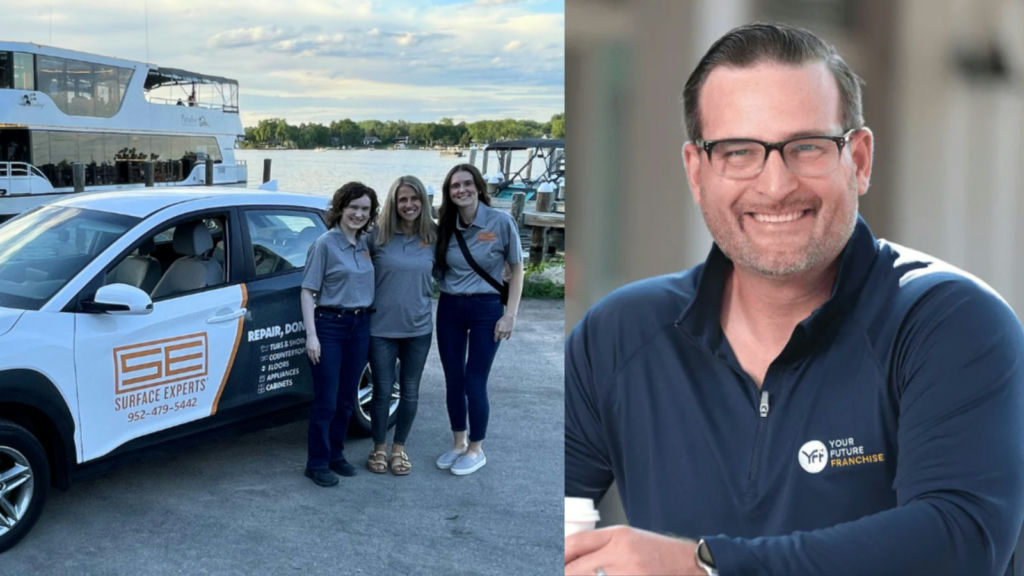
Kristin Flaherty, a former corporate healthcare professional, transitioned to franchise ownership with the help of Scott Thompson from Your Future Franchise. She is now working with Surface Experts out of Spokane, Washington, and is off to a strong start.
Less than a year ago, Kristin Flaherty was working as global director of customer experience at a major medical informatics company. She’d been in the corporate healthcare space for nearly 15 years when something that should’ve been destabilizing happened: She got laid off.
Determined to bounce back and take control of her own life and career, Kristin decided to make a change. She wanted the chance to lead her own business, and she had heard positive things about franchising from a family member, but she wasn’t sure where to start.
Enter Scott Thompson of Your Future Franchise, who was able to provide Kristin with the advice, knowledge, and perspective she needed to make a successful transition into life as a franchise owner-operator. He helped Kristin build industry knowledge, understand which opportunities might fit her goals, and select the best opportunity for her.
Franchise transition journey
KF: I was, let’s say, feeling a bit of a stirring in my career, just having been in the corporate world for so long. I was feeling those golden handcuffs and was just so sick of working under a boss and culture that had gone south. When I look back at that time, I was relinquishing control of my future.
I’d become more aware of others, namely my uncle, who had worked with Scott previously. My uncle had recently sold his franchise and retired, and he told my husband and I his story from beginning to end, and I was immediately interested. I’m like, “Okay, this sounds much more appealing,” particularly the freedom, flexibility, and control. It also really fit my background of liking to look at an entire organization and focus on putting all the pieces together.
Earlier this year, I was actually laid off at a time when I had already begun looking for another job. But being laid off ultimately was the door that opened and kickstarted my search and really sped it up. I felt ready to do something where I was leveraging the expertise I had built in my prior career but using it in ways that aligned with my interests and trust in myself.
KF: What excited me when I started exploring the franchising world was the range of possibilities. Before, I didn’t really appreciate everything that the industry entails – that it was more than just Chick-fil-A. The possibilities were endless.
It was very exciting just to learn that there are things that we could enjoy and that we think we could do well at. Things felt fun, exciting, and new.
It also felt like a chance to reclaim my control of my own future and really steer something myself.
On the other hand, I had lots of reservations. I needed to feel confident that I would have the support, resources, and guidance to be successful. I’ve had a career and been a professional, but I was moving into an industry I was unfamiliar with.
KF: Working with Scott was great. He was a very grounding person that would roll with me through the ups and downs, the concerns, the excitement while also keeping me in the reality of, “Look, here’s what this would actually look like.” Scott was very thorough, very educated, and very helpful when it came to connecting me with others who could lend some advice or wisdom to me.
In Scott and I’s early meetings, he focused on building an understanding of what our interests were, what our values were, what goals we had, and what we wanted our future to look like. Then, he was able to take that and present a range of options that were within the realm of the requirements I gave. I don’t think I ever would’ve had the time or resources to find all the opportunities he presented. Plus, he was able to add great insights as he talked us through each brand.
I mentioned before that I had some reservations about making sure I was joining a system with strong franchisee support. Scott did a good job of giving me very defined questions that I could use to speak with both the franchisors and their current owner-operators to figure out what those resources actually looked like and whether they worked.
Just in general, Scott’s so well-connected that the referrals and people he could connect me with were tremendously helpful. He’s just a wealth of knowledge, and the thoroughness made me feel like more of an expert myself.
KF: I’m still learning a lot and learning quickly. I’m officially working with Surface Experts out of Spokane, Washington, and we’re off to a strong start.
I started a little smaller with my first franchise intentionally because I wanted to do something I felt really comfortable with, where I knew I could also focus on developing my skills and confidence. I’m already thinking about what could be next and how to grow from here.
Franchise support approach
SCOTT THOMPSON: I work with all different kinds of folks who are serious about figuring out who they are and what they want to do next in their lives.
Like Kristen said, I focus on values, mission, purpose, transferable skills, investment comfort, sales ability, people management ability, and all the tangible things that matter when you’re selecting a business. Do you want to grow an empire, or do you want a lifestyle business that’s fairly small?
I help people talk through all those factors and then also explore their preconceived notions and biases about franchising. A lot of people come to the table thinking of franchising as cooking fries or running a pack-and-ship store, or they have preconceptions one way or the other because they know someone who’s run a franchise before. I try to uncover that and help them expand their knowledge of the different options that are out there.
I spend a lot of time using data to match them to the right brands and not just picking what’s hot on the market or where the best commission is, because there’s a lot of that out there in our space, too.
ST: A lot of people have never managed a P&L before – a profit and loss statement. Most people have been on a W2 income, so they’re used to getting post-tax dollars that they manage according to their lifestyle.
I try to teach people about pre-tax dollars when you’re owning a small business and some of the associated tax strategies – owner discretionary expenses and things that you can use to reduce your personal expenses in favor of business expenses. When they learn that, a lot of people realize that maybe they don’t need as much salary as they once thought to get into business for themselves.
I also always spend time on making sure new franchisees understand their ramp period and how much capital they actually need to do this the right way and how to validate those numbers with franchisees. It’s very easy to look at the Item 7 of the FDD and say, “Oh, I only need, 30 grand of working capital.” But what if that’s only three months of working capital and it takes you 18 months to break even? So, really, I teach the basic things that people don’t necessarily know getting into this.
And then, honestly, the last thing is fear – overcoming fear. I like to put fear into two buckets: there’s good fear, and there’s bad fear. The good thing to fear is false evidence appearing real. In those situations, we need to say, “Okay, let’s pause there. Let’s go talk to somebody and make sure we’re clearly understanding that.” In that way, we can use knowledge to overcome that fear. There’s still some unease, but at least you have a degree of confidence.
Then, that second kind of fear looks like “forget everything and run away.” For example, when a bear comes in the room, you don’t even think about anything, you’re gone. Some people can never overcome that fear. They see market instability or risk, and they’re always going to retreat back into “keep job” mode.
I can help you overcome the reasonable fear of false evidence appearing real, but if you’re the type who’s always going to run from the bear, I can’t really help you fix that; but I can help you understand that about yourself too.
ST: She’s a professional. She’s worked in corporate. She’s built a career. She’s got great skillsets.
A lot of white-collar jobs right now are at risk of being disrupted. Obviously, every industry is different in how much they embrace AI. The transition is already happening much faster at technology companies, while in certain other industries, it might take some time. When companies realize you can close the books with one person and an AI tool versus seven different people to do the job in an office, you’re going to lay people off and save that capital.
But there are also industries that won’t be destabilized by AI, like home services. When you start a home services franchise, like Kristin has, you own that business in an industry where you’re always going to be needed. You’re also building an asset. If you don’t like your franchise business anymore, guess what, you can sell it.
In this story
This story was originally published by David Gibb in Franchise Magazine USA on August 11, 2026. Burnaze summarizes and links to the original reporting.
Read the full story at Franchise Magazine USALiked this? Get the week's franchise news, explained
- Sunday 8 AM ET weekly + a monthly deep dive
- Sections picked for the industries you follow
- Every claim linked to its source. Free.