TL;DR
Karen E. Abrams, a trusted advisor to franchisees, has built a reputation for her practical and business-minded approach to franchise law, with experience advising franchisees from major brands like Wingstop and Wendy's. Abrams focuses on helping entrepreneurs scale responsibly and navigate risk, growth, and long-term planning.
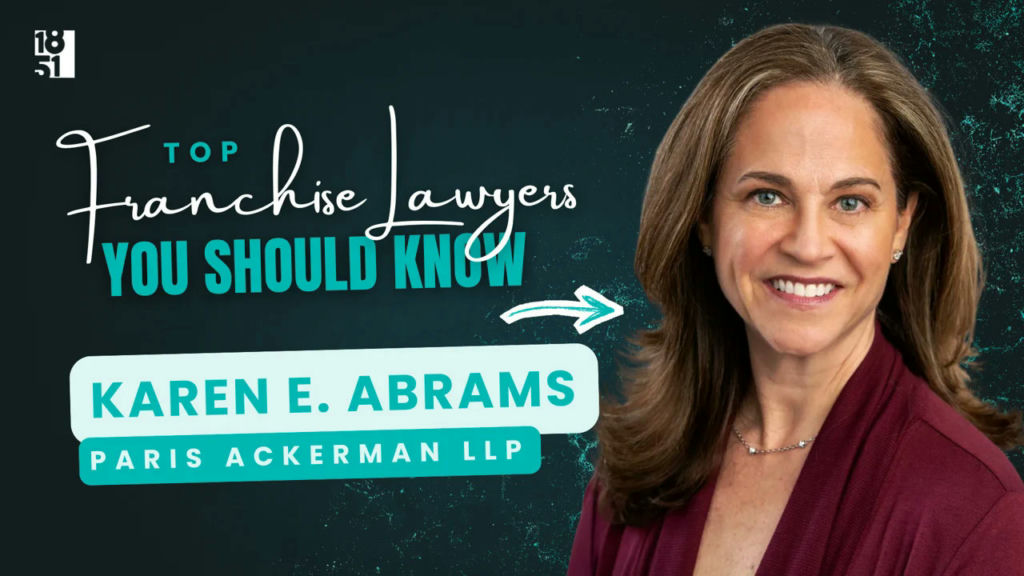
Karen E. Abrams has built a reputation as a trusted advisor to franchisees navigating risk, growth and long-term planning. With experience advising franchisees from major brands like Wingstop, Wendy’s, Great Clips and Dunkin’ on lease negotiations, sales and acquisitions, and growth strategy, Abrams brings a practical, business-minded approach to franchise law. As an experienced franchisee herself, Abrams is passionate about helping entrepreneurs scale responsibly and focuses her work on that mission.
1851 Franchise connected with Abrams to discuss franchise compliance, where legal risk hides during expansion and the lessons that continue to shape her advisory philosophy.
Karen E. Abrams: I was initially drawn to franchise law because it is one of the few areas of practice where legal structure, business reality and human risk intersect so directly. Franchisees are not passive investors — they are operators committing substantial capital, personal guarantees and years of their working lives to a system they don’t control.
That dynamic immediately interested me. What has kept me engaged for more than 30 years is that franchising continually exposes the tension between growth and sustainability. Every cycle brings new concepts and new real estate pressures.
Having also been a franchise owner myself — and having experienced both success and failure — I’ve seen how early legal decisions reverberate years later. That long arc is what keeps the work meaningful.
Abrams: Brands continue to underestimate the long-term consequences of real estate allocation and risk shifting. In many systems, franchisees are required to accept lease structures that heavily favor landlords and, indirectly, the franchisor’s growth goals. Personal guarantees, limited termination rights and rigid use clauses can trap otherwise capable operators in unworkable situations.
While these provisions may accelerate development in the short term, they often undermine system stability when markets soften or unit economics change. The legal risk is not limited to individual disputes; it can also lead to cumulative franchisee dissatisfaction and attrition.
1851: In your experience, where do emerging franchisors tend to get tripped up from a compliance or documentation standpoint?
Abrams: Emerging franchisors often struggle with over-templating — relying too heavily on “one-size-fits-all” documents that don’t reflect how the business actually operates in the real world. From a compliance standpoint, there is frequently a disconnect between what the FDD says, what the franchise agreement requires and what the brand’s sales or operations teams are communicating to prospects. That inconsistency creates unnecessary exposure. Early-stage brands benefit enormously from aligning their documentation with their operational realities before growth accelerates.
Abrams: Risk management should be viewed as a system-wide issue, not just a legal one. As brands expand into new markets or pursue alternative growth strategies, they need to assess whether their existing agreements, support structures and real estate assumptions actually work in those environments. Growth magnifies weaknesses. Franchisors that take time to stress-test their models — especially around unit economics, real estate obligations and franchisee support — tend to build healthier, more sustainable systems.
Abrams: My approach is rooted in advocacy, transparency and long-term thinking, and it’s always about protecting my clients. Many of my clients are quitting their day jobs, entering retirement, coming out of retirement or cashing out their life savings to start a franchise. I take the responsibility of protecting these clients very seriously and consider it a privilege that my clients put their trust in me.
I generally only represent franchisees, and my role is to help clients understand not only the legal language in front of them, but the practical implications of that language over the life of the franchise. I focus on identifying risk and negotiating meaningful protections where possible. My own experience as a franchise owner guides that work — I know how these agreements feel when you are living with them, not just reviewing them.
Abrams: The most impactful lesson I’ve learned is that the quality of a franchise relationship is often defined by how it ends, not how it begins.
Early in my career, I focused heavily on launch issues — site selection, build-out and opening obligations. Over time, I’ve seen that transfer rights, renewal terms, exit options and post-termination obligations are what ultimately determine whether a franchisee can adapt to change. Today, I advise clients to think about flexibility and exit strategy from day one, because no business plan survives unchanged for ten or twenty years.
In this story
This story was originally published in 1851 Franchise on June 23, 2026. Burnaze summarizes and links to the original reporting.
Read the full story at 1851 FranchiseLiked this? Get the week's franchise news, explained
- Sunday 8 AM ET weekly + a monthly deep dive
- Sections picked for the industries you follow
- Every claim linked to its source. Free.