TL;DR
Everytable, a food company founded by Sam Polk in 2015, has launched an entrepreneur-friendly franchise offering, with a mission to increase access to healthy food in underserved communities. The company uses a central commissary kitchen approach, making it an accessible franchise opportunity with low labor and simple operations.
Sam Polk, CEO of Everytable, was a Columbia-educated hedge fund trader who woke up one morning wanting to make a difference. Inspired by every book he could get his hands on about the Civil Rights movement and several high-profile food documentaries, Sam decided to refocus his energy on making meaningful progress at the intersection of food and poverty. That led to the founding of the non-profit FEAST (Food, Education, Access, Support, Together) in 2013 and Everytable in 2015.
After more than a decade increasing access to food where it’s needed most, Everytable launched an entrepreneur-friendly franchise offering this spring. We sat down with Sam to discuss what’s so special about Everytable, how their franchise model works, and how their mission and business model align in ways that benefit everybody.
Franchise model details
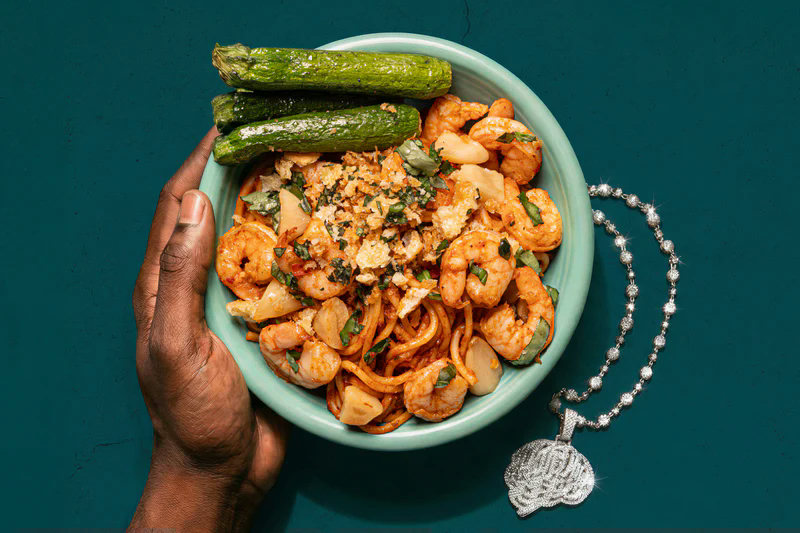
We call our locations “scratch-cooked meal shops.” They can be a variety of sizes – the average is maybe 800 square feet – and as you walk in, there’s a bunch of beautiful display refrigerators showing all these freshly prepared meals. There are hot plates like jerk chicken or a turkey taco bowl or chicken shawarma and also a variety of salads, wraps, coffee, pastries, and juice. Then there’s a point-of-sale where you can check out, and some locations provide a table and chairs if you want to eat on-site.
Some people will come in to buy lunch, but Monday is also our busiest day because we’ll see people coming in and buying six meals for the week. Other people use our subscription service to order meals, which are fulfilled at their local shop, so it’s much more responsive and there’s less shipping involved compared to other meal services. About a third of those folks pick up the meals themselves; the rest get that food delivered to them.
We use a central commissary kitchen approach. The shop operates as a point of sale and distribution hub for all the orders in the area without any cooking actually taking place on premises.
In a lot of ways they’re the same basic structure: same ownership, same royalties, same startup costs– everything is the same. The difference is that the social equity franchise model is for folks who start working in our stores – employees that start off at seventeen dollars an hour and then twenty-two dollars an hour. And these are often folks that are really talented and entrepreneurial but don’t have a lot of access to capital.
Social equity and funding
And so we went out and raised capital from large philanthropic foundations like the Kellogg Foundation, the Annenberg Foundation, the California Wellness Foundation, and the Kroger Foundation, so that when these talented entrepreneurs have gone through and completed a rigorous training program, they then get lent the money to build their own franchise. So, it’s a very philanthropic entrepreneurial empowerment model.
And then we opened recently to traditional franchise for a couple of reasons. One is that Everytable is a company that’s really about being inclusive and a model that works for everyone. So, while we have a path for folks that don’t have a lot of capital, we now also have a path for people that might have slightly better access to that capital. Reason two is that Everytable has made a lot of improvements over the years, from our packaging to our internal processes to our brand to all the different sort of like revenue channels that flow through the store.
We’re now at a place where we feel like we’ve got the capability to really scale. And so now is the time to open it to traditional franchisees who want to build one, two, or fifty to a hundred stores.
Everytable’s a pretty interesting franchise model as far as that we sell scratch-cooked meals, but for our franchisees, there’s absolutely no cooking. All of the cooking is done at the single central kitchen. And so, because of that, it’s a really accessible franchise opportunity. Folks don’t need to know how to run a five-million-dollar restaurant space, they don’t have to invest the capital to build out a kitchen, and they don’t have to cook food on a daily basis. That means the labor is low, and the operations are really simple. The build-out cost is really inexpensive.
As an operator, you’re not just supporting a retail location, you’re building relationships in the community that drive business and have a real impact. Our sales team signs contracts with schools, Meals on Wheels-type programs, homeless shelters, senior centers, and beyond, and fulfillment of those orders runs through the stores. For example, you might have a standing hundred-bowl order for a school lunch program each day or deliver three meals a day to your local homeless shelter.
The shop is basically a small box that’s easy to operate, and all these different revenue channels flow through it – and in the direction of the franchisee.
Growth and opportunities
In my mind, it’s also a great time for this franchise opportunity because the world is experiencing such crazy disruption and displacement, and AI and jobs are moving and everything. Now there’s a place where, even if you don’t have a lot of franchise experience and you don’t have a huge amount of capital, you can start building, not only a great business, but also a very impactful business that brings healthy food into the communities that you want to operate in.
One of the things that I love about my career is I found a business where I could drive a lot of wealth if we’re hugely successful – the American dream of entrepreneurship – and it has this deeper sort of purpose and impact.
And I think the really exciting thing for franchisees is that they can do that too. It’s a really fulfilling and financially rewarding situation.
I would say there are three things. One is that they’ve got to love the mission. They’ve gotta love increasing access to healthy food in their community and bringing it there.
Second, you need to be an operator. You need to be someone who connects with the community and is always reaching out to build relationships. You’re going to need to be an ambassador for the brand.
And then, third, I love to work with tough entrepreneurs who are going to fight for every customer and make sure they consistently have a great experience. It’s so important to uphold the quality of both the brand and the experience.
Most of our stores are in California right now, Southern California specifically. We’d really like to spread business all throughout the state. We’re also actively working to grow our presence in Arizona, Nevada, Oregon, and the Seattle area.
We’d like to really cement our presence on the West Coast and then open up a second kitchen somewhere in the Midwest, which would enable us to really hit the gas pedal on accelerating growth across the entire country.
We’re really excited about continuing to make franchising even more accessible for a lot of people.
In this story
This story was originally published by David Gibb in Franchise Magazine USA on June 1, 2026. Burnaze summarizes and links to the original reporting.
Read the full story at Franchise Magazine USALiked this? Get the week's franchise news, explained
- Sunday 8 AM ET weekly + a monthly deep dive
- Sections picked for the industries you follow
- Every claim linked to its source. Free.