TL;DR
HomeVestors Vice President Mike Oberholtzer discusses the franchise's fees, support, and growth, with 70 new franchisees added in 2023. The company operates with a unique culture where owners welcome neighboring franchisees, which helps with marketing and deal flow.
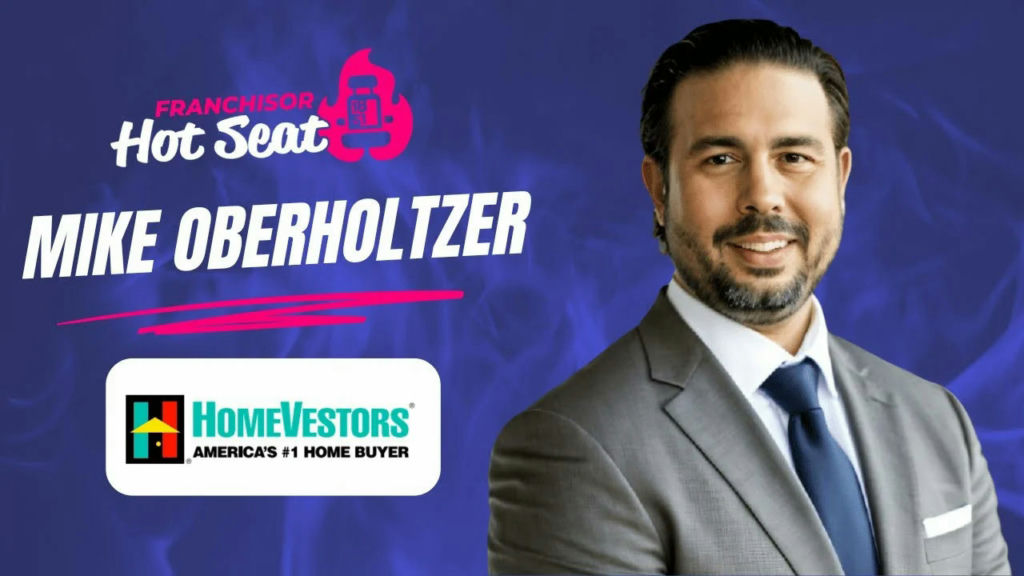
In a recent “Franchisor Hot Seat” conversation with 1851 Franchise Publisher Nick Powills, HomeVestors Vice President of Franchise Development Mike Oberholtzer made the case to would-be real estate investors: a culture where owners welcome neighbors because it lifts marketing and deal flow; tangible value from vendor relationships and access to capital; and steady expansion — about 70 new franchisees this year — even as prospects watch interest rates and the housing market.
“In my first pipeline meeting, I heard, ‘I’ve got so-and-so in Dallas, and I just introduced them to all the franchisees around them.’” Oberholtzer said. “I asked if they warned them that franchisees tend to be territorial. They looked at me like I had three heads. In this brand, our franchisees want more franchisees right next door to them.”
Oberholtzer is a 20-year franchise veteran who started in SBA lending at Cottman Transmission in the Philadelphia area, shifted into franchise sales after Cottman merged with AAMCO, and joined HomeVestors in February to lead development. The company behind the “We Buy Ugly Houses” billboards operates with five-year agreements but keeps owners for decades by stacking practical advantages: a marketing flywheel that scales from mailers to billboards as operators cluster, peer referrals and a support structure designed for openings and renewals — not just signed deals.
“There’s a bunch of reasons: inbound leads, community, vendor relationships that saved franchisees over $10 million last year, and access to capital,” Oberholtzer said. “Finding off-market homes and capital are the biggest hurdles when you’re independent. Many people don’t even know we’re a franchise — they’ve seen ‘We Buy Ugly Houses’ and the billboards. I’m OK that they don’t know; I want them to know they can invest in it.”
He also described a fee model built to reward growth — an $85,000 “full” option with no royalties or a half-fee path with a small royalty and a decelerating 0.8% to 3% transaction fee that drops as volume increases — while stressing “radical transparency” in discovery and a focus on candidates who will open, renew and refer. And because franchisees buy large Metropolitan Statistical Areas (MSAs), the brand avoids multi-packs that can lock out momentum from local word-of-mouth.
The upshot for would-be owners: If you want in on real estate investing with community ballast, practical savings and capital partners, HomeVestors is pitching a system where neighbors make you stronger — and it believes that approach will carry growth even in a cautious market.
A transcript of Powills interview with Oberholtzer has been provided below. It has been edited for clarity, brevity and style.
Nick Powills: All right, Mike — first you, then we’ll talk HomeVestors. It’s the only scripted question I have, and it’s the same one I ask at the start of every one of these. How did you accidentally fall into franchising? What’s your franchise accidental story?
Mike Oberholtzer: It is accidental for everybody. In about two weeks, it’ll be 20 years on the dot since I first started in franchising, with a regional automotive repair concept called Cottman Transmission in the Philadelphia area, where I’m headquartered. I started out doing SBA loans for new franchisees.
I don’t know how I got that job, honestly. They wanted somebody with a sales background and a little bit of finance, and I had done mortgages for six months. I think I was the only applicant, to be honest. But I learned everything about SBA 7(a) loans and got pretty good at it.
A year and a half in, Cottman and AAMCO merged. I raised my hand and said, “I’d like to help people get into this business. I’ve got a pretty good system set up for the loan piece. Can I do franchise sales?” They said, “Yeah, sure. We’re going to drop your salary. Here’s a stack of leads. We’ll do franchise sales.” I’ve done that ever since.
I’ve had really good mentors and been with great brands. That’s the accidental story.
Powills: Love the Cottman story — we worked with them a long time ago when we started this business. What I like about this topic is that for 99% of franchisees there’s turbulence that makes them reevaluate their career, and they buy into a franchise. Most weren’t thinking about it. If you had asked me to explain franchising the day before I joined the industry, I couldn’t. If I go to a franchisee and say, “Could you explain it?” they say no — yet every franchisor says, “Buy my franchise.” What is this thing?
Oberholtzer: That’s a good point. I try not to forget that feeling of not knowing 20 years ago what it was. It’s easy to take for granted how much we know. Start every conversation assuming the new person has no idea what it is. That gives more opportunity to explain or get through myths and head trash. We all got here sort of accidentally.
Powills: Your first message is “Join the No. 1 real estate investing franchise.” Your second is “Build financial independence.” But how and why through franchising? Even talking about what an FDD is and what they’ll see in the process accelerates their decision to fill out a form. What’s the state of the union with HomeVestors? How’s growth?
Oberholtzer: It’s going really well. I’m the new kid on the block here — started with HomeVestors in February. Everything I thought I knew about franchising didn’t go out the window, but it’s a lot different than my experience with other brands, in really good ways.
In my first pipeline meeting, I heard, “I’ve got so-and-so in Dallas, and I just introduced them to all the franchisees around them.” I asked if they warned them that franchisees tend to be territorial. They looked at me like I had three heads. In this brand, our franchisees want more franchisees right next door to them.
Yes, more franchisees means more marketing dollars and brand awareness, but for us it’s a core component. It’s how you go from mailers to billboards in a market. We have more franchisees referring friends and family right in the same area.
Real estate investing is also a harder conversation to navigate because most people know somebody who flipped a property or saw a TV show that made it look easy. “Why do I need a franchise to buy a house cheap, find a contractor and sell it?” I spent a lot of time with franchisees. We have a five-year franchise agreement, yet we have 10-, 15-, 20-, 25-year franchisees. Why stay when you could go independent?
There’s a bunch of reasons: inbound leads, community, vendor relationships that saved franchisees over $10 million last year, and access to capital. Finding off-market homes and capital are the biggest hurdles when you’re independent. Many people don’t even know we’re a franchise — they’ve seen “We Buy Ugly Houses” and the billboards. I’m OK that they don’t know; I want them to know they can invest in it.
State of the union: We’ll probably have a bit of a lull as folks look at interest rates and the housing market, and we’re still going to bring in 70 new franchisees this year — short of expectations, but still a solid year. Validation is awesome. Franchisees will tell prospects the good, bad and ugly. Our new CEO, within the last three years, has boosted morale. We have almost 1,000 franchisees across the U.S., and they still have a voice. We’re in a really good spot.
Oberholtzer: I have a lot of influence on our franchise landing page; little to none on the primary site.
Powills: If I was reshaping the user experience, my first message would be, “Our franchisees want you next door.” It’s powerful. Bullet points like “nationally recognized” are boring. What I heard from you: $10 million in vendor savings, exclusive lender relationships, a marketing machine. Also, the domain WeBuildBeautifulFranchisees.com is available — buy it.
Oberholtzer: You’ve done some marketing in your time. That’s awesome. I appreciate that.
Powills: Selling franchises is hard — you’re convincing someone to invest life savings in a business they have little control over. The value of a deal is often treated as the franchise fee. I push teams to look at three-year royalty and consider dropping the fee. When you see $200,000 in three-year royalties, suddenly the $10,000 marketing budget per deal looks upside down. What’s your reaction?
Oberholtzer: I want to be careful, but I think franchise fees are high because of the cost to attract franchisees. Our brand is well known; you can get in for a franchise fee in the low $40,000s. Then a brand-new junk removal franchise might charge $70,000. There has to be value — beyond covering the cost of adding franchisees.
We have a full franchise at $85,000 with no royalties attached. Most franchisees pay half of that and have a small royalty, and a piece of every transaction goes toward becoming “full.” It’s a milestone path to growth. We also have a decelerating transaction fee — 0.8% to 3% — that goes down as volume increases. Once you become full, royalties drop off. A couple of years in, you need less support; here’s your reward.
If someone asks why fees are high, I’d say because attracting franchisees is expensive in a crowded space — around 4,000 brands now. I tell candidates: make the franchise fee the last part. Fall in love with the model and the people. Treat the fee as part of startup cost. My job is to show the value of the fee and the royalties. If, at the end, it’s worth it to you, then we have something. It’s not always a comfortable conversation.
Powills: Imagine a real estate agent selling a house with termites — doesn’t happen. In franchising, buyers get steered by “we work for free” brokers toward brands that pay higher commissions. I think franchise salespeople are undervalued and underpaid. “Royalty” should be reframed as infrastructure — it funds the support you outlined. I’ve seen an FDD break down the franchise fee: $20,000 for recruitment, broker or organic. That’s the transparency buyers deserve.
Oberholtzer: I love that. “Responsible franchising” became a buzzword a few years ago. Some of us have done it for 20 years — bringing in the right people, right deal, right situation. I’m a fan of radical transparency. I’d rather scare a candidate with things they didn’t think of than make it rosy, especially with a brand like this. We could sell 200 franchises; I don’t want to sell a franchise. I want renewals and referrals.
Be consistent. Don’t advertise to broker groups that you’re giving them the entire franchise fee, then go on an IFA panel and talk responsible franchising. There are awesome brokers and groups, and some are different than others. For us, broker leads are harder because when someone buys Dallas, they get the whole MSA. I’ll never do a two-pack or three-pack. Some regular people miss out because there’s not enough upside for the broker they’re working with. That’s tough, but there are great people on all sides.
Powills: I like painting a view of culture so buyers can see the people behind the business. It’s tough to be a buyer —who to trust and how to cut the cards. Multi-packs can look great, but I saw a 70-pack sold for the commission; the franchisee opened one and failed because all cash went to fees, not operations. Also, the best drivers of new franchisees are franchisees; when you lock off a territory, you block that. Associations should protect the buyer first. To a buyer watching: learn to bet on the jockey, not the horse. What’s your closing statement for why they should reach out?
Oberholtzer: If you’re thinking about real estate investing and want to make a difference in the community, this belongs on your radar. Our mission statement starts with “to help others,” and we don’t take that lightly. When we go into a distressed property and someone’s crying, we ask how we can help. It may not even be that we buy it — we might suggest the MLS and a coat of paint.
If you think you could do it on your own, have the conversation with us so you know what you might be missing. It’s easy to make big, expensive mistakes. Our $42,500 franchise fee — if that saves one mistake like missing a cracked foundation — it could save your business. You’ll have a mentor, franchisees sharing contractor intel and a corporate office with loyalty and pride. This is a special franchise people need to look at.
Powills: For two 20-year industry veterans, “disgruntled” isn’t bad — it means we want to make the industry better. I can tell you do. Thanks for the conversation.
Oberholtzer: Same here. I even bought a website — coreb.org, the Coalition of Responsible Emerging Brands — because I think there’s a problem and there should be a group focused on responsible growth. I don’t want to be negative about franchising, but there’s work to be done.
Powills: It’s a positive message. Many dev teams are driven by an uneducated target number and pressure. If we keep having conversations about building really good businesses, those are the brands that rise. I didn’t expect this, but it worked out great.
Oberholtzer: I’m grateful. It’s cool to find like-minded people who care. Do the right thing, and we’ll be OK.
In this story
This story was originally published in 1851 Franchise on September 4, 2025. Burnaze summarizes and links to the original reporting.
Read the full story at 1851 FranchiseLiked this? Get the week's franchise news, explained
- Sunday 8 AM ET weekly + a monthly deep dive
- Sections picked for the industries you follow
- Every claim linked to its source. Free.