TL;DR
Smoothie King is reclaiming its position in the smoothie category it created by realigning its message, menu, and experience around its core idea of making nutrition taste good. The company is introducing a new food lineup, including toasts, protein boxes, and warm items, to capture full meal occasions and increase ticket size.
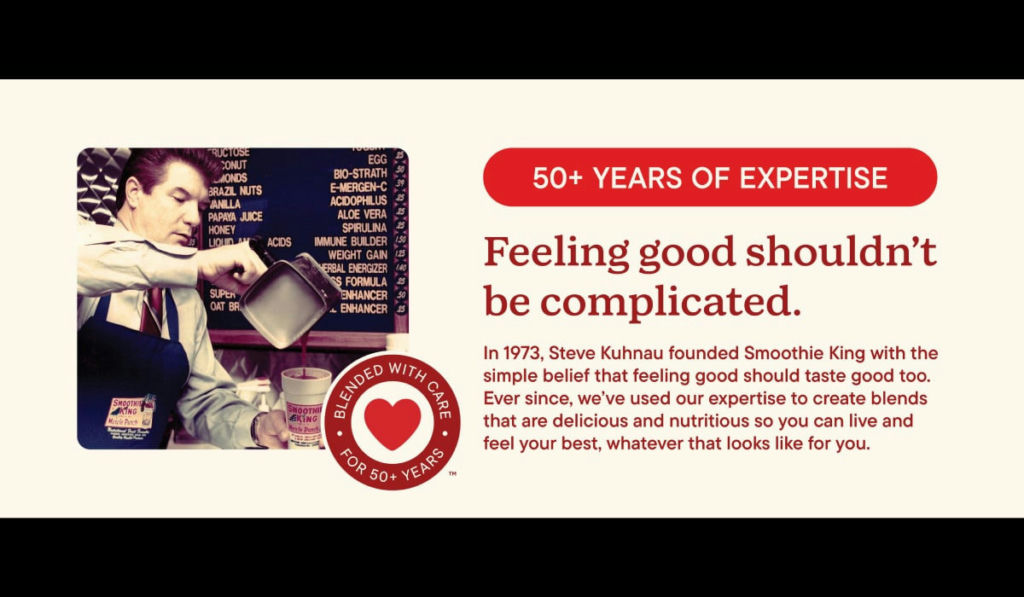
For more than 50 years, Smoothie King has built its business on a simple premise—make nutrition taste good.
The brand coined the term “smoothie” in 1973 and spent decades crafting recipes with nutritionists and developing a menu around function as much as flavor. But somewhere along the way, leadership realized that story wasn’t reaching customers.
Even among loyal guests, awareness of what made Smoothie King different had eroded.
“We have an incredibly loyal customer base,” says Gavin Felder, Smoothie King president and CFO. “We have an incredibly high level of frequency with our customers.
A lot of them didn’t know the story. They didn’t know that we served the first smoothie, that we invented the word smoothie.”
That disconnect—between what the brand is and what customers perceive—now sits at the center of Smoothie King’s latest evolution. The company isn’t repositioning itself so much as realigning its message, menu, and experience around a core idea it believes has always been true.
The goal is straightforward. The chain wants to clarify its role in a category it created and build a more scalable foundation for growth.
Reclaiming narrative
Reclaiming the Narrative
Smoothie King’s leadership sees its heritage as an underutilized advantage.
The brand introduced smoothies to the market and spent five decades working with dietitians and nutrition experts to build recipes from the ground up. Yet much of that work had been overshadowed by a bigger perception that all smoothies are inherently healthy.
Internally, executives came to view that as both an opportunity and a risk.
“We think this is the perfect time to remind people what we stand for, why we even exist in the first place, and then why we’re the category leaders,” Felder says. “And so, we just think it creates a really natural springboard for our next chapter of growth for the business.”
That thinking helped inspire the brand’s “De-Dupe” initiative (active earlier this year), which invited customers to trade in receipts from competing smoothie purchases. But more broadly, it showcased a shift in how Smoothie King plans to communicate value.
Instead of competing on a general “health halo,” the company is leaning into what it calls a “nutritious halo,” a distinction rooted in how its products are developed.
Consumers, however, don’t always see that nuance.
“What we started hearing from guests was that, wow, you know what, nutrition feels so overwhelming because there’s so much nutritional information out there. It’s a little bit hard to know who to trust,” says CMO Claudia Schaefer.
Smoothie King’s response is to position itself as that trusted source that has already done the work.
Why now
Why Now
The timing of the brand evolution is tied to internal momentum and external shifts.
Over the past several years, Smoothie King has experienced steady growth, with more than 1,500 locations in its development pipeline. At the same time, leadership saw a cultural change in how consumers define health.
The old model—based heavily on fitness—no longer captured the full picture.
Research showed that consumers increasingly view wellness as a combination of movement, nutrition, mental health, social connection, and recovery. Sleep, for instance, emerged as one of the most commonly cited indicators of health in consumer studies.
That shift exposed a misalignment inside Smoothie King’s own brand system.
Marketing leaned heavily into high-performance fitness imagery. Store designs felt functional, even sterile. Menus, while robust, could be difficult to navigate.
None of it was wrong individually. But collectively, it didn’t reflect how customers think about wellness today.
“It just felt like not all touchpoints were laddering up to who we want to be as a brand,” Schaefer says.
The solution wasn’t a single change. It required adjustments across nearly every part of the business.
On the marketing side, Smoothie King launched a new campaign, “The Best Kind of Delicious,” meant to highlight taste and nutritional intent. The messaging shifts away from a narrow fitness audience and toward a group of consumers navigating different wellness goals.
At the store level, the company is introducing a warmer, more approachable design.
The updated look incorporates softer color palettes, natural textures, and visual cues tied to ingredients and freshness. The goal is to create an environment that feels less transactional and more aligned with the brand’s emphasis on care.
“It’s a little more stark today,” says chief development officer Chris Bremer. “It doesn’t necessarily give off a warm tone. We want to make sure that we do that.”
The redesign will roll out gradually across new builds and remodels, with a focus on keeping costs manageable for franchisees.
“We wanted to make anything as cost neutral or even slightly reduced compared to what we do today,” Bremer says.
Arguably, the most significant operational change is happening in the kitchen.
For years, Smoothie King’s menu revolved almost entirely around beverages and bowls. While those products drove strong loyalty, they also limited the brand’s ability to capture full meal occasions.
Customers frequently paired smoothies with food purchased elsewhere.
“We heard for years that people love our smoothies, they love our bowls, but they can’t get a full meal at Smoothie King,” Felder says.
That gap led to the development of a new food lineup, including toasts, protein boxes, and, more recently, warm items like flatbreads and chicken bites.
The rollout has been methodical.
The company began with small-scale tests in Dallas-Fort Worth before expanding to larger groups of stores. Only after refining the menu and operational processes did it move toward a systemwide launch.
Key to that effort is the installation of ovens across the network—equipment Smoothie King is providing at no cost to franchisees.
“We’ve incurred a substantial cost for that because we really believe it’s transformative for the brand,” Bremer says.
The addition of food should increase ticket size, extend dayparts, and reduce leakage to competitors. It also increases the brand’s appeal beyond its traditional use cases.
Growth ahead
Introducing new equipment and menu items could have added complexity. However, Smoothie King treated it as an opportunity to streamline operations.
The company analyzed store layouts across the system, developed standardized installation plans, and optimized workflows to maintain speed and efficiency.
Importantly, those changes were made without requiring larger footprints or significant additional investment.
That discipline has helped build confidence among franchisees, who were involved throughout the testing and development process.
“It has been unanimously more positive than I would have expected, and that’s been great,” Bremer says. “They have loved the way it looks. They are all on board, obviously with the food component. When you marry that together and just bring them through the journey, I think that’s extremely helpful. And again, it’s with consumer and true data behind it. Again, not our opinion. This is what the guest is telling us.”
As Smoothie King evolves, it is also rethinking how it views competition. The company isn’t strictly focused on other smoothie brands. The chain actually views itself as part of an ecosystem around healthy living. That includes not only traditional beverage competitors, but also quick-service concepts, coffee chains, and emerging better-for-you brands.
“To us, anybody who wants to live a healthy and active lifestyle, we’re there to cater for,” Felder says.
In that context, differentiation becomes less about product category and more about credibility.
Smoothie King believes its long-standing focus on nutrition gives it an edge, but that’s only if it can communicate that effectively.
The company’s long-term ambitions remain tied to expansion.
Felder estimates that more than half of the potential Smoothie King system has yet to be built, with over 1,500 identified trade areas ready for development.
Interest from franchisees is rising as well.
Last year, Smoothie King opened 74 shops and signed 101 franchise agreements spanning 47 unique DMAs across the U.S. The chain also expanded into Utah and Minnesota for the first time and grew its nontraditional footprint, including one at Joint Base Andrews.
Smoothie King predicts it will open more than 90 locations this year. It has franchise incentives in place for Arkansas, Arizona, Colorado, Illinois, Massachusetts, Michigan, Minnesota, New Mexico, Oklahoma, Pennsylvania, Utah, Virginia, and Wisconsin.
“We’re really getting some exciting traction, not only from both the existing people in the system who are wanting to sign up and we’re seeing that as well as new people coming in new markets,” Bremer says. “You can’t ask for anything more than that because they really feel the care and support that we’re putting forth in this plan in a very diligent manner.”
That momentum is supported by a combination of factors such as improved unit economics, a more complete menu, and a clearer brand identity.
Leadership is measuring success across three key dimensions—consumer understanding, same-store sales growth, and new unit development.
“We saw this as a huge opportunity, once we had done that research, and once we saw all the category tailwinds that I just described, to really celebrate what makes us unique and to share that with the world. And so we’re kind of ready to do that, and we think we have the right platform to do that,” Felder says.
Smoothie King’s evolution is not about becoming something new. It’s about making something longstanding more visible and more relevant.
There’s certainly demand for it. Earlier this year, the brand released a Healthy Habits and Smoothie Trends report, a survey of 2,000 U.S. adults that found “getting healthy” has remained a priority over the past decade. Respondents said it was a part of their New Year’s resolutions an average of six out of the last 10 years.
The brand still wants to be known as the originator of smoothies. But it also wants to be seen as modern, differentiated, and aligned with how consumers live today.
“I think they will still see us as the original,” Felder says. “But also the most relevant and differentiated.”
In this story
This story was originally published by Ben Coley in QSR Magazine on June 9, 2026. Burnaze summarizes and links to the original reporting.
Read the full story at QSR MagazineLiked this? Get the week's franchise news, explained
- Sunday 8 AM ET weekly + a monthly deep dive
- Sections picked for the industries you follow
- Every claim linked to its source. Free.