TL;DR
Quintin King, President and Principal of Brightwater Senior Living, discusses the need for senior living providers to simplify operations, strengthen staffing models, and create clearer experiences for residents and staff. The industry is facing pressure from a growing older population and staffing shortages, driving consolidation and the need for more flexible and transparent operators.
Senior living providers are under growing pressure to do more than adapt. They need to simplify operations, strengthen staffing models and create clearer, more transparent experiences for residents, families and team members alike.
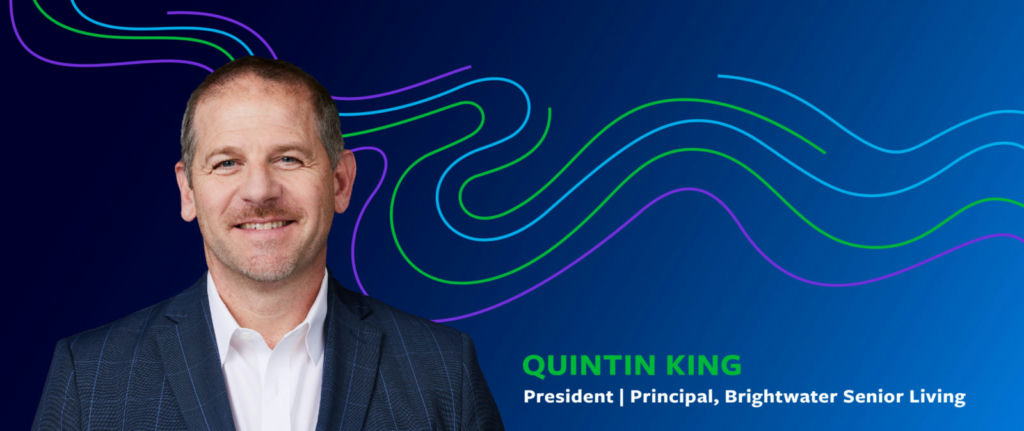
For Quintin King, president and principal of Brightwater Senior Living, that work begins with a practical sequence: people, process, then technology. In this Changemakers interview, King shares his perspective on the forces reshaping senior living, the role of connected systems, the need to reduce friction for staff and why lasting change depends on building ownership with the people responsible for carrying it forward.
The industry is being shaped by a growing older population with a direct opposite effect of staffing shortages. We’re seeing a disconnect between where operating fundamentals are going and how capital is underwriting those fundamentals. Labor volatility, interest rates, and insurance pressures have fundamentally changed how deals pencil, which is driving consolidation.
The next generation continues to want choice. That has not changed over the last 10-plus years, but they also want clearer information, greater transparency and services that fit their individual needs. Operators will need to be more flexible, explain their value more simply and treat residents as informed consumers, not just occupants.
By being more transparent and telling real stories. Showing what day-to-day life actually looks like in communities, including the care, relationships and sense of purpose residents experience, can go a long way toward building trust.
At the same time, companies need to be upfront about costs and outcomes. The more honest and clear the industry can be, the easier it becomes for the public to understand the value senior living provides.
I’ve focused more deeply on staffing and our teams, especially understanding team members and how to make their workday less challenging. Not necessarily easier, but more efficient.
That includes cutting unnecessary processes by using more connected systems. Instead of reporting back and forth through emails, timelines and separate updates, we can use systems that already have the information and are connected to each other.
When the CRM, EHR and financial systems are connected in the same environment, there is less need to pass information along manually because it is already there. That helps reduce friction for teams and allows them to spend more time focused on the work that matters.
What staffing changes does the larger senior living industry need to make to meet the staggering level of demand ahead from new residents?
We have a staffing shortage, yeah, but we have job design problems.
Many roles are reactive and fragmented. People leave because the work feels unmanageable, not because they don’t care. The next evolution is simplifying roles, aligning responsibilities, and using technology to remove noise — not add to it. Retention will come from making jobs clear, sustainable, and purposeful, not just better paid.
Some organizations are moving quickly, but overall, the industry is still slow to change. Old models and limited labor make transformation harder. However, pressure from workforce challenges and consumer expectations is pushing progress faster than before. The pace still may not be where it needs to be, but the urgency is much clearer now.
I’m a technology-driven person, and I’ve learned that pushing change too quickly is not always accepted by everyone right away.
There was a time when I pushed a change forward while teams were still focused on supporting residents and families. Even though the idea was sound, people were not ready for it at that pace, and I learned that staggering change over a longer timeline can make a big difference. It gives teams more time to understand the change, adapt to it and still keep progress moving forward.
Stepping into larger leadership roles meant shifting from doing the work myself to trusting and supporting others to do it. That change was difficult at first, but it ultimately led to better outcomes and stronger teams.
I learned that leadership is not about holding every piece yourself. It is about creating the conditions for other people to succeed, then trusting them enough to let them do it.
Using a single integrated ecosystem with our ERP system. This has allowed us to focus on the outcomes more than focusing on different vendors and where the information is coming from.
People, process, technology, in that order.
Focus on people first, then identify the processes that need to change and use technology only where it is truly needed. If you start with technology first, you miss the opportunity to build ownership with the people who will actually use it.
That it is solely about the residents. Senior living is about both residents and team members.
You cannot support one without the other. A strong resident experience depends on strong, supported teams.
Business Process Consultant
Both. Coffee is new for me, though. I only started drinking it about two years ago.
In this story
This story was originally published in Senior Housing News on June 10, 2026. Burnaze summarizes and links to the original reporting.
Read the full story at Senior Housing NewsLiked this? Get the week's franchise news, explained
- Sunday 8 AM ET weekly + a monthly deep dive
- Sections picked for the industries you follow
- Every claim linked to its source. Free.