TL;DR
The Glass Guru, a 17-year-old franchise brand, is expanding nationwide by building a franchise culture of partnership and transparency, led by director of franchise development Nesa Opp. The brand offers a relatively low-cost investment and the opportunity to build a recession-resistant business with strong margins and corporate marketing support.
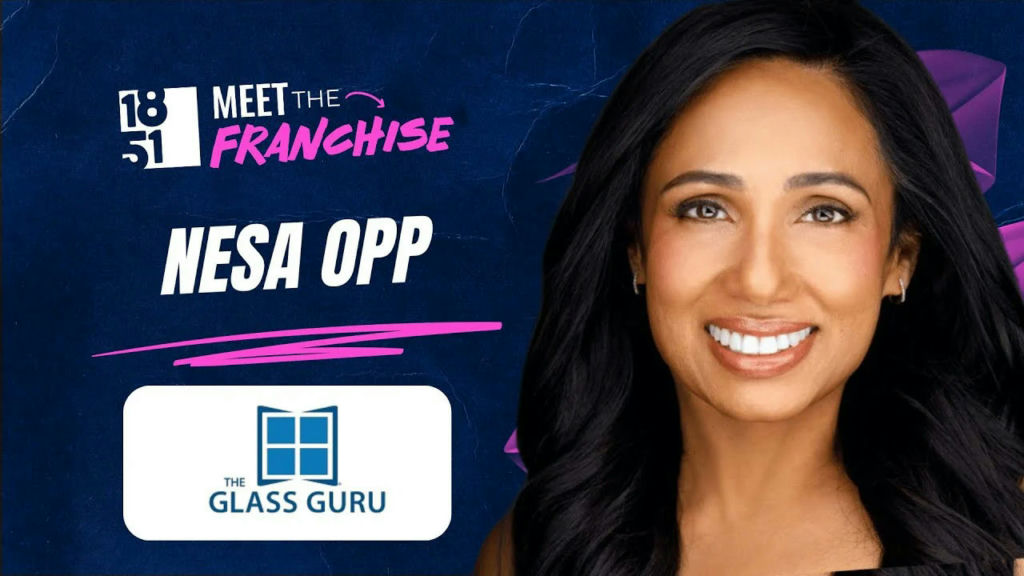
After more than two decades in franchising, Nesa Opp knows that growth is more about building meaningful partnerships than about deals closed. Now, as director of franchise development for The Glass Guru, she’s helping the 17-year-old brand expand nationwide by leading with transparency, culture and purpose.
“If you do it right and you're focused on your people, your culture and who your candidates are, it isn't just about selling a franchise or hitting those numbers,” she explained to 1851 Franchise Publisher Nick Powills on a recent episode of the “Meet The Franchise” podcast. “Your numbers are automatically just going to organically come because you just have built a culture around that.”
For Opp, franchising wasn’t a planned career path. With a background in international business, she started working with an international franchise more than 20 years ago and quickly discovered her passion for the people behind the business. Since then, she’s served both as a franchisee and a franchisor, giving her a unique understanding of the challenges and rewards on both sides.
“I've been a franchisee for nine of the 24 years and can understand the plight, the hardship and the struggle, especially with an earlier brand or one that didn't have over 100 franchisees,” Opp said. “So I understand it from both angles.”
That dual perspective is what drew her to The Glass Guru, a franchise specializing in glass restoration and repair for homes and businesses. Opp joined the brand after a trusted colleague decided to invest in a Glass Guru franchise himself. What she found impressed her: strong leadership, an ethical culture and a team-first approach.
With about 100 units nationwide, The Glass Guru offers a relatively low-cost investment and the opportunity to build a recession-resistant business with strong margins and corporate marketing support. Franchisees typically launch within six to eight weeks and can expect a steady flow of leads, with 70% to 80% coming directly from the brand’s marketing team.
“It usually just takes about a day or two,” Opp said. “As soon as they open, their phone is ringing.”
As for who fits best within the system, Opp says The Glass Guru often attracts former corporate professionals who can apply their leadership and team-building skills in a hands-on business. The model is scalable, with many owners running multiple teams to increase revenue, and it’s supported by a corporate team that leads by example — 80% of The Glass Guru’s executive team are franchise owners themselves.
“Personally, I think from vetting hundreds of franchisors, this is probably one of the best concepts I've ever represented,” Opp said.
A transcript of Opp’s interview with Powills has been provided below. It has been edited for brevity, clarity and style.
Opp: I have never seen myself as a salesperson. I don't think I ever could. I think I'm just someone to walk people through an investigation process to see if it's a match. And a lot of people who are in the franchise world sometimes believe it's about the deal and the sales. And at the end of the day, it's genuinely a partnership between the franchisor and that franchisee to see if they can reach both of their goals.
So I see that more than anything. And I don't even like the word sales because it just has a different type of image. And I don't particularly like that image. I like to be more of a person who's just ushering people through a process. If it's not a fit, there's another franchisor that is. Or franchising isn't for them at all.
Powills: I love that you said that. Unfortunately, in the industry that we're in — brands, CEOs and boards over-index on sales — meaning let's go ahead and award more franchise units. Whereas if they over-indexed on the success or the potential success of a franchisee, they would quickly understand that not all franchises are created equal.
Now, to your position, you're measured on how many deals you push through into the system. But I would rather look at it and say, “Well, look at the number of deals that got pushed through, that expectations were met, which means they scaled their business, which means they created more royalty stream for the business. And they were happier because they had achieved their goals.”
And so I like that you said that, because that's one of the biggest misses in franchise growth: We over-index on sales, not necessarily on partnerships. Because if a franchisee makes more money, that's ultimately where a franchisor is going to make more money. Thoughts?
Yes, I've been in franchise development, and I've been successful because I've been honest and chosen franchisors I feel are ethical. I've been a franchisee for nine of the 24 years and can understand the plight, the hardship and the struggle, especially with an earlier brand or one that didn't have over 100 franchisees. So I understand it from both angles, and it just, again, organically happens if you set it up right and create that culture within and outside.
Opp: Not sure. I think I'd have to find the right franchisor to connect with, and that's hard. And that's why I'm very proud to represent The Glass Guru.
And I was surprised. I wanted to know why and dug in, realizing there were so many important nuggets I believed in and could stand by to really promote a brand that believed in its people and culture and was ethical in every way. I'm not saying other franchisors are not.
Powills: It's interesting because what I just heard is culture and support. And it's hard because for most franchisors, including The Glass Guru, the outside world — it's hard to necessarily portray that story because we default to “Buy my franchise.” And so for a candidate, they have to cut through somehow and say, “Wow, there's something special.”
You were able to do that because you knew someone who bought into the business that gave you an insight that gave you comfort in going from franchising to franchisor. But it's hard because that message is a hard message to get across. Sometimes it can be done in a podcast like this where someone can actually see that there's a good person behind it.
Opp: I agree. I think that, being exposed to as many franchisors as I've been in the last 24 years, I've realized there are a couple of key ingredients, and that would be obviously the people and how they represent themselves, and what kind of questions are answered. Because oftentimes, even with an Item 19, it can be very vague and their validation may not be as strong.
And again, I bring up culture because I think that's critical — and just seeing yourself day to day. So often, people pick a franchise because they think it's going to work with them, what they've done, what they're interested in.
But essentially, what you do day to day is what you're doing for the rest of that term of your agreement and however long you decide to stick with it. So the piece is often missed, and you need to investigate that as a franchise candidate. What are you doing day to day, and are you going to enjoy it?
Is it something that will really bring you to a place of that new season where you do feel fulfilled? Because it's not worth it if you're not just fulfilled, not just financially, but also just from your day-to-day experience.
It takes six to eight weeks from the time you sign on to open, which is rare. And we would hope that our franchisees break even fairly quickly. That's not an earnings claim by any means, but we hope that they would break even in about three to six months, which is what our working capital says.
So all in all, I feel like if you have the skill set, which is just oftentimes just desirability, but also the fact that you oftentimes, if you're leaving a corporate role, can build teams, and that's what it's about. So if you can build multiple teams, you will definitely increase your revenue. And based on our Item 19, I can give you some of those numbers here in a few minutes before we get too far into it.
Powills: So is there a consistency on who you're looking for as a franchisee or does it end up just being someone that's in a career transition and looking to go into business for themselves?
Opp: No, I think it's all of the above, but oftentimes our candidates are coming out of a corporate role and they're able to take their white collar skills and easily apply it to a blue-collar business. And I think oftentimes when people think of a service business. They're coming out, they're a director of sales, and now they're thinking, “Oh, am I going to buy into The Glass Guru?
And how am I going to do that when I've been selling tech,” or whatever it may be that they're involved in. And it's actually an easy transition as long as they can transfer that skill set of building teams, connecting with culture and rallying around their few employees. It's just three employees to start.
Opp: You know, in our Item 19, we have three different numbers depending on how we break it down. And we have a group of franchisees that do around $600,000 to $750,000. And there's another group that does about $1 million, and another group that does closer to about $2 million.
Marketing changes almost every day as we know it. So to be able to come in and have those processes outlined and the support systems in place — especially the marketing, where your phone is ringing the first day and the rest of it is just networking and building relationships — I think is quite extraordinary.
**Powills: Well, it's huge because I think the biggest obstacle for a new franchisee is they're thrown in and automatically they have to be an expert in marketing and sales and HR and supply chain management and accounting. That's very heavy for someone who's not the crazy entrepreneur. So the more support that a franchisor can give, one, it shows the value of why you pay royalty, which I think royalty needs to be rebranded as support mechanisms or a line item that just says, this is staffing support for your business.
Opp: I personally think, from vetting hundreds of franchisors, this is probably one of the best concepts I've ever represented. And I think if they're looking for something within a smaller range of around $100,000 that they're able to get involved with, that isn't going away, that is just tried and true, the original founders are part of that, of the business and are very involved, this is it. In fact, 80% of the executive team own franchises themselves in The Glass Guru, which is everything, so their hands are in it.
I think it's just, again, one of the better ones, and I'm very fortunate and grateful to be able to represent it and connect with the people that are interested. So thank you for having me on and making this happen.
In this story
This story was originally published in 1851 Franchise on December 8, 2025. Burnaze summarizes and links to the original reporting.
Read the full story at 1851 FranchiseLiked this? Get the week's franchise news, explained
- Sunday 8 AM ET weekly + a monthly deep dive
- Sections picked for the industries you follow
- Every claim linked to its source. Free.