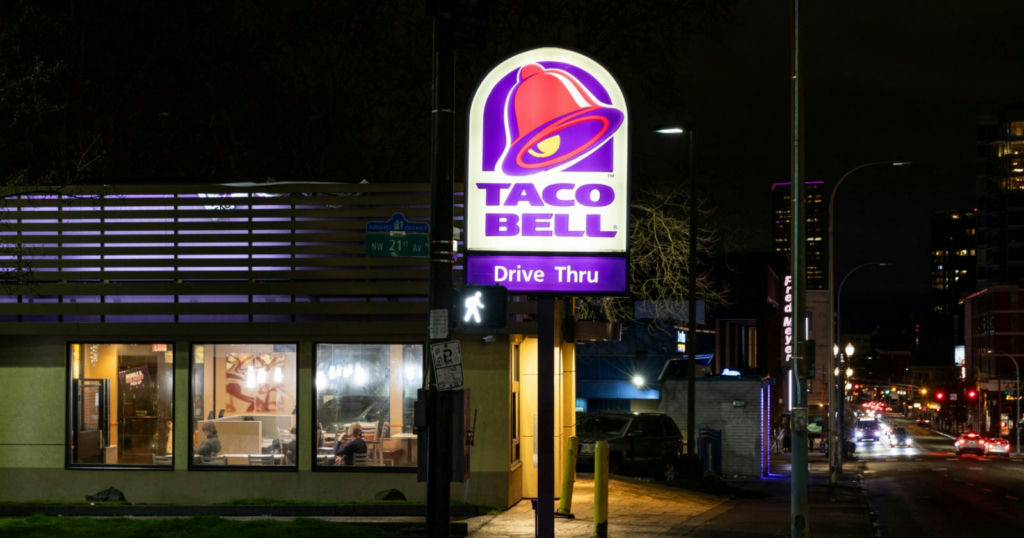
Taco Bell is planning to add AI to about 600 more drive-thrus by the end of the year. | Photo: Shutterstock
Get ready to hear a lot more voice AI in the drive-thru.
Over the past month, three fast-food chains — Taco Bell, Bojangles, and Checkers and Rally’s — have unveiled that they are extending their AI efforts, with plans to bring the technology to hundreds of additional locations in the coming months.
Bojangles and Checkers/Rally’s will add AI to about 100 more stores each in the near-term, while Taco Bell expects to expand its drive-thru AI footprint from about 900 locations to 1,500 by the end of the year.
Meanwhile, after years of back-and-forth with the technology, McDonald’s announced that it plans to have voice AI in most of its more than 13,000 U.S. locations by the end of next year. That’s an aggressive pace considering that it started with just a five-unit pilot over the summer.
The burst of updates follows a stretch of uncertainty for drive-thru AI. In August 2025, Taco Bell said it would tweak its use of the technology following glitches and mischief, like a customer ordering 18,000 cups of water. At the FSTEC conference in September, a Burger King executive told the audience that the brand had found that some consumers don’t like ordering from a robot, and that it was working to make it easier for customers to choose how they order.
McDonald’s, of course, already tried voice AI once, starting in 2021, but abandoned it in 2024 before starting again this year with a different vendor.
And then Chick-fil-A CEO Andrew Cathy came out and said the chain would never use voice AI in its drive-thrus, preferring to stick with “human to human” hospitality.
It all raised questions about when and if the technology would be ready for prime time. Now apparently some restaurants believe that it is.
Taco Bell’s decision is the most notable, given that it appeared to be doing some soul-searching a year ago. On an earnings call earlier this month, executives said that at Taco Bells using drive-thru AI, drive-thru satisfaction has improved by 6%, sales have risen 1.5% due to automatic upsells, and employee retention is better.
The company is also planning to add more features to the AI, such as loyalty integrations and personalized messages.
“We’re seeing uplift and are focused on getting the deployments right in Q4,” Yum Brands CFO Ranjith Roy told analysts. “But the opportunity is much bigger both in terms of number of deployments and the impact we can have in each deployed location.”
Bojangles and Checkers/Rally’s shared similarly upbeat numbers. Bojangles’ AI bot, Bo-Linda, is now processing more than 1 million orders a week across about 500 locations, with a 98% success rate, the company said, adding that the bot has been “extremely well-received” by both customers and employees.
“This has given us the confidence to continue and expand Bo-Linda,” CIO Richard Del Valle said in a statement.
At Checkers and Rally’s, voice AI has boosted ticket averages by 1.1% and has brushed up on its accuracy, cutting in half the number of orders that required a human to step in. It’s currently in 267 stores.
None of the three chains said much about how the AI is impacting their bottom line, which you would think would be one of the main reasons to automate. When asked point blank on the earnings call about how Taco Bell’s AI was impacting franchisee profits, Roy did not answer directly, but said that the uplift “benefits the team members and our franchisees.” He noted that voice AI is just one of a number of AI tools within Yum’s Byte technology platform.
Most chains have said that they don’t plan to use AI to replace human employees, but rather free them up to do other things, while paring back labor hours on the margins. The recent commitments suggest that the chains are seeing benefits from the technology. But it’s not exactly clear whether that is translating into profits after the cost of the AI is factored in.
Reports from the ground are, predictably, mixed. A recent thread on the Fast Food subreddit included complaints about drive-thru AI at Bojangles, Wendy’s, Panda Express and Checkers, with some users vowing to never return. Others piped in to say they haven’t had any issues with drive-thru AI.
Last week, we got a look at McDonald’s AI efforts courtesy of Justin Foster. They come with a caveat: Foster runs a competing voice AI drive-thru business and noted that his thoughts should be taken with a grain of salt. But he did flag at least one legitimate issue: When he asked to add pickles to his chicken sandwich, the AI wouldn’t let him, and he had to ask to speak to an employee. (Pickles are not a default option on the McSpicy, which is why the AI rejected it, according to the employee.)
That issue is both anecdotal and fixable. But it points toward one of my bigger concerns about drive-thru AI: Even if the technology does what it’s supposed to do, customers may still be left with a bad taste in their mouths. And many are not likely to give it the benefit of the doubt: Americans remain wary of AI, and in many cases their skepticism is increasing, even as AI becomes more ingrained in everyday life.
According to a Bentley University-Gallup poll published in July, 39% of people believe AI will do more harm than good; 73% said they do not trust businesses to use AI responsibly; and 79% expect it to take jobs from humans.
In each instance, consumer attitudes toward AI worsened compared to the prior year. And the shift was especially pronounced among younger consumers, a hugely important group for the restaurant industry.
For instance, among adults aged 18 to 29, 47% said they believe AI does more harm than good, up from 36% in 2025 and 27% in 2024.
Can you blame them? In the past several months, we’ve seen OpenAI agents break containment and hack another AI platform; the CEO of the world’s most powerful AI company ousted in disgrace over an affair with an alleged Chinese spy, only to be reinstated; and a historic but also underwhelming IPO from Anthropic, the maker of the Claude chatbot.
Democrats’ sweep of the midterms this month, meanwhile, could lead to a push for more AI regulation. While that may help ease consumers’ anxiety, it also adds to the uncertainty surrounding the technology.
That anxiety and uncertainty will likely trickle down to fast-food drive-thrus whether it is warranted or not.
“When public trust is already low, even modest shifts in public opinion like these may matter as businesses continue to expand the use of AI across products, services and workplaces,” the Bentley-Gallup pollsters wrote.
Overall, restaurants seem to be responding correctly to this ever-shifting landscape. According to a recent report from the National Restaurant Association, 42% of operators say they’re taking a cautious approach to AI adoption. About 2 in 10 are experimenting with it on a small scale, and just 3% have launched companywide AI projects.
Their reasons for the measured pace are largely practical: Complexity (46%) and cost (43%) are the biggest factors holding them back, the report found. But restaurants are also conscious of how customers might react to more AI in their dining experience: 42% said they were concerned about whether customers would accept the technology.
With McDonald’s and other brands poised to take drive-thru AI mainstream, we may finally be able to lay that argument to rest one way or another.
But for now, I think it’s still wise to proceed with caution.
This story was originally published by Joe Guszkowski in Restaurant Business on November 23, 2026. Burnaze summarizes and links to the original reporting.
Read the full story at Restaurant BusinessLiked this? Get the week's franchise news, explained
- Sunday 8 AM ET weekly + a monthly deep dive
- Sections picked for the industries you follow
- Every claim linked to its source. Free.