TL;DR
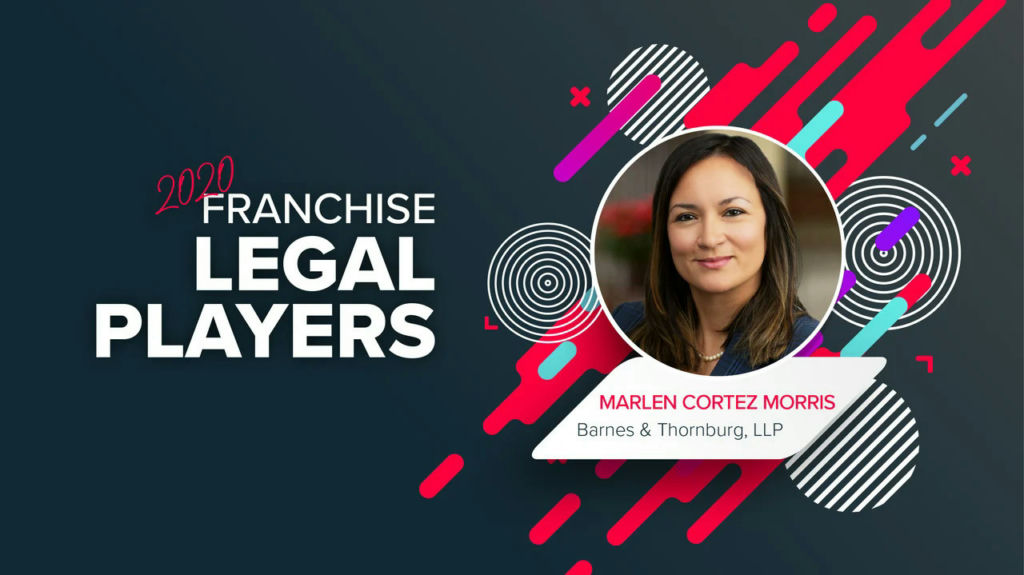
Marlen Cortez Morris is a franchise law expert with broad experience in representing and advising clients on franchise and distribution, commercial litigation, and labor and employment matters. She works with clients to provide strategic guidance on navigating joint employment, vicarious liability, and general labor and employment law issues arising in the franchise relationship.
Marlén Cortez Morris got her start in law at the University of Tampa — Florida, where she graduated magna cum laude in pre-law and criminology. She later attended law school at the University of Illinois. Cortez Morris is well-versed in many areas of the law. She represents and advises clients on a wide range of topics, such as franchise and distribution, commercial litigation and labor and employment matters in courts and alternative dispute resolution venues.
From counseling and litigation avoidance to instituting and defending against litigation, including appeals, my experience includes a broad spectrum of claims involving contract rights, intellectual property, torts, franchise-related laws and joint employment liability.
I defend franchisors and other businesses against wage and hour class and collective actions and claims for wrongful termination, discrimination, harassment and retaliation arising under various federal, state and local laws. Understanding the complexities of labor and employment law and franchising, I also work closely with clients to provide strategic guidance on navigating joint employment, vicarious liability and general labor and employment law issues arising in the franchise relationship, employment relationship and corporate transactions and due diligence initiatives.
- I am a member of the ABA’s Forum on Franchising, where I am an associate editor of the ABA’s Franchise Law Journal, and of the International Franchise Association, where I serve on the Diversity Institute Board.
Barnes & Thornburg is a full-service firm, offering clients access to more than 600 attorneys and other legal professionals throughout offices in Atlanta, California, Chicago, Delaware, Indiana, Michigan, Minneapolis, Ohio, Raleigh, Salt Lake City, Texas and Washington, D.C. They are among the 100 largest firms in the nation with experience across virtually all legal practice areas required to do business in today’s global marketplace.
Franchise law issues
In the franchise and distribution arena, the firm works with complex franchise law issues in a diverse array of industries and jurisdictions. Their clients include established and emerging franchisors that operate franchise systems domestically and globally. The firm has experience crafting strategies to encourage and protect its clients’ franchising interests. The team approaches clients’ business goals as a business partner would: offering guidance, industry wisdom and creative ideas and solutions.
Cortez Morris: Opportunity. Franchising is all about opportunity — taking that leap of launching a business from concept to reality, through the process of invention and reinvention.
Franchise law found me. After years of practicing law as a commercial litigator and labor and employment lawyer, franchise law became the path to drive my diverse legal training in new and innovative ways. Franchise law is fascinating because it is rooted at the intersection of multiple areas of law.
Whether that involves effective registration, use, and protection of trademarks to run a successful franchise program; antitrust implications in franchise pricing programs; or joint-employer implications arising out of franchisor controls over franchisee operations. I thoroughly enjoy working with so many inspiring entrepreneurs who took the leap and who have been successfully maintaining or growing their franchised businesses.
Franchise relationships
Every franchisor should know what a franchise relationship is for legal purposes. There are several business arrangements that can accidentally fit the legal elements of a franchise relationship under federal law and applicable state law and, in turn, expose the unknowing franchisor to significant liability. It is important to partner with experienced franchise counsel who can offer guidance on this fundamental question.
Franchising offers opportunities, but, as with all opportunities, there is risk. Every prospective franchisee should carefully evaluate what type of franchise would be a good fit based on not only the concept, but also his or her risk tolerance and willingness to follow the franchisor’s requirements on various aspects of business operations. Every prospective franchisee should do his or her due diligence and seek guidance from experienced franchise counsel and other business professionals who can help gauge the benefits and risks of the franchise and enable the franchisee to make an informed decision.
Joint employment liability
It will remain a hot topic throughout the year and likely next year too. With the shift in Congress and regulatory bodies, every time one positive move is made to appropriately limit joint employment liability, a step in the opposite direction follows.
For example, the NLRB has yet to adopt its final joint-employer rule to undo its controversial 2015 ruling and reinstate its longstanding “direct and immediate control” joint-employer test. The rule is set to take effect in late April 2020. The Department of Labor has also released its final joint employer rule for purposes of the federal wage and hour law.
Set to take effect in March 2020, this rule similarly focuses on direct and immediate control and expressly recognizes that a franchising business arrangement — or a franchisor’s quality control standards to protect the brand and ensure uniformity to customers — does not make joint-employer status more likely. However, these steps — arguably in the right direction — could be undone by the recently introduced PRO Act, which seeks to codify the expanded — indirect or reserved control — joint-employer standard previously articulated by the NLRB.
In addition to joint-employment, which is a continuous issue to watch, those in franchising must stay attuned to developments with respect to California’s AB-5, which makes it more difficult to classify independent contractors, and data privacy laws, rules and regulations.
In this story
This story was originally published in 1851 Franchise on July 4, 2020. Burnaze summarizes and links to the original reporting.
Read the full story at 1851 FranchiseLiked this? Get the week's franchise news, explained
- Sunday 8 AM ET weekly + a monthly deep dive
- Sections picked for the industries you follow
- Every claim linked to its source. Free.