TL;DR
International Workplace Group (IWG) releases a whitepaper on transforming for hybrid work, outlining challenges and questions for corporate leaders. The whitepaper discusses the need for digital infrastructure, cybersecurity, and flexible meeting spaces to support hybrid work.
International Workplace Group (IWG), one of the world’s leading flexible workplace providers, recently released a whitepaper titled “Transforming for Hybrid,” in which several writers outline the challenges and questions corporate leaders will be facing as they transition to the hybrid working model where employees divide their work time between a central office, their home and a workspace close to home.
“The shared workplace only ever existed because it contained the materials and equipment workers needed but didn’t have at home: typewriters, computers, photocopiers and filing cabinets to store countless kilometers of paper,” says Mark Dixon, Founder and CEO of IWG. “But today, digital technology puts into every white-collar worker’s hands all the tools they need to do their job. The office is no longer a defined physical space, but rather it has become digital.”
Hybrid work challenges
Here are some ways employers can navigate the shift to hybrid work.
Looking ahead, organizations will need to invest in the digital infrastructure to help employees securely communicate and collaborate from home, writes Chintan Patel, Chief Technologist at Cisco UK & Ireland. Physical offices will also have to change as companies adapt to a more hybrid environment. For example, many videoconferencing and wireless audio tools create more automation to simplify the work experience for the teams operating in these hybrid environments.
Additionally, companies must prioritize cybersecurity to keep their employees’ information safe at home and in the office. This will require in-depth training on best practices and procedures.
“Ultimately, the right technology in a hybrid world means delivering employees with as rich a set of collaboration tools as possible, ones that don’t exclude people on the basis of their physical location, and ones that can be trusted one hundred percent,” Patel writes.
Real estate strategies
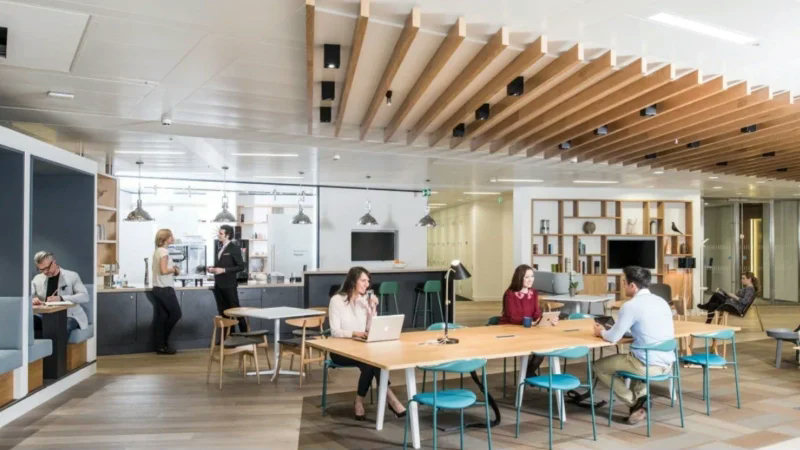
A new set of hybrid, flexible program requirements are affecting organizations’ real estate portfolio optimization strategies, writes Doug Demers, Managing Principal at B+H Architects and the Centre for Advance Strategy. In order to encourage workers to actually come back to the office, organizations are currently looking for ways to “create magic” in the workspace. In other words, keep things interesting. They are also looking for ways to create the kinds of flexible meeting spaces people are looking for.
“That is why the hub-and-spoke model is top of mind right now for many companies as they fine-tune their real estate footprint to be more appropriate to the way the next generation of employees are looking to work,” Demers writes. “It’s a win-win if you can attract and retain the best talent while doing it with a smaller footprint.”
In today’s post-COVID world, most employees want to decide when they go to their main office and when they work from home or in a workspace close to home. That means employers need to shift how they structure and manage work, writes Christie Smith, Global Lead of Talent & Organization/Human Potential at Accenture. With such a tight labor market, retaining talent has become really important, but in order for employers to ensure that individuals stay with them, they have to allow them to be successful and productive anywhere.
“Overall, the future of work needs to be a frictionless experience in which people have flexibility, and a human-led culture that’s omni-connected: digitally connected, in-person connected, and
connected to opportunities and roles,” Smith writes. This can lead to greater autonomy, positive mental health, a high degree of digital skills, better health policies, digital maturity and supportive leadership.
Best practices for hybrid work
Chris Barez-Brown, founder of worldwide consultancy Upping Your Elvis and tech startup Talk It Out, outlines six best practices employers should keep in mind when transitioning to hybrid work.
Get a facilitator — With some employees in the room and others remote, companies need to have a much higher level of facilitating skill if they want everything to go smoothly.
Don’t let the room win — It is no secret that those in the room are always prioritized over those on the screen. That is why companies need to create a solid strategy to give everyone their own tasks and bring teams together in the end.
Explain what an idea looks like — Since remote workers spend so much time thinking up ideas on their own, they need to be properly trained on what an idea should look like for that particular organization. That way, when they’re on their own, they will come up with something of value.
Do it in bursts — Long-day sessions may be a thing of the past at this point. The latest research suggests that we can only focus between 90 and 120 minutes a day, and for most people, the best time is early in the day. Companies need to keep this in mind when scheduling creative time.
Invest in tech — It has never been more important to have a solid internet connection in order to maintain a connection between workers.
Try changing the dynamic — If the energy’s dropping and ideas aren’t there, breaking people off into different dynamics can inspire creative thinking.
The shift to hybrid working offers employers a valuable opportunity to pause and ask themselves what they really want their culture to look like, both in the office and outside of it, writes Jane Sparrow, co-founder of business consultancy The Culture Builders. Making a significant change will undoubtedly impact culture, which is why employers need to put the time and strategic thought into how they will intentionally evolve the culture at both organizational and team levels.
For example, in a hybrid environment, organizations must focus on different employee experience aspects. Mental health and well-being is one area that will need a greater level of care. Human connection is another area, especially for those remote workers who may feel isolated.
Overall, organizations may be facing some challenges, but Dixon says the advantages are more than worth it in the end. “I know from speaking to many of our clients that transforming for hybrid
is a significant challenge, but it’s of paramount importance,” he said. “The opportunities it offers to both employers and employees can’t be underestimated. Companies and organizations that embrace the hybrid model have the world to win. And now is the time to make that change.”
In this story
This story was originally published in 1851 Franchise on November 23, 2022. Burnaze summarizes and links to the original reporting.
Read the full story at 1851 FranchiseLiked this? Get the week's franchise news, explained
- Sunday 8 AM ET weekly + a monthly deep dive
- Sections picked for the industries you follow
- Every claim linked to its source. Free.