TL;DR
Salad and Go, a drive-thru quick-service chain, shut down after rapid expansion and financial struggles, filing Chapter 11 bankruptcy and closing its remaining 70 restaurants. The company's demise is attributed to an overly aggressive push for growth, poor site selection, and high overhead costs.
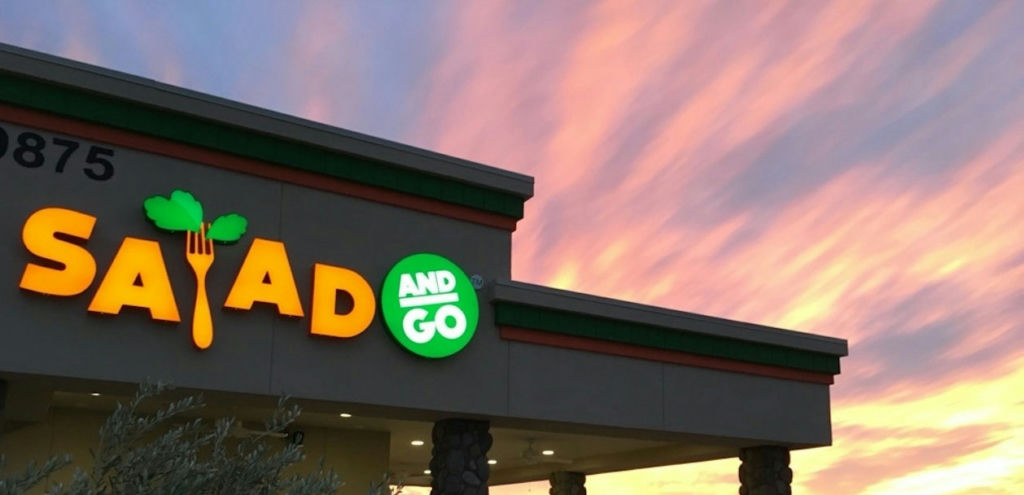
In 2022, the drive-thru quick-service chain Salad and Go concept seemed to be riding high, with a $1.1 billion valuation and about 140 units in four states.
Just four years later, the private-equity-owned concept filed Chapter 11 bankruptcy and shuttered the 70 restaurants it had left in the system at that point.
And now it’s gone.
About 1,300 people were put out of work, including 521 full timers and 137 salaried staffers. There was no warning about a mass layoff, as required by Arizona law. By some accounts, those workers received no severance pay.
What the heck happened?
Rapid expansion issues
As the dust settles, and drive-thru coffee chains battle over the remaining leases, opinions about what happened to Salad and Go vary.
But there is a factor about which most agree: The demise of Salad and Go appears to be the result of a domino effect sparked by an overly aggressive push for growth.
In court documents, Salad and Go blamed poor site selection, expansion that came before brand awareness, and high overhead costs.
The company also blamed inflation, saying consumers were spending less and gas prices were high. And the chain blamed “food-safety events,” the latter a reference to the cyclospora outbreak in July that scared consumers away from lettuce for a few weeks, though Salad and Go was not implicated in the outbreak at all.
“It doesn’t help when salad is literally in your name,” said one attorney in a bankruptcy hearing last week.
But the decision to dismantle Salad and Go likely began long before cyclospora hit headlines.
The chain closed about half of its fleet last year in an attempt to right the ship, only to watch the “unsustainable cash burn” continue, according to court documents.
Founder Tony Christofellis, who sold the concept to private-equity firm Volt Investment Holdings in 2021, saw the failure coming a mile away.
He said the new owners believed they had acquired the “next Chipotle,” and that it could grow as fast as the more than 4,000-unit fast-casual chain.
Along the way, the company lost its essence, he said.
“Everyone who came in had the wrong idea,” said Christofellis.
Salad and Go’s original culture was about “grit, blue collar. It was about whatever it takes,” he said. “And then they brought in people who were more interested in building their resumes for the next gig.”
Tony Christofellis and his wife Roushan Christofellis first opened Salad and Go in 2013 in Gilbert, Arizona. Working with them was chef Daniel Patino, whose experience included restaurants like The French Laundry in California and Daniel in New York City. Patino remained with the brand through the bankruptcy, but declined to comment for this article.
The idea for Salad and Go was essentially to democratize healthful food for everybody, not just those who could afford a certain price point. Their goal was to bring freshly prepared salads, wraps and soups with clean, organic ingredients to the masses at an affordable price and with the speed of a drive-thru.
There were skeptics at the time, the couple wrote on a Facebook earlier this year. Some questioned whether consumers want drive-thru salad, or whether the concept could keep the price low, given rising ingredient costs.
The Christofellises bootstrapped their first locations, selling their house and cashing out a retirement account.
But, to their great delight, the first Salad and Go was greeted with enthusiasm. The couple said they loved hearing the stories from their customers: a Mom battling cancer, who was trying to eat better; and a man recovering from a heart attack who was determined not to fall back to his unhealthy fast-food habits.
But soon, the couple realized they needed funding to grow. In 2016, they won an investment from Volt, which “believed in our craziness and our mission and even supported our mission to lower prices! Who does that?!” the couple wrote on Facebook.
With that investment, the Christofellises were able to build on the model they believed would make it work.
A key aspect of Salad and Go was vertical integration: buying straight from farms and prepping ingredients in a central commissary that delivered to the restaurants for made-to-order assembly. There were no corporate offices. Marketing was low-cost. That’s how they planned to keep prices accessible.
In addition, Salad and Go's drive-thru units were tiny, less than 1,000 square feet, with no dine-in space and no kitchens. Some also had walk-up windows or double drive-thrus.
Private equity involvement
A representative from Volt, who asked not to be quoted directly, provided some context, saying they very much believed in the vertical integration model.
In fact, the model proved to be ideal for the COVID-19 years, when other restaurants were struggling to pivot to pickup and delivery. It was the success through those years that cemented the notion that, if it worked in Phoenix, it would work elsewhere, the representative from Volt said.
Initial growth focused on Arizona. It wasn’t long, however, before the Christofellises began to feel they were not seeing eye to eye with the private-equity investors.
Volt was pushing the brand into Texas and Oklahoma, later adding Nevada. Tony, meanwhile, felt the chain needed more time to solidify the model in Arizona and strengthen operational efficiencies.
So in 2021, the Christofellises sold their equity fully to Volt and stepped out.
The couple went on to create the Angie’s brand, another vertically integrated drive-thru concept that offers more than salads. Angie’s has 26 units, including three in Texas and another five coming to Phoenix this year, and the couple has acquired a meat processing and distribution plant in the Northeast, where they plan to make their next move.
When Tony stepped out of the picture, Charlie Morrison was on Salad and Go’s board.
Morrison at the time was CEO of Wingstop, where he had spent a decade growing that fast-casual chicken chain into a powerhouse.
Morrison said he nominated himself for the CEO role at Salad and Go, which some saw as a head-scratching move at the time.
Morrison had helped Dallas-based Wingstop go public in 2015 and expanded Wingstop from about 500 units to then about 1,800.
At the time, Morrison described Salad and Go as “a simple concept with a grand plan.” He also called the brand “The QSR industry’s best-kept secret,” though Salad and Go had roughly 60 units at that point. It would double over the next year.
Salad and Go's salads were generously portioned. | Photo courtesy of Salad and Go.
Morrison praised the brand’s lack of additives and preservatives, the speed of service and vertically integrated supply chain.
There were plans at the time to start building the brand’s infrastructure in Southern California and Florida. Units could be operated with as few as three people per shift, he said. The small footprint was flexible and could exist essentially anywhere.
“To be able to see a brand that’s able to deliver a really fresh, healthy, good-for-you product with the speed and convenience of QSR at a price point that beats even most casual dining today, I was really attracted to that,” he said at the time.
Salad and Go's unit count doubled in 2022 to 82, and then reached 136 in 2023.
Financial struggles
By 2024, Salad and Go’s sales grew nearly 20% over the prior year to $246 million, after adding 10 units for a count of 146, according to Technomic data.
But the average unit volume began to tick down, moving from $1.9 million in 2023 to $1.75 million in 2024.
Meanwhile, Salad and Go moved its headquarters to Dallas. The company invested around $47 million to expand a commissary in Garland to support the growth in Texas, for a total of about $72.5 million. That capital investment demonstrated the fact that Volt fully supported the vertically integrated model, the investment firm's representative said.
Morrison had a goal of opening one store per week that year, according to a press release.
“We have the right offering and the right team at the right time,” he said in a statement at the time. “We are at an inflection point in this country where Americans are demanding more from restaurant chains. They should have to compromise on fresh, nutritious food that’s also convenient and affordable.”
Tony Christofellis, however, now argues that Morrison “destroyed Salad and Go.”
After the founder left, Volt and the board began chipping away at the vertical integration model in their drive for growth, moving away from organic ingredients, adding preservatives to dressings, using third-party suppliers for proteins, adding labor and, ultimately, increasing prices.
It started with the sourdough croutons, which were made in house daily, Tony said.
The new owners felt making croutons was too time consuming, so they outsourced them, and it just carried on from there.
“Once you go down that slope, you’re not going to be able to get back up,” said Tony.
But the representative from Volt said it's unlikely any restaurant chain that grows from 30 to 150 units would be making its croutons the same way.
The move into Texas was also hampered by a number of factors, according to the filing. Sites were chosen that were not as accessible to cars or visible to customers, for example. The chain was expanding faster than it could build brand awareness, and overhead costs from the Garland commissary cost roughly $15 million to $20 million a year.
Indeed, Texas has been a tough nut to crack for a number of restaurant chains. And the attempted growth did come as many restaurant chains were battling for diminished consumer traffic.
By November 2024, Morrison announced he was leaving Salad and Go at the end of the year. Sources have told Restaurant Business that Morrison disagreed with the board about the pace of growth.
Morrison, who just a few months later was named CEO of Jersey Mike’s, declined to comment for this article.
Salad and Go's unit count doubled in about two years. | Photo: Shutterstock
Final attempts at turnaround
By spring of 2025, Salad and Go had a new CEO: Mike Tattersfield, the former CEO of Krispy Kreme, who also invested in the drive-thru concept, taking a minority stake.
Tattersfield, who has also led Caribou Coffee and Einstein Bros. Bagels, is described in court documents as having “proven turnaround experience.”
Tattersfield came in as Salad and Go was dealing with local reports in Texas that the chain’s chicken was being served undercooked, citing employees of the chain as a source. Company officials told CBS News they didn’t believe there was a health risk, and the chain switched vendors to ensure chicken met standards.
Late in 2025, a recapitalization brought in about $27 million in new-money capital, according to the filing.
Tattersfield at the time said Salad and Go had a unique opportunity to disrupt.
“You can do healthy eating that’s actually really tasty and great, and you can actually get affordable with a model that they have,” he said at the time. “And then you can figure out how to disrupt the category in a unique way.”
Tattersfield said he planned to bring some discipline to the chain’s approach to growth with a focus on finding the best real estate.
He was also looking at broadening the menu, testing grain bowls and doing more with beverages. The chain added its first-ever sweet treat, and a new slow-roasted pulled chicken.
In 2025, the chain was promoting value and beverages. | Photos courtesy of Salad and Go.
Tattersfield also said at the time that he was open to the notion of franchising the chain, which was entirely company-owned.
Just five months after that interview, however, Salad and Go announced it was shuttering 41 restaurants throughout Texas, more than a quarter of its fleet.
Tattersfield at the time said the closures would allow a focus on strengthening the brand’s presence in Dallas, along with Oklahoma, where it had 10 units, as well as Arizona.
But those measures “proved insufficient” to address liquidity constraints, among other reasons, the company said in the bankruptcy filing.
Stores in Arizona and Nevada reached break-even at the store level, but there was corporate overhead and obligations for closed store leases, or “dead rent,” and administrative costs resulting in “unsustainable cash burn” at the company’s reduced scale.
So, four months later, more restaurants were closed.
The company said in January this year it would be shuttering all of its units in Texas and Arizona, along with the commissary facility in Garland, which chopped the chain in half.
In addition, Salad and Go’s headquarters would move back to Phoenix. At that point, there were 70 units left in Arizona and Nevada.
Tattersfield told the Phoenix Business Journal at the time that Salad and Go’s aggressive growth was based on a flawed business plan.
But he still believed the chain could be reinvigorated.
“This strategic focus positions us to strengthen our brand and ultimately grow again when the time is right,” Tattersfield said in a statement at the time.
The company did not respond to requests for further comment.
Even at the end, Salad and Go ranked highly with consumers. Technomic data from the second quarter of 2025 through the first quarter this year showed Salad and Go outperforming competitors on aspects like availability of healthy options, price, quality and speed.
The representative from Volt, however, said the efforts in 2025 were too little, too late to save the business. He agreed, fundamentally, that the chain grew too quickly and mistakes were made, though very sophisticated investors felt the growth was plausible, at least based on the early data points at the time.
By late 2025, decisions were being made by the board, and Volt was no longer a direct shareholder, he noted.
In the court documents, however, the company said a chief restructuring officer had been hired prior to the filing to explore a potential sale of assets.
In February this year, there were discussions with an unnamed party for a sale of some locations, but those discussions fell through.
Meanwhile, as recently as July this year, Salad and Go was promoting a “2.Go” menu overhaul — bizarrely just as cyclospora was dominating headlines. It seemed to be unfortunate timing.
The bankruptcy, however, seemed to be timed perfectly for unloading what could prove to be Salad and Go’s most valuable assets: its drive-thru locations.
Salad and Go units are just about the perfect size for the rapidly growing drive-thru coffee chains battling for market share.
Dutch Bros has made a bid for about 65 units for $105 million. Rival 7 Brew, however, would also like a piece of that action and has challenged the proposed sale.
The sale has yet to be approved by the court, but attorneys have said they believe all creditors will be paid.
Tony Christofellis said he hates the thought that so many former Salad and Go employees would be left in the lurch, with no compensation.
“That’s inexcusable,” he said. “It blows my mind because the investors that I knew, they were good people. I don’t understand how they even allowed that to happen.”
Tony said he hired those he could to work at Angie’s, which is growing, but at a slower pace.
Meanwhile, others are taking on the challenge of a drive-thru salad concept.
There’s Greenlane, which last year won an investment from NFL star Rob Gronkowski. Sweetgreen has a handful of drive-thru “Sweetlane” locations. Just Salad launched its first drive-thru last year and is planning more.
Just Salad founder Nick Kenner said his drive-thru units would be focused on speed but also maintaining operational standards and great execution.
“I really believe that salad is in the early innings of replacing the sandwich as the default lunch item, and in some cases, the default dinner item,” Kenner said. “So I think there’s a ton of opportunity.”
Lisa Jennings is a veteran restaurant industry reporter and editor who covers the fast-casual sector, independent restaurants and emerging chain concepts.
View All Articles by This Author
In this story
This story was originally published in Restaurant Business on August 13, 2026. Burnaze summarizes and links to the original reporting.
Read the full story at Restaurant BusinessLiked this? Get the week's franchise news, explained
- Sunday 8 AM ET weekly + a monthly deep dive
- Sections picked for the industries you follow
- Every claim linked to its source. Free.