TL;DR
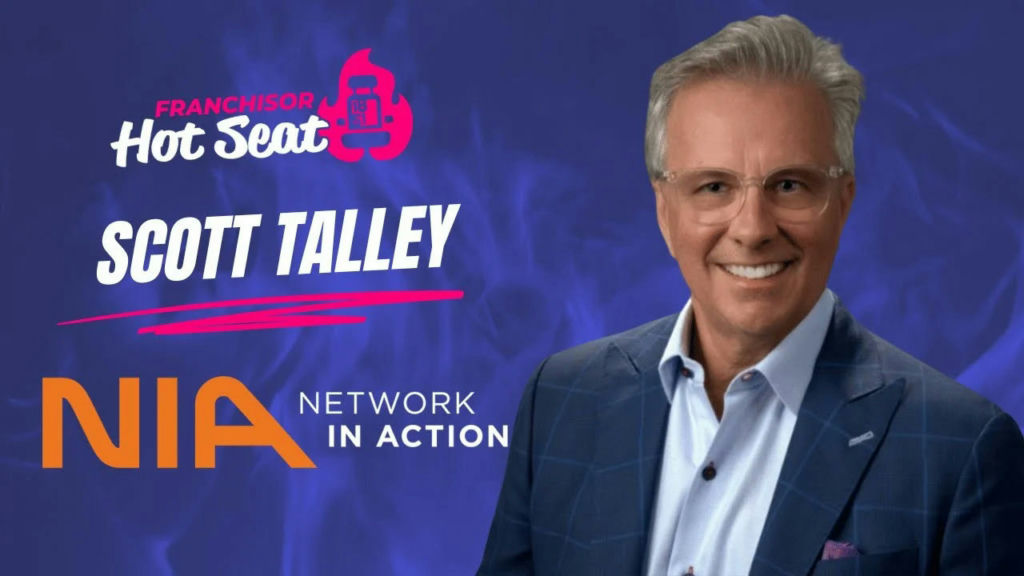
Network In Action has grown into a system with more than 150 franchises across 33 states and operations in nine countries. Founder Scott Talley shared the story of how he moved on from a failed franchise concept to launch Network In Action.
When Scott Talley set out to build Network In Action, he wanted to create something different from traditional networking groups. Instead of canned elevator pitches and forced referrals, Talley envisioned a franchise model built around authentic connections, technology-driven transparency and a structure that could produce results quickly. That vision has grown into a system with more than 150 franchises across 33 states and operations in nine countries.
“We don’t worry about a red-yellow-green scoreboard. We focus on relationships. The business will follow,” Talley told 1851 Franchise Publisher Nick Powills on a recent episode of the “Franchisor Hot Seat” podcast
Talley shared the story of how he moved on from a failed franchise concept to launch Network In Action, what makes the business sustainable and why franchisees see both financial and lifestyle benefits. The system’s model has attracted executives, entrepreneurs and professionals across industries, creating a community that is scaling quickly while staying rooted in its mission of connection.
“This is an asset you own, a business you can sell,” Talley said. “Take a semi-retired executive who has 90 minutes a month to spend. Whether they have 30 members or 130, the commitment is the same 90 minutes. Everything else is handled electronically.”
From fast ROI and flexible operations to stories of franchisees out-earning McDonald’s owners on a fraction of the investment, Talley believes Network In Action has found a sweet spot in franchising.
A transcript of Talley’s interview with Powills has been provided below. It has been edited for brevity, clarity and style.
Nick Powills: How did you accidentally fall into franchising? What’s your franchise backstory?
Scott Talley: Well, I had a previous franchise. I call it my MBA. My first franchise failed, and I spent three years buying back about 10 franchises that never should have been awarded because I didn’t want people to suffer. It was an expensive, painful, time-consuming lesson.
What I learned was: dumb it down, keep it simple. We had a really cool model the first time, but the market wasn’t ready for it. It had a lot of moving parts, and it was difficult for franchise owners to scale. So I said, “You know what? Let’s undo this.” That was my introduction to franchising.
Powills: What was the first business?
Talley: It was called Hourblock. Imagine in a city like Chicago, a franchise owner would get a small section of town. The goal was for every single person in that area to get a card, like a rewards card, that could be tied to the charity of their choice. So maybe you like veterans, and your significant other prefers a women’s shelter. Vendors would agree to give a percent of what was spent to that charity, and you would also get rewards. It was a rewards program for smaller entities.
It was a great idea, maybe a little ahead of its time. The problem was you could get 30 restaurants in Chicago in a two-mile area, and 20 of those managers would leave within five months. Nobody knew how to run the software.
Powills: You had an idea, and you could convince people to invest part of their life savings into the business. How were you able to do that without perfecting some of the operational side?
Talley: I had people who were passionate and wanted to do something ministerial, even before COVID. I think COVID really triggered people’s journeys inward — like, “Hey, I want to do something meaningful with my life.” But even before that, there were people who wanted to do something ministerial. And what could be more ministerial than giving back to nonprofits in a community?
I think that’s what appeals to people. They can make money, be a connector in the community. In some ways, that’s what Network In Action is all about — it’s just a lot easier, much more successful and profitable, and impacting more lives.
Powills: Before I go into that, I heard you say you had to cut back from being a franchise and buy back locations. I assume the idea was great, but tying operations and money back to profitability was a challenge for your operators. Talk about what it was like to do the right thing there, because a lot of franchisors would have just closed shop and walked away.
Talley: It was tempting, but probably a third of the 14 or so franchise owners were friends of mine or people I had relationships with. Money’s never been as important to me as relationships, and I didn’t want to see these people suffer. So that was the best thing I could do.
I didn’t think it was going to take three years, to be honest. I thought I could get it done faster. In hindsight, I might have said, let’s shut this down and I’ll pay you over the next three years with a new venture.
But the bottom line is we all have friends. In fact, one of them is a current franchise owner of ours now.
Powills: When you created that business, did you create it with franchising in mind?
Talley: Yeah, we proved the model for the first year or so with one unit. And I always say you can get anyone to buy something once. But will they renew, will they keep it up, and is it sustainable so it doesn’t require so much work?
In this case, Hourblock wasn’t. Our franchise owners were constantly having to replenish customers, going back to people who had already said no and hoping management or methodology had changed. It was viable, but it was a lot of work, a lot of moving parts, and not easy to scale.
Powills: So you shut that down, and then you created Network In Action. Talk about that process and timeline. How did you get this going?
Talley: That was an interesting chapter. My two girls were finally old enough to be in school, and I told my wife she needed to find a way to make a living in case something happened to me. I’m older than her. She got her real estate license, and I still had some marketing capabilities in the neighborhood. I said, put your pearls on, your black-and-white dress, and I’ll take pictures of you and market the heck out of you. But it won’t work unless you network.
The problem was you couldn’t be late or miss meetings. We traveled a lot, and there weren’t really groups that worked for us. We looked at opening one through a different company, but there wasn’t one thing about that model I liked. One night, over a glass of wine, she said, “You think you know so much? Why don’t you start a networking group?” And today, we’re in nine countries. We have 380 units open, about 155 franchises in 33 states.
Powills: It feels like we’re in a massive shift in the way younger folks are learning how to network. The only way I was going to build our business was through hardcore networking and kissing a lot of frogs. With the shift in behavior, is there hope for that next group when it comes to networking? Or is it going to have to go through some major change?
Talley: I think you’ve hit the nail on the head, and the timing of this is great. I totally agree with you. My research shows that only about 2% — maybe less in some markets — of businesses in a community actually participate in a formal networking group. We think everyone does, but most don’t. That doesn’t mean people don’t join chambers or Rotary Clubs. There are places to network. But a formal group where you’re held accountable for referrals and attendance? Very few people participate — and even fewer younger people.
So I started researching why. It’s because they don’t like being told what to do. They don’t like having to be in a meeting. If they’re introverts, they don’t like people. If they have ADHD, they can’t keep meetings on their calendar. If they travel, they can’t make it. So we created a model called NIAX — Network In Action X — for the younger generation. There are four fundamental differences. The first one is we’re legally able to have everyone in the group share revenue on closed business.
Instead of giving a referral and hoping to get something back in a few months, now when you give a referral and the business closes, the commission automatically goes from the member’s credit card into the checking account of the person who made the referral.
Think about it. On Instagram or TikTok, people are told to create an Amazon store and get paid. On Etsy, create a product and get paid. Like a YouTuber’s page, and if someone buys off that page, get paid. We built the same concept for referrals. With our model, 250 to 500 people in a community can download an app, pass a referral and get paid. No meetings required. Think of LinkedIn or Alignable with a monthly meeting for members, but the whole community can also refer electronically and get compensated.
The reason people want to refer is because every member gets a background check, is personally vetted and signs a customer service agreement to take care of the customer — or they get removed from the group. We believe this is a whole new model for the next generation of business owners, and we think it’s going to be extremely popular and profitable.
Powills: So what I’m hearing is there has to be some transparency in a networking group that’s built on referrals. Maybe that’s what’s been missing, and that’s part of the problem you’re solving. Your friend might say, “Oh, you should totally use this,” but they never disclose there’s an incentive. You think they’re recommending something out of kindness, but in reality, they’re trying to get paid. By disclosing it, you create credibility and transparency.
Talley: Total transparency. And we’re using AI. Imagine you download the app — it just becomes another one of the 300 apps on your phone that you rarely use. But in this model, every single referral partner is assigned a bot. The bot reminds them and says, “Hey, Nick just got $600 in commission. Now it’s your turn.” Or, “A new member just joined the group and is paying 10%.”
So picture this: You’re at your parents’ house on Sunday, and they say they’re going to remodel the kitchen. You say, “Let’s see if my guy’s any good.” You refer him, he gets the business, it’s a $60,000 kitchen job, and you get $4,000 in your bank account. It’s all seamless and transparent because we’re connected with each other through the community.
Powills: How many people do you have in the community?
Talley: The franchise owner recruits what we call NIAXers. Those are the people who refer. From a membership standpoint, each group has 50 or more members.
Why can we build groups that large when others stick around 20 or 22? Because members aren’t required to attend meetings. They can do everything electronically. The meetings that do happen are educational and social — and they’re making money. We’ve essentially created a chamber of commerce without the civic responsibility, where everyone can refer and get paid. More people want to participate in that model, and that’s what we’re experiencing.
Powills: Out of curiosity, let’s use your wife as an example. If this had existed when she was getting started, it obviously would have accelerated her first-time customers. She’d still need to service those customers, but would this have changed her onboarding?
Talley: Yes. In our model, every single member gets a welcome call and onboarding. They’re assigned a bot, and the bot helps guide them on how to get the most value from their membership.
You’ve got two audiences here. First, the paying members who are part of the group. Then there’s a cohort of people referring them, who don’t pay to use the app.
The paying members provide the funds that make the system work — but it’s all transparent. We partnered with Stripe, which handles about a third of the world’s credit card processing. We’re not moving money ourselves — it’s all done securely through their platform.
Our technology just makes it all happen.
Powills: We’ve hit on the vision and the points of differentiation. The next thing people want to know is: what does it cost to get in, and how much can I make? How do you answer that?
Talley: Today, our franchise fee is $35,000, and that includes three protected territories in a market. Members can come from anywhere — if someone wanted to drive from South Bend, Indiana, to attend a group in Chicago, they could. The protected territory means we won’t award another franchise on top of yours. From there, you can grow the groups as large as you want, and you have three options. You can run a traditional NIA group, which is a monthly meeting with professional leadership, similar to a mastermind. People usually pay a couple thousand dollars to be a member.
You can also run a trades group — roofers, plumbers, electricians. Those are more educational and help tradespeople grow their businesses to compete with private equity that’s buying up their competitors. Typically, the fee for those groups is about $4,800.
And then there’s NIAX, which is a lower price — around $119 per member — and those groups will typically be 50 or more people. You can run one of each, all NIAX, or any combination. At the end of the day, though, you have to be passionate about helping people and at least comfortable with sales calls.
We show people five different ways to grow these groups, and we offer strong support to make sure new franchisees launch successfully.
Powills: Where do you put Item 19 in the conversation?
Talley: Our Item 19 is live and real, and we’re proud of it. I even have a standing challenge: the first person who brings me an Item 19 with a higher median income on a $35,000 all-in investment, I’ll give them $1,000. We believe we’re the lowest-cost franchise out of the 4,300 out there with one of the highest Item 19s.
The numbers vary depending on whether someone is running one group, two groups, three or more. But I’ll share a story. A gentleman bought his franchise 11 months ago, in August of last year. He trained late August and early September, so he really started mid-September. He’s already added 111 members at $2,000 apiece. His net is 85% of that, or about $180,000, in just 11 months — off a $35,000 investment.
Powills: When your investment is that low, yes, you can find people with grit and hustle, but sometimes you get people with what I call a $100,000 mindset, not a million-dollar mindset. How do you make sure your franchisees are coming in with the right mindset?
Talley: I’ll be honest — it’s probably not a million-dollar franchise, though the franchisee I mentioned has a plan to get there and could be our first in 11 years. Most of our franchisees are people who already own a company — maybe an insurance agency or a coaching business — and they want to create an extra $100,000 to $150,000 with this part-time.
Many others are people tired of corporate life. They can’t leave their jobs overnight, so they start this on the side, and within six to eight months, they quit corporate. About 90% of our owners run their franchises part-time. It’s not a million-dollar opportunity, but it is clearly a six-figure opportunity, with residual income and the freedom to travel and control your schedule. That’s the appeal. But I do vet people. I don’t want to work with anyone who isn’t going to make at least $100,000.
Powills: Part of the reason I asked you that is because I’m almost proud of this — I’m a two-time quitter of Vistage. The reason I quit is that, in our group setting, and it’s just how my brain works, I would turn into the coach. The whole group would say, “Nick, give us advice.” But I joined because I wanted advice. Suddenly, it felt like my group, and I wasn’t getting paid for it.
The point is, when you get someone like you — who’s found success in life and business, figured out how to grow and recovered when things didn’t work out — that coaching element is powerful. Add the networking and referral side, and you’ve got a tremendous marketing engine that helps people lift their businesses.
On the coaching side, though, I want someone who’s been there and done that. That’s where the millionaire mindset versus the $100,000 mindset comes in. I don’t mean the business has to make a million dollars, but when you think like that, you don’t look at every check and say, “What’s my profit margin?” Instead, you ask, “How do I reinvest this to get a bigger return?” That’s why I asked the question—because your model has the capacity for people with that mindset to scale the way that franchisee did in 11 months.
Talley: To answer that, we do have three or four area developers with that million-dollar mindset. The math works on an area developer or master franchise, which is what we typically launch in a foreign country. We just got the go-ahead in Malaysia this week and the UAE a few days ago, and we’re about to start in Turkey. That’s typically a master deal, and that is a million-dollar opportunity.
For most people, though, it looks different. About 40% of our franchise owners have bought an additional unit. We’re proud of that because it means they’re a year, maybe 15 or 18 months in, they’re making six figures, they’ve taken a long vacation, and then they realize adding another group only adds 90 minutes a month to their schedule.
I was in Vistage too, and I have a funny story. My Vistage chair is known for two things. I’ll let the audience decide whether he went one for two. He talked me out of selling my publishing business years ago. I had a life-changing offer of $18 million when the company was four years old. He told me to wait a couple of years, make a few adjustments, and it would be worth more.
During that time, a little company called Google came along and changed the publishing business. There were 600 publishers then, and 600 went out of business in 18 months. I lost on that deal. But my chair also introduced me to my wife.
One more thing about Vistage — or Tech, as it was called back then. Even after 20-plus years, three or four of my closest business friends today are people I met in that group. They’re still my very best friends. We see the same thing with Network In Action.
We don’t worry about a red-yellow-green scoreboard. We focus on relationships. The business will follow.
Powills: To be really vulnerable, that’s why I joined in the first place. When you’re running a business, it can be lonely. Misery loves company, so when you can be with others going through the same challenges — whether it’s an employee issue or a client problem — it’s therapeutic. That’s probably what you’ve created, right?
Talley: That’s what we’ve created. When you come into a Network In Action meeting, you don’t do an elevator pitch — we’ve already shot a video of you. We don’t have member reports or forms to impress guests or corporate.
We focus on the clients. Every month, members are introduced to a different concept — whether it’s an AI tool, strategies to get more five-star reviews or something else. And if I’m sitting at a table with you, being vulnerable, it’s like the Marines bonding at Camp Lejeune.
When it comes time to refer Nick, it’s easy to say, “Call my buddy Nick.” Referrals are much more organic, not canned or forced, and they end up being stronger.
Powills: Out of curiosity, do some of your franchisees come as referrals from the groups already running?
Talley: Thirty-five percent of our franchise owners were introduced by someone in the system. That continues every month. I’m talking to two people now who were referred by happy owners. It's common for someone to say, “I found this franchise in Nashville,” and a friend responds, “That’s right down my alley.” If they can’t afford it, we have strong financing sources, starting at a 680 credit score. Often, franchisees recoup their investment within 20 days, and almost always within 75 to 90 days. It’s a very fast ROI. You only need 17 customers to break even.
Powills: I love what you’ve pieced together. Vistage isn’t a traditional franchise, but you have a coach who makes money and gets their cut. It’s similar, though less transparent. They say, “I’m giving back,” but they’re also profiting. What I really hear is your franchisees are validating. They’re scaling, they’re reinvesting. I’ve been in franchising for 20 years, and I’ve never bought a franchise. I came close five years ago but asked one validation question: “Would you do it again?” The hesitation I heard was enough for me to say no.
Talley: One of the differences between becoming a Vistage chair and a Network In Action franchise owner is simple: this is an asset you own, a business you can sell. Take a semi-retired executive who has 90 minutes a month to spend. Whether they have 30 members or 130, the commitment is the same 90 minutes. Everything else is handled electronically.
Two years ago, I took my kids out of school, and we traveled the world for seven months. During that time, I grew my franchise. I still run two groups because I love my members. I added members, closed deals from my smartphone and kept building. One of our owners in Minnesota netted $223,000 last year. She had an HR background, took two months off, traveled to Europe and South Africa, and still made $80,000 more than the average McDonald’s franchise owner — all on a $35,000 investment, $45,000 with an extra group.
Powills: Let me close with this: brands don’t sell brands — people do. The one thing I think your website is missing is the human side. We just talked about connection and lifestyle. Your top franchisee took vacations and still out-earned the average McDonald’s owner. Position it as “Learn how business and lifestyle merge with NIA.” That message could resonate.
Talley: Great advice. We’re working on that now. Think about it: when you buy a house, you’ve already decided based on the website. When you buy a car, you might pre-order it like a Tesla.
You can do the same with Network In Action. We’ve added calculators so people can project revenue share, estimate members, take out royalties and see what they could earn. It’s essentially a build-a-franchise tool.
Powills: I love the idea of putting more human stories on there. Scott, it was a pleasure talking to you. Thanks for sharing your story.
In this story
This story was originally published in 1851 Franchise on September 8, 2025. Burnaze summarizes and links to the original reporting.
Read the full story at 1851 FranchiseLiked this? Get the week's franchise news, explained
- Sunday 8 AM ET weekly + a monthly deep dive
- Sections picked for the industries you follow
- Every claim linked to its source. Free.