TL;DR
Children's Lighthouse, a leading early education franchise, has enhanced its financial transparency by revising its Item 19 disclosure to include detailed breakdowns of payroll costs, occupancy costs, and gross profit. The brand's Vice President of Franchise Development, Matt Kelton, led the initiative to provide franchise candidates with unprecedented insights into franchise profitability.
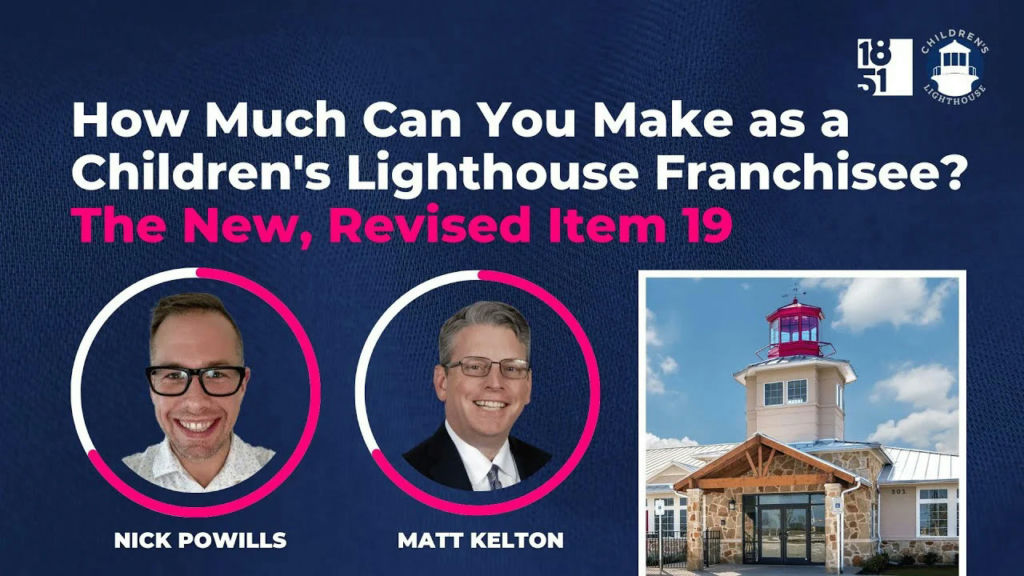
Children's Lighthouse, a leading early education franchise, recently hosted an informative webinar titled "How Much Can You Make as a Children's Lighthouse Franchisee? The New, Revised Item 19." The discussion, led by 1851 Franchise Publisher Nick Powills and Children's Lighthouse Vice President of Franchise Development Matt Kelton, unveiled the brand's revised Item 19 disclosure, offering franchise candidates unprecedented insights into franchise profitability.
Historically, Children's Lighthouse had only disclosed gross revenue figures in its Franchise Disclosure Document (FDD). However, recognizing the sophistication of potential franchise investors, Kelton led an initiative to significantly expand financial transparency. For the first time, the brand's revised Item 19 now includes detailed breakdowns of payroll costs, occupancy costs, additional operational expenses and gross profit.
Kelton, who has extensive franchising experience, emphasized the necessity of detailed financial reporting for franchise candidates making sizable investments of approximately $6 to $7 million. He shared that prospective franchisees, often experienced professionals or investor groups, seek comprehensive financial data to make informed decisions. This level of detail also enhances the due diligence process, helping investors understand the full financial landscape of owning a Children's Lighthouse school.
Financial Transparency
During the webinar, Kelton outlined the importance of franchisees understanding their potential earnings beyond just gross revenue figures. By providing data on payroll, occupancy, royalties and marketing costs, Children's Lighthouse empowers potential franchisees with a clearer understanding of the profit landscape.
The revised Item 19 includes 43 "mini P&Ls," allowing prospective franchisees to examine individual franchise performance across various markets, clearly illustrating the range of profitability.
The webinar highlighted how this enhanced transparency has already positively impacted franchise recruitment, providing reassurance and clarity to potential investors. Kelton shared an example of a group of franchise candidates from the Houston market who re-engaged after viewing the updated financial disclosures, quickly moving towards franchise agreements after previously stalling in the due diligence phase.
Internally, existing franchisees also benefit from greater financial transparency, enabling them to benchmark performance and identify areas for operational improvement. Kelton noted that sharing detailed financial data internally has sparked healthy competition and best-practice sharing among franchisees.
Investment Model
Kelton also emphasized the unique investment model offered by Children's Lighthouse, describing it as a dual opportunity. Franchisees not only operate a profitable early education business but also invest in valuable commercial real estate. Over time, franchisees build significant equity in both their business and their real estate assets, creating multiple avenues for wealth generation.
One standout fact Kelton highlighted is that, in nearly 30 years, Children's Lighthouse has had zero SBA loan failures, underscoring the strength and stability of the brand’s business model.
Growth and Stability
This impressive track record, combined with the franchise’s new financial transparency, positions Children's Lighthouse as an attractive opportunity for sophisticated investors.
Nick Powills: All right, Matt, lots to unpack. But let's start with why we're talking. You've made some decisions or recommendations when you got involved with Children's Lighthouse to change or adjust the reporting within the FDD under Item 19. What was the reasoning behind that? What was the gap you saw when you joined the company?
Matt Kelton: I've been here exactly one year, but I've been in franchising for 25 years. Before this, I ran a real estate home services franchise for 17 years, so I've experienced this before. Children's Lighthouse has been around for almost 30 years and is a leader in early education schools.
For years, frankly, they only shared gross revenue in their Item 19. We’re second-generation family-owned, definitely not private equity — it's very much a family culture. Frankly, they had never gotten P&Ls on a regular basis.
When you're looking at an investment of this size — around $6 to $7 million — you're dealing with sophisticated buyers who want detailed financial data. We want transparency, so we decided to show core expenses like payroll, occupancy, additional costs such as royalties and marketing, and EBITDA numbers. It took time, but we finally achieved this about a month ago.
Powills: I have a follow-up question on Item 19, but first some context. The double-edged sword of Item 19 is that it's restrictive on what data it can share since it's based on actual P&Ls. More sophisticated candidates learn through due diligence that there's a good business behind it if franchises are happy, investing, and building an asset. Clearly, your growth shows a fundamental strength. Philosophically, do you think that financial disclosures in the FDD should allow deeper discussions outside its current framework?
Kelton: That's one of my frustrations. In my 25 years in franchising, I've never seen it. We're now showing 43 mini P&Ls from our franchisees, not just an average, because we want prospects to see the ranges clearly.
Results vary significantly based on location, management skills, and market conditions. Candidates commonly ask, "How much can I make?" There's a story I use: A guy in Times Square asks a hot dog vendor, "How long would it take to walk to Carnegie Hall?"
The vendor doesn't know. Later, he shouts back, "10 minutes." The guy asks why he didn't say that initially, and the vendor replies, "I didn't know how fast you walk."
Powills: I love that analogy. It reminds me of car dealerships — people see inventory and perks, assuming profitability. Franchising candidates must look beyond the foundation of a business. Children's Lighthouse has a solid foundation, even at 25 locations, let alone 50. This is a sophisticated investment, and your detailed Item 19 helps show that.
Kelton: It helps engage prospects earlier, providing a clear range of possibilities. It also assists in final due diligence, helping franchisees see the financial potential. Previously, our competitors had extensive data disclosures, placing us at a disadvantage. For such a sizable investment, detailed data is essential.
Powills: TWO MEN AND A TRUCK® had a similar transformation by making P&Ls visible internally, creating healthy competition and operational improvements. Is your data transparency creating internal improvements too?
Kelton: Absolutely. We're just starting that internally. The goal is benchmarking top performers, comparing payroll percentages, rent, electricity, and cleaning costs. It's crucial for franchisee support, driving profitability.
Kelton: I had a group in Houston who stalled, but after seeing our new FDD, they moved quickly to franchise agreements. Without detailed data, prospects had to do extensive research. Now, seeing real numbers helps them feel confident in their investment decision.
Kelton: Exactly. This model includes commercial real estate. You're investing in land and a building, creating wealth over time. It’s more than just owning a business — it's building significant equity.
Kelton: Yes, real estate drives wealth creation significantly. Many franchisees, often immigrants, pool resources to invest, viewing this as a long-term wealth generator. Compared to hotels, it's a smaller but still sizable commercial investment, attracting partnerships.
Kelton: The lack of SBA failures is huge. We're stable, family-owned, and demand-driven. We don’t rush growth and avoid heavy litigation common with faster-growing franchises. Demand is enormous due to dual-income families. Real estate appreciation adds significant value.
Powills: To anyone interested, I recommend filling out a form and speaking to Matt. Education on the investment structure alone is invaluable.
Kelton: Agreed. We strive for transparency and openness. Our franchisees also share detailed insights, which I legally cannot. These discussions are crucial.
Powills: Matt, thanks for sharing. Great work at Children's Lighthouse. This was another webinar. Thanks, everybody.
In a recent webinar, the early education franchise unveiled its revised Item 19 disclosure, providing unprecedented transparency into profitability, including gross revenue and EBITDA margins.
Kelton: Thanks, Nick. Appreciate your time.
Watch the full webinar here.
To find out more information on costs to buy this franchise, please visit *
In this story
This story was originally published in 1851 Franchise on March 26, 2025. Burnaze summarizes and links to the original reporting.
Read the full story at 1851 FranchiseLiked this? Get the week's franchise news, explained
- Sunday 8 AM ET weekly + a monthly deep dive
- Sections picked for the industries you follow
- Every claim linked to its source. Free.