TL;DR
Convenience store operators are facing new challenges due to tobacco regulations, including flavor bans, tax shifts, and enforcement priorities, as they head into the 2026 fall season. The FDA has released new enforcement guidance for tobacco products and proposed a rule requiring foreign tobacco product manufacturers to register their establishments and list their products with the FDA.
C-store operators manage flavor bans, enforcement priorities, tax shifts and directories as they head into the 2026 fall season.
As convenience retailers shift into their autumn planograms, tobacco category managers are keeping an eagle eye on the regulations that will affect their backbars in the cooler months. No longer a stranger to flavor bans, increased taxes and Food and Drug Administration (FDA) fluctuations, tobacco retailers are setting their sights on flexibility and compliance.
Federal regulations
In May, the FDA released new enforcement guidance for tobacco products marketed with premarket authorization.
“FDA does not intend to prioritize if a product has a pending application that has been accepted and filed, or when a manufacturer has a pending and accepted supplemental PMTA (premarket tobacco product application), and if FDA has determined the application includes data necessary to evaluate whether the product is appropriate for the protection of public health in the case of non-tobacco flavored ENDS products,” the organization stated in its announcement.
Unless these products contain elements appealing to youth, enforcement won’t be prioritized. However, the FDA will consider whether a tobacco product presents a significant health or safety concern.
The FDA also announced that it will create and maintain a publicly available list of products in which it doesn’t intend to prioritize enforcement.
“I think that what’s really happened in the past … 60 days with the FDA taking this approach to non-enforcement of some products has really created a cyclone of activity that feels chaotic right now,” said Melissa Donoghue, category manager, cigarettes and other tobacco products for Atlanta-based RaceTrac.
RaceTrac operates 615 stores in 13 states, largely concentrated in the South.
“I certainly have been in tobacco for 16 years. I haven’t seen it like this before in terms of the amount of new products coming and specifically within the modern nicotine category. …” she continued. “(FDA has) opened a window. I think it will close at some point, which is why everyone’s rushing in.”
The FDA also proposed a rule in June that would require foreign tobacco product manufacturers to register their establishments and list their products with the FDA, an action currently required of domestic tobacco product manufacturers, before the products are imported into the U.S.
The proposed rule is available for public comment until Sept. 14.
State legislation
C-store retailers are contending with state and local legislation of tobacco, too.
In Louisiana, the state legislature recently clarified that all nicotine/vape products are subject to a three-tier system, further regulating the industry in a state that already had a vape registry. The intent is to “keep bad players out and a level playing field. It is my understanding our state alcohol and tobacco control (agency) is actively seizing illicit inventory to deter bad actors,” said Annie Gauthier, CEO, St. Romain Oil Co., which operates 17 Y-Not Stops.
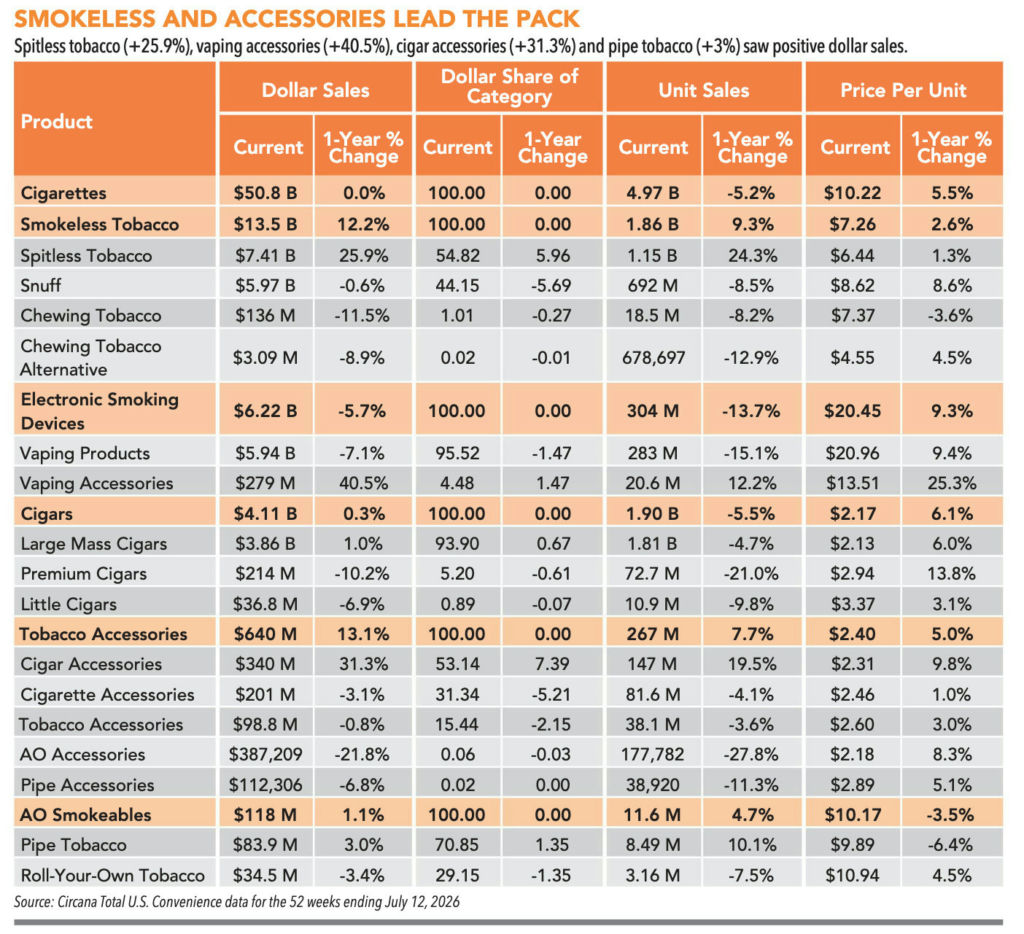
Market research firm Circana data shows electronic smoking device sales are down 5.7% in dollars and 13.7% in units for the 52 weeks ending July 12.
In Minnesota, anti-tobacco organizations (ATOs) are meeting with country administrators, county commissioners, mayors, city councils and city administrators, according to Lance Klatt, executive director of the Minnesota Service Station & Convenience Store Association.
“These (flavor ban) policies take effect, retailers can lose anywhere from 35-55% of their tobacco/nicotine sales, not to mention ancillary sales of fuel, candy, beverages etc. These ATOs are getting ahead of retailers as retailers need to play defense. Time to be more on the offense,” he said.
Just as at the federal level, enforcement is also a topic of concern statewide.
Klatt noted lack of enforcement in Minnesota and other states where flavor bans have been implemented, stressing an absence of violations for retailers selling flavored products when there is an ordinance not to do so.
“City and county officials pass a favor ban and other anti-tobacco ordinances as an opportunity to enhance their political agendas. It’s too easy to pass anti-tobacco ordinances — one thing to say something, another thing to enforce,” he continued.
And, if retailers own multiple locations in multiple cities and counties, it presents a particular compliance challenge. Employees might forget to act on an ordinance if they are accustomed to a different ordinance in another city or county.
RaceTrac, operating in multiple states, must constantly keep on top of the differing regulations. Luckily, it has the resources to employ a government affairs and legal team that is heavily involved in federal and state legislation.
The retailer also follows tobacco news outlets and listens to their supplier partners to stay abreast of looming legislation.
“It is a balancing act, but we have a lot of support in that,” said Donoghue.
Still, the backbar in one store can look completely different from a store one town away.
Minnesota retailers are losing sales and foot traffic due to current tobacco legislation.
“I’ve seen nearby retail locations selling flavored tobacco sales increase by 30-40% when one city has a flavor ban vs. a neighboring city, county or even state. The state tobacco tax for locations near bordering states has a huge impact, not to mention the fiscal note this also has on revenue for the state of Minnesota. It creates challenges for many retail locations with category management and planograms,” Klatt said.
Other legislative trends Minnesota retailers should be watching are increasing fines, employment age to sell tobacco, distance from schools, minimum retails on tobacco and nicotine products, and a moratorium and sunsetting of tobacco licenses.
Taxation trends
Like Minnesota retailers, RaceTrac has also been dealing with changing tobacco taxes.
More states are considering taxing nicotine pouches differently, Donoghue said, with some states opting out of taxing these and other states taxing them as an other tobacco product.
“With the recent FDA authorization of ZYN to be marketed as a less harmful tobacco nicotine product, some states are then looking at segmenting those items differently and applying a lower or reduced tax to them. It’s really running the spectrum of taxation from no tax to a low tax to a high tax,” she said.
A bigger concern for the chain, however, is the total nicotine directories that states are evaluating. These would slow the release of products if retailers were unable to stock them until they are published on a state’s directory.
RaceTrac currently operates in two states with directories, which are slow to react.
“As new products are launched and we’re able to get them into our other stores, we’re not able to bring them in (to the stores in these two states) yet. I think that’s one of the biggest challenges we’re facing,” Donoghue said.
She noted that convenience stores are known for speed to shelf and wishes that lawmakers better understood that they can execute more quickly than other formats including big box, mass and grocery. Legislation such as the directories isn’t a bad idea, per say, but they need to work faster.
“They’re not able to keep up with the changes in the industry as quickly as they’re happening, and it’s hurting c-store businesses,” Donoghue said.
Klatt advocated that retailers pay attention to the legislative happenings in other states. Many retailers are worried about their future and the future of the industry.
“Preemption would be good. Get more involved with city leaders (and) community, local and state politicians and leaders. Retailers seem to act when it’s too late. Get involved. It’s your future,” he advised.
Immerse yourself in the category, Donoghue added. Build relationships; focus on inventory, pricing, promotions and other aspects that matter to operational partners; and leverage trade associations.
Klatt also noted that operators can focus on additional methods to increase foot traffic. “Adapt or die.”
In this story
This story was originally published by Emily Boes in CStore Decisions on September 1, 2026. Burnaze summarizes and links to the original reporting.
Read the full story at CStore DecisionsLiked this? Get the week's franchise news, explained
- Sunday 8 AM ET weekly + a monthly deep dive
- Sections picked for the industries you follow
- Every claim linked to its source. Free.