TL;DR
Jet's Pizza generated an 11.5% sales increase year-over-year in 2025, finishing with $613.4 million in sales, despite the pizza category experiencing a -0.3% year-over-year sales decline. The company was founded in 1978 by Eugene Jetts and expects to reach 500 locations by the end of this year.
Indeed, pizza was the only industry category in the red in 2025, with -0.3% year-over-year sales decline, following a nominal gain of just 0.6% in 2024. Six out of the top 10 QSR pizza chains were negative last year, including Pizza Hut at -8.2% and MOD Pizza at -10.6%.
Conversely, Jet’s Pizza generated an 11.5% sales increase year-over-year in 2025 to finish with $613.4 million, according to Technomic data.
Company history
Jet’s is finding this groove at almost age 50. The company was founded in 1978 in the Detroit suburb of Sterling Heights and expects to reach 500 locations by the end of this year. The company was established on a bit of a whim — Eugene Jetts was on his way to buy a new home but ended up signing a lease on a space he envisioned as a pizza shop instead.
Eugene and his brother John opened the doors to the then-Jetts Party Shoppe & Pizzeria shortly thereafter, and that concept has since evolved into the seventh largest chain in the category behind Domino’s, Pizza Hut, Little Caesars, Papa Johns, Marco’s, and Papa Murphy’s.
Focus on quality
During a recent interview, John Jetts said the company’s growth has been slow and steady, driven by a focus on offering premium ingredients no matter how volatile the commodities markets get.
“We rode the storm every time cheese fluctuates and never jeopardized that,” he said. “That’s what has brought us our returning customers.”
A little over two years ago, the company brought on Andy Wetzel as chief operating and chief marketing officer to better tell this story as consumers started to become a bit more discerning. He has nearly 30 years of experience in the pizza category, mostly at Domino’s, which is headquartered about an hour west in Ann Arbor. Wetzel said his first priority in the role was to research what customers want from the brand, and from pizza in general.
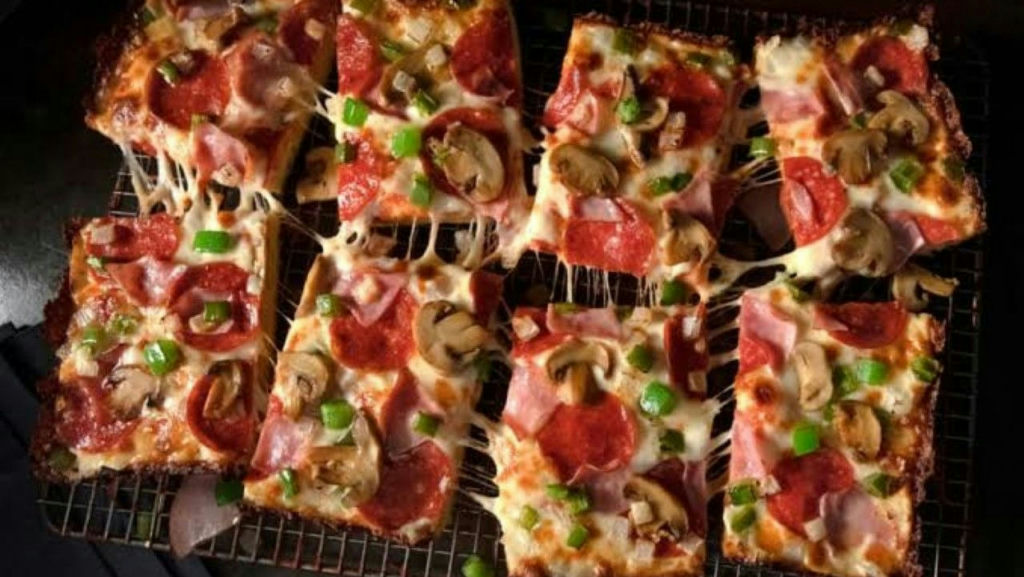
This research helped solidify Jet’s positioning; last year, the company launched “It’s Not Pizza. It’s Jet’s” to home in on its Detroit-style roots and premium approach amid a sea of aggressive promotions.
“The category has become a chase to the bottom. The category has trained consumers to seek out the next big discount,” Wetzel said. “It’s not a race we are participating in or plan on participating in. It has been proven over the history of our organization, and specifically in tenuous times, that consumers are willing to pay for quality and food."
Wetzel said Jet’s employees hand-cut vegetables, mix multiple types of flour for the dough, and grate fresh cheese every day, for instance. To relay this, the campaign included a fictional competitor named “Bottom Line Pizza Corporation," with executives obsessed with cost-cutting and shortcuts.
Wetzel said Jet's non-discount positioning, and subsequent campaign, have “helped us weather the storm.”
“Anyone can talk about ingredients, but we have an opportunity to point out our differentiation, not only with our core Detroit-style pizza, but because we’re using good ingredients. We’re proud to be serving a product made well,” Wetzel said. “Our product is non-negotiable.”
Owner operator model
The product isn’t the only driver behind Jet’s growth, however. About seven years ago, the company shifted to an owner/operator model, and Jetts said this immediately made the company stronger.
“We’re not going to grow as fast as some others. We want our owner/operators in the store,” he said. “We told them you can be very successful with one of our stores, get a great bonus, and make good money. Just don’t change the product.”
Wetzel added that the owner/operator model has allowed the company to be a bit more prescriptive on choosing franchisees.
“We want people who have relationships with our customers. It’s vitally important and allows us to talk about our product and also our service,” he said. “It’s why we have such loyal customers.”
It’s also why Jet’s will continue a slow-and-steady expansion strategy of about 20 to 30 new stores a year, despite significantly outpacing its competitors in sales.
“There is no doubt we could throw up 100-plus stores a year,” Wetzel said. “That is not our plan. We’re not in a race. We’re building a foundation to grow at a rate to make sure our franchisees are successful.
“Our goal is that Jet’s never becomes a turnaround story.”
Members help make our journalism possible. Become a Restaurant Business member today and unlock exclusive benefits, including unlimited access to all of our content. Sign up here.
In this story
This story was originally published in Restaurant Business on August 18, 2026. Burnaze summarizes and links to the original reporting.
Read the full story at Restaurant BusinessLiked this? Get the week's franchise news, explained
- Sunday 8 AM ET weekly + a monthly deep dive
- Sections picked for the industries you follow
- Every claim linked to its source. Free.