TL;DR
Wonder has installed its first automated makeline, acquired from Sweetgreen for $186 million, to offer lower prices and expand into new markets. The technology will be rolled out to tens of locations across the Northeast, Texas, and the Washington, D.C. metro region in 2027.
The food hall company will use the tech it acquired from Sweetgreen for $186 million to offer lower prices, extended hours and expand into new markets.
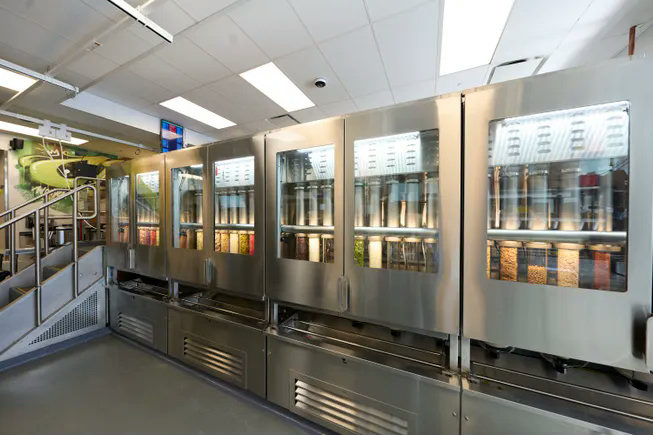
Wonder has installed its first Infinite Makeline, an automated bowl assembly system, in its Midtown East location in Manhattan, the company said in an emailed press release.
Wonder will roll out the technology to tens of locations across the Northeast, Texas and the Washington, D.C., metro region in 2027.
The debut follows Wonder’s $186 million acquisition of Spyce , the developer of the makeline, in 2025 from Sweetgreen. The company expects to use the technology to offer lower prices, extended hours and further expansion into new locations.
Automated production benefits
The automated makeline can address various challenges related to restaurant operations, including throughput, consistency, waste and repetitive, labor-intensive tasks, the company said. These changes could support expansion into locations that were previously not viable for Wonder, including lower-density suburban markets.
The Infinite Makeline can produce up to 500 bowls from 68 ingredients and support six of Wonder’s concepts. The technology boasts an average order-to-ready time in under three minutes, per the press release.
The makeline dispenses ingredients with “precision and speed,” the company said using universal dispensers that can accommodate various ingredients. Bowls can pass through the makeline several times to allow for any complex recipes and customizations.
It also integrates with Wonder’s tech stack, including its proprietary point-of-sales and kitchen display systems, as well as its kitchen operation and real-time data systems. The technology was redesigned from Sweetgreen’s original Infinite Kitchen system to work for Wonder’s model, in which various restaurant concepts are prepared within the same kitchen.
Technology and staff roles
Wonder said the technology is not meant to replace chefs or “culinary judgment.” Culinary staff still develop recipes, as well as ingredients and standards. The technology is meant to handle repetitive and precision-based assembly while workers add any final touches.
“The goal is to combine precision, timing and creativity, allowing chefs’ recipes to be executed consistently at a scale that would be difficult to achieve manually,” the company said.
Wonder also recently secured $650 million in Series D funding, bringing its total amount raised to over $3 billion. This new funding could support further deployment of the new technology. Chipotle has also been experimenting with an automated makeline from Hyphen, but it has yet to deploy it across its system.
In this story
This story was originally published in Restaurant Dive on September 15, 2026. Burnaze summarizes and links to the original reporting.
Read the full story at Restaurant DiveLiked this? Get the week's franchise news, explained
- Sunday 8 AM ET weekly + a monthly deep dive
- Sections picked for the industries you follow
- Every claim linked to its source. Free.