TL;DR
Walmart uses AI and digital twins to optimize its supply chain, leveraging predictive models and machine learning technology to navigate a challenging landscape. The company partners with OpenAI and Google on AI certifications and uses digital twin technology to test its network's response to disruptions.
Before Walmart kicked off an effort to get AI into the hands of 2 million employees, the retail giant's supply chain team already relied on the technology to help get products where they needed to go.
Predictive models have always had a home within the supply chain industry, Indira Uppuluri, Walmart’s senior vice president of supply chain technology, told sister publication CIO Dive. But the amount of data and AI tools her teams have access to now gives them stronger signals to navigate a sometimes challenging landscape, Uppuluri said — “That's where the industry is going.”
The data collected about weather patterns and customers’ buying history, coupled with machine learning technology, has leveled up the insights that supply chain technology teams can offer, Uppuluri said.
AI tools and partnerships
She added that Walmart has access to all of the large language models and open source models that are popular among enterprises. Data science and optimization teams also build custom AI tools to meet the needs and objectives of the business.
Walmart partners with OpenAI and Google on role-specific AI certifications offered through the company’s associate-facing platform, Squiggly, which encourages employees to also build custom tools themselves.
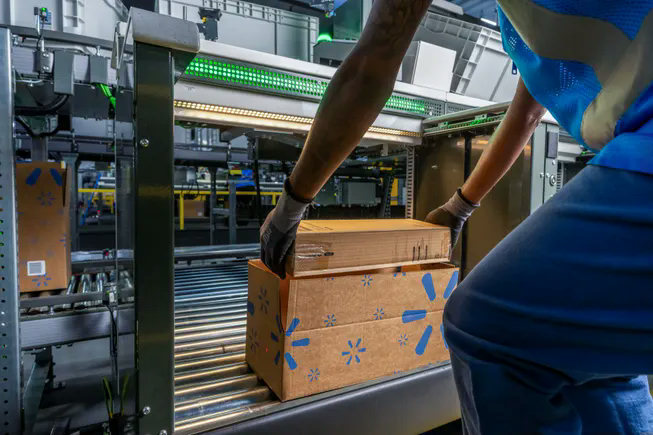
The retailer's supply chain technology team is responsible for managing its nodes, or where products are received, processed, stored or shipped, as well as its fulfillment engine, which sources inventory and refines the standards of what will be delivered to customers.
Supply chain management
The team also oversees the technology that guides out and inbound transportation and middle-mile transportation. It’s a growing challenge, as same-day delivery becomes more commonplace for large retailers. Walmart-owned Sam’s Club debuted a one-hour offering in April.
To optimize all of the moving parts that happen behind the scenes of product management, Uppuluri said her team uses AI models and agents.
Instead of looking at one node at a time, associates can access agents to inform them how the company’s resources are being leveraged as a whole, and how they can best optimize them or fix bottlenecks.
“Assortment, speed, and cost are the three [factors] that we are trying to balance and optimize in through the supply chain,” she added.
So far, 2026 has been defined by tariff and geopolitical-fueled turbulence, making it a difficult year for supply chain leaders. Extreme weather or environmental disruptions can add to the challenge.
Much of supply chain management is preparing for and reacting to events that become barriers to getting products where they need to go. Sometimes her teams can anticipate disruptive events such as weather, but often they cannot, Uppuluri said.
Digital twin technology
The same internal platform that helps move products efficiently also helps Walmart prepare for quick and unexpected change. Uppuluri's team uses modeling tools and digital twin technology to test how the network might respond to facility closures, transportation delays or sudden shifts in customer demand. Transportation teams use virtual replicas of the company’s logistics network to simulate how goods move across the supply chain under stress.
“If you suddenly have a fire somewhere, how do you react to it pretty quickly?” she said. “The systems behind the scenes leverage the data to come up with actions that we can take, and our associates can take those recommendations and implement them for us.”
The supply chain industry has evolved along with AI, back from stochastic models, to LLMs and now AI agents and agentic work, Uppuluri said. The combination of technologies they use will also evolve over time.
“It's both the supply chain evolving and the models behind it evolving as well,” Uppuluri said.
In this story
This story was originally published by Paige Gross in Retail Dive on July 15, 2026. Burnaze summarizes and links to the original reporting.
Read the full story at Retail DiveLiked this? Get the week's franchise news, explained
- Sunday 8 AM ET weekly + a monthly deep dive
- Sections picked for the industries you follow
- Every claim linked to its source. Free.