TL;DR
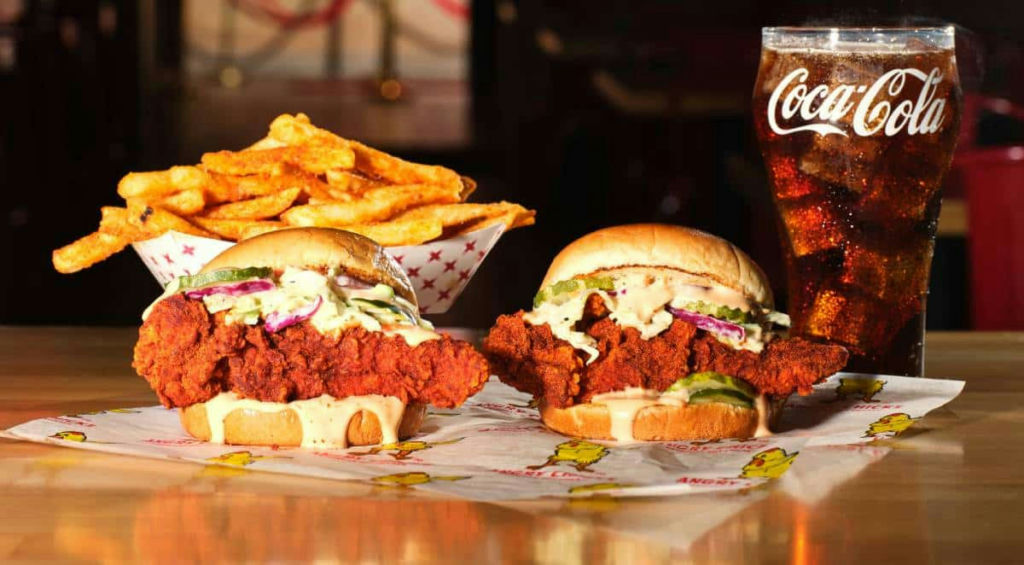
Spicy menu items continue to be successful in the QSR industry, with brands like Slim Chickens and Angry Chickz offering unique and customizable spicy options. Angry Chickz plans to open around 20 new locations in 2026, focusing on growth and laying groundwork for scale.
When Patrick Noone joined Slim Chickens as CMO early last year, he noticed that, despite a market obsessed with heat, Slim’s lacked a true spicy platform. He wanted to “get into the spicy game” but “do it in a Slim’s way,” grounded in variety, customization, and sauces.
To get there, Slim’s partnered with vendors and corporate chef Andrew Ruga to develop a proprietary way to cook spice into the breading so it could be consistently applied to tenders or a chicken breast with even coverage and no bottlenecks.
The work happened in Slim’s Fayetteville R&D kitchen and vendor labs, with consumer panels helping calibrate heat and flavor. Internally, Noone set a target that about 80 percent of guests should say the heat is just right, while 10–20 percent say it’s too hot as proof the product isn’t watered down. Just as important, he didn’t want “empty burn.” Feedback needed to highlight the flavor of the spice blend, too.
Spicy menu success
The launch hit menus as a promoted LTO in November 2025, but what convinced Slim’s to make it permanent was what happened after promotions ended.
“Everybody in this building was stunned how little the product mix dropped after we stopped promoting it,” Noone says. “It outperformed expectations and became one of our most successful menu additions.”
What sets Slim’s apart, he argues, is flexibility. Guests can add spice to tenders, wraps, salads, or mac bowls and still get something that feels like Slim Chickens first, spicy second.
“We’re not just blowing your head off with heat,” he says. “We’re adding a new flavor dimension.”
He’s not dismissing the importance of the burn, though.
“Spice is one of the few things on a menu that guarantees a physical reaction,” Noone says. “You can see it on people’s faces—laughing, fanning their mouths, breaking into a mild sweat.”
That visceral punch is a big part of why spicy food has taken hold in quick service. It shows up on camera and across the table, turning the menu into something interactive.
Social dynamic around spice
“We see younger guests come in as a group and turn heat levels into a challenge—‘I’ve had this one, can you handle the next?’” says David Mkhitaryan, founder and CEO of Angry Chickz, a California-based fast-casual chain specializing in Nashville hot chicken. “It stops being just a meal and becomes something they do together.”
It took five to six years to open the first 20 Angry Chickz locations, but the brand is now entering a different phase. It plans to open around 20 restaurants this year alone.
Mkhitaryan frames 2026 as a “foundational” year focused on growth and laying groundwork for scale, noting most new locations are corporate-owned. That raises the operational bar while giving his team a firsthand view of how that social dynamic around spicy plays out in grand openings and everyday service.
“Spicy chicken is as much a shared experience as a flavor,” Mkhitaryan says. “In the restaurant, you see people comparing plates, filming reactions, and daring friends to go hotter. The heat gives them something to talk about.”
The landscape is vastly different than eight years ago. Mkhitaryan now views hot chicken as a distinct category rather than a niche, with more brands forcing specialists to sharpen execution. This adds pressure to master the fundamentals, starting with the recipe. Before opening, he spent six months tuning the product, obsessing over spice blends so heat would climb without flavor dropping off. He wanted every level to feel balanced rather than just hotter for its own sake.
“In many places, flavor drops as heat increases,” Mkhitaryan says. “I wanted the opposite—the kick you’re looking for without the flavor disappearing.”
He also noticed the category over-indexed on tenders and sandwiches. To carve out a lane, he leaned into bowls, specifically the Angry Mac Bowl: fries, chopped tenders, mac and cheese, sauce, and seasoning. It is now the brand’s top seller, accounting for half of sales in some locations.
Beyond that, he’s been conservative with menu expansion. The core still revolves around tenders, sliders, and bowls. That choice was shaped by time spent in his family’s restaurant, where a large, sprawling menu convinced him that “do everything” concepts struggle to excel.
If the brand carried 10 main items, he argues, “at least a few would be average.” He deliberately sacrifices breadth for depth. Despite outside pressure to add wings or splashy LTOs, Mkhitaryan “cancels out the noise” to focus on items the brand can execute at a high level daily.
Competitor strategies
Another California-based fast casual, Crimson Coward, takes a different tack. Founder Ali Hijazi also spent months perfecting his hot chicken recipe, traveling to Nashville, talking with local chefs, and then turning his garage into a test kitchen where he worked through different oils, cook times, and seasoning approaches until he landed on the flavor and heat profile he wanted.
With that foundation, he’s been a bit more willing than some spicy chicken competitors to venture beyond the core.
Hijazi hammers home scratch prep and the fact that “everything is cooked to order with no pre-cooking or holding on warmers.” That, plus standardized spice blends across all locations, is the backbone of Crimson Coward’s menu architecture. The brand can support a relatively broad set of offerings because they all feed off the same tight, controlled prep system.
That discipline allows for variety without excessive complexity. Most menu items recombine the same core ingredients—chicken, sauces, bread, tortillas, fries, and slaw—into different formats. Tenders become sliders, wraps, burritos, and more. Even additions like a smash burger required minimal new inputs since kitchens already had the supporting ingredients.
The result is a wider-ranging menu—shawarma-style wraps, blooming onions, loaded fries, chicken and waffles, quesadillas, nachos, and wings—built largely from the same base.
The philosophy, he says, is “lots of formats and occasions, minimal incremental complexity.”
That thinking extends to smaller innovations like Crimson Nugs, inspired by watching families cut tenders into smaller pieces for kids. Instead of creating a new product, the team formalized the behavior using existing ingredients.
Crimson Coward is structured around a heat ladder that runs up to “Burn, Baby Burn,” with different peppers at different tiers, including ghost pepper at the top and habanero powder in the hot level. That heat logic applies across formats: whether guests are ordering sliders, wraps, burritos, or loaded fries, they can sit wherever they want on the scale.
“We’re very honest when it comes to heat,” Hijazi says. “Our hot is honestly hot, our medium is an honest medium, and our ‘Burn, Baby Burn’ has ghost pepper in it. People know exactly what they’re getting into.”
Crimson Coward doesn’t add items frivolously, he says. New limited-time offers or variations are tested in different parts of the country first; some never make it to a systemwide launch and instead live on as regional or “secret” offerings. The result is a menu that looks broad to guests but is underpinned by a clear filtering process and a reluctance to saddle operators with unmanageable complexity.
That operating model—scratch kitchen, cook-to-order, simple but tightly controlled systems—is built with franchising and multi-unit growth in mind. Crimson Coward was founded in 2019 and has grown to 20 open stores with five more in development. The brand’s footprint now spans California, Washington, Texas, Illinois, Virginia, and Maryland, with its first Florida location opening this year and more markets on the horizon.
Looking ahead, Hijazi expects more entrants and more exits in the space and says not everyone will survive the shakeout as the category matures.
“There will be some new players and some old players that leave,” he says. “Fried chicken is not going anywhere, though, and the brands that take care of their product and their operations are the ones that are still going to be here in 10 or 20 years.”
In this story
This story was originally published by Danny Klein in QSR Magazine on July 8, 2026. Burnaze summarizes and links to the original reporting.
Read the full story at QSR MagazineLiked this? Get the week's franchise news, explained
- Sunday 8 AM ET weekly + a monthly deep dive
- Sections picked for the industries you follow
- Every claim linked to its source. Free.