TL;DR
SweatHouz, a wellness franchise, is growing rapidly with over 70 units in the US, prioritizing people, health, and innovation in its business model. CEO Mike Tan emphasizes the importance of quality and people in the company's growth strategy, focusing on small teams and strong relationships with franchisees.
Currently valued at just over $6 trillion, the worldwide wellness economy is primed for explosive growth, a valuation expected to reach $9 trillion in the next three years.
SweatHouz is growing alongside it. Founded in Atlanta, Georgia, by Jamie Weeks in 2019, the brand began franchising just three years later. SWTHZ currently operates more than 70 units in the United States.
Delivering an immersive experience within a membership-driven model, SWTHZ supplies health and relaxation, catering to privacy via suites touting an infrared sauna, cold plunge tub and Vitamin C shower.
Prioritizing people, health and innovation, SWTHZ delivers a convenient, personalized wellness experience.
Franchise growth strategy
**“**The people aspect is critical. If you do that well, you can go farther,” said CEO Mike Tan. “Franchising at scale is challenging. It becomes hard to grow quickly and keep the company’s ethos when you have so many variables. I’ve always believed in small teams that do mighty things. That’s true in franchising. If you need to pivot, you can do it together and make great decisions as a smaller organization.”
An emphasis on the importance of quality sets SWTHZ apart as the company continues to grow, delivering a convenient, customized wellness experience in a science-backed environment.
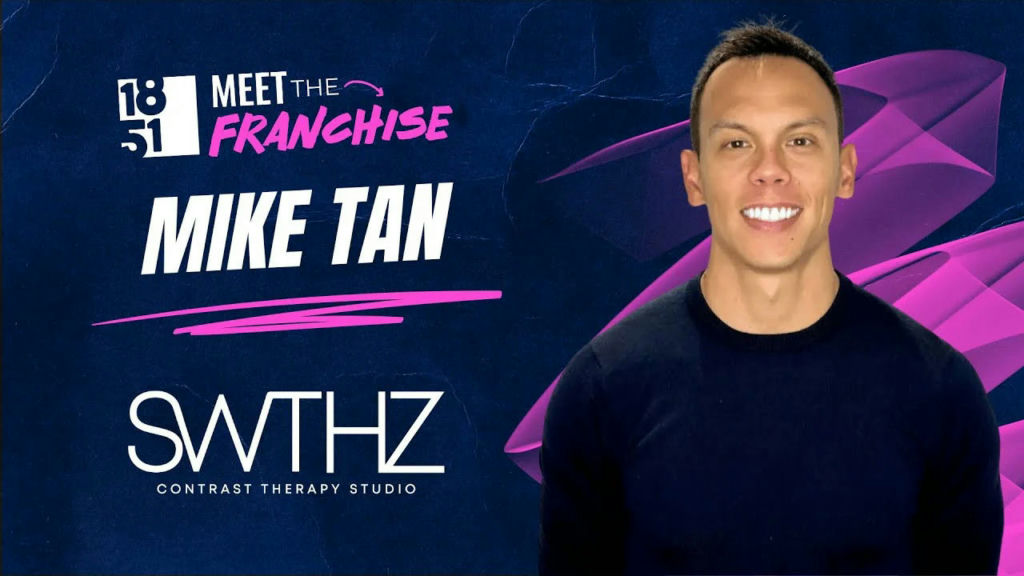
Mike Tan joined 1851 Franchise Publisher Nick Powills on the “Meet the Franchise” podcast to discuss his entry into franchising, lessons learned during his time with Orangetheory and the unique emphasis on quality and people that set SWTHZ apart. A transcript of Tan’s interview with Powills, edited for length and clarity, has been provided below.
Nick Powills: All right, Mike, before we get into business, I want to start with you. So many people watching, live or recorded, are going through some sort of transition, thinking, “What is franchising? Maybe I should join it.” What’s your franchise backstory? How did you accidentally fall into franchising?
Mike Tan: This is exciting. For those of us in franchising, we’ve all landed here through different paths, but mine was absolutely not planned. I got into the wellness industry by complete fluke. I thought I was going to be an investment banker but I got an opportunity from the founder of 24 Hour Fitness to run some of his locations.
Fast forward a few years, and Orangetheory — a brand a few of us had heard of — was scaling quickly and had begun its international expansion. I was recruited to help lead and drive revenue for Canada. What a ride that was.
Of all the growth vehicles, franchising has become one I truly admire and love because you get to work with incredibly successful people and help others become entrepreneurs while building strong brands. You get the best of both worlds.
We like to move fast at SWTHZ, and franchising allows you to move fast too.
Powills: I want to unpack a few things. When you were pursuing investment banking or finance, did you understand franchising’s depth? When did that “Aha!” moment, where you thought, “That’s really good business!” come?
Tan: No, I didn’t.
Franchisee selection process
When I think about the perfect recipe for franchising, it’s great real estate, great systems and incredibly engaged franchisees. That last part is key. You can have all the numbers but, at the end of the day, your franchisees and their teams must drive the mission.
I’ll never forget jumping on my first call with a franchisee who was going through challenges, even though the business was growing. It occurred to me that it had nothing to do with not understanding the business case. It was about the relationship they wanted with the head office.
That lesson stuck with me. The people aspect is critical. If you do that well, you can go farther. They say, “If you want to go fast, go alone. If you want to go far, go together.” That’s very true in franchising.
Powills: I love that. Before I get to a follow-up, let’s jump to your Orangetheory experience because it gives you a unique lens as you look at SWTHZ. Orangetheory was a rocket ship in a category with limited innovation. What did you see there that impressed you? What have you carried over to SWTHZF?
Tan: A lot of us at Orangetheory experienced rapid growth. We went from 15 to 120 units in Canada in less than three years. Jamie Weeks, the founder of SWTHZ, went through similar growth to 150 units.
Being a science-backed business is really important — it’s at the core of what we do at SWTHZ. But franchising at scale is challenging. It becomes hard to grow quickly and keep the company’s ethos when you have many franchise partners.
I’ve always believed in small teams that do mighty things. That’s true in franchising: a few franchise partners who want to do great things. If you need to pivot, you can do it together and make great decisions as a smaller organization.
Powills: You mentioned earlier the importance of the right people. How have you learned to say no — to protect culture and choose the right franchisees?
Tan: Great question. There are two common paths: many franchisees with small territories or few franchisees with large territories. It comes down to your DNA. Some people move fast, some don’t. You can feel that through the process.
We go through the traditional vetting — net worth, experience, all of that — but it really comes down to vision and speed. After 30 or 60 days of conversations, you know in your gut: Do I want to go to war with this person? If the answer is yes, you go with it. That gut has proven right for us so far.
Powills: I was with a client last week who turned down a half-billion-dollar candidate because they lacked hunger. They were afraid the person would stall out. You’re looking for someone financially strong but still hungry — someone playing the game for growth.
Tan: Exactly. There’s a famous Theodore Roosevelt quote about “the man in the arena.” When selecting a franchisee, we’re not just awarding a territory — we’re making a bet that we want to be in the arena with that person. If they won’t be in their building with us, it’s probably not the right fit.
I’m on calls every week with a large portion of our franchisees. That connection is important. We can’t lose touch with what’s happening on the ground. The entrepreneurs we admire most are in the weeds and understand their business top to bottom. We want our franchisees to be the same.
Powills: In business, we’re told to work on the business, not in it. But in franchising, being “in the arena” seems essential. The multi-unit operator who wants passive income might actually be the wrong fit.
Tan: You’re right. Like Tom Brady. He’s not on the sidelines; he’s on the field. If you don’t have your finger on the pulse, you lose the partnership dynamic. Even though we’re HQ, our local market operators — Boston, Chicago, etc. — are the true masters of their regions. You can only own your market if you’re in it doing the work.
Supporting franchisees
Powills: Every brand has a bottom third of franchisees. How do you motivate underperforming ones to get back on track?
Tan: Over the years, we’ve turned a lot of red-flag locations into top performers. They usually have the same real estate and systems but lack engagement. We do sales and marketing audits of 50 to 70 best practices, identify what’s missing and focus on those opportunities. Sometimes, all it takes is someone saying, “I believe in you. Let’s do this.”
It can be lonely at the top. Supporting franchisees through that is crucial. Our ethos is about building a small team capable of incredible things.
Powills: Entrepreneurs are crazy — founders more so than franchisees. Founders see opportunity in storms; franchisees might just see rain. So, when franchisees need that motivator, that culture and support become critical.
Tan: Completely agree. Michael Dell said it takes a lot of “crazy,” but within that crazy are a few great ideas. A founder’s, CEO’s and franchisee’s levels of “crazy” are different, but in their heads they’re living it fully.
We have to recognize that franchising is hard. When franchisees struggle, we can’t dismiss it. We need to support them like we promised when they joined the network.
Powills: When high-net-worth individuals join as franchisees, they often underestimate the learning curve. Suddenly, they’re responsible for HR, operations, marketing and more. Many franchisors under-index on how much support these people actually need.
Tan: Exactly. When someone joins, we want them “in the arena.” Give them tools and space to grow. We sell large territories using a hub-and-spoke model (one main market hub with smaller surrounding locations). It’s important to be local and move methodically, but we’re scaling fast. We just opened Los Angeles and are moving into New York.
Our focus is success in each market — no infighting, just partnership. Business is hard enough without fighting each other.
Technology and innovation
Powills: Before we wrap, I want to talk about technology and your “moat.” When you build a moat, competitors can’t easily get in. Talk about that and the business opportunity for potential franchisees.
Tan: It took us six to eight months to figure out how to build a contrast therapy suite in 75 square feet. It’s hard. You have a sauna at 170 degrees, a cold plunge, motors, condensation, heat management — it’s complex.
We can now monitor every plunge across our network: flow rate, temperature, water height — even if someone only dips a toe in. This helps us improve the experience and reward engagement.
Our moat starts with engineering, extends to hardware and carries into customer experience. That’s how we acquire and retain customers, boost lifetime value and drive the mission. The best way to stay number one is to keep innovating and building for scale.
Powills: Final question. What do you want potential franchise buyers to know about the opportunity?
Tan: I’ve never heard anyone say they dominated a category by being the last one in. There’s always risk, but when you join a proven team that scales quickly and builds enduring value, you position yourself for success.
If you want to be a man or woman in the arena, care about wellness and see the metrics, let’s talk and see if it’s the right fit.
Powills: Well said. This is still early, even though the science behind heat and cold therapy has been around forever. This is going mainstream for everyday people, not just athletes. When Massage Envy built a membership-based massage brand, it changed the industry. SWTHZ has that same potential, but with a stronger science-backed foundation and a real moat.
When I heard you speak, I thought, “That’s how a unicorn brand is created.” Early adopters are pioneers, betting on the jockey, not just the horse.
Mike, thank you for your time.
Tan: Thank you, Nick. And I want to thank our incredible franchise partners and HQ team — we wouldn’t be here without everyone. Onwards and upwards, as they say!
In this story
This story was originally published in 1851 Franchise on October 21, 2025. Burnaze summarizes and links to the original reporting.
Read the full story at 1851 FranchiseLiked this? Get the week's franchise news, explained
- Sunday 8 AM ET weekly + a monthly deep dive
- Sections picked for the industries you follow
- Every claim linked to its source. Free.