TL;DR
KFC is expanding its specialty beverage extension, Kwench by KFC, to over 3,000 restaurants by the end of 2026, with a £38m investment from KFC and its franchise partners. The brand has seen success with Kwench, with over 90% of users saying they 'loved' the new drinks and half saying they'd visit KFC specifically for them.
Dhiren Karnani noticed a guest behavior that’s become a common tale in QSR. Beverages are often now a price of entry. Yet how does that manifest at a legacy chain like KFC, as synonymous with its hero product (not drinks) as any retail operation in the country?
Karnani, who elevated to the role of senior director, global head of food and experience at KFC Global in May, promoting from global director, next generation KFC and new concepts, says the aim started from the first observation and found its way to the second. Could KFC get customers to come for drinks and stay for chicken?
Kwench expansion plans
Earlier in the year, the company began materially expanding “Kwench by KFC,” a specialty beverage extension that first ran across 38 stores. Success led to visions through the U.K. and Ireland over the summer and, as Yum! Brands shared in Q4, a 3,000 or so restaurant outlook by calendar-end 2026.
Kwench appreciated a splashy “thirst-trap” Canadian launch in August, and, more recently, backed by a £38m investment from KFC and its franchise partners, set course for Scotland. The Middle East and other global markets are lining up, too.
Fueling Kwench are those same outset points. One, the market, from upstarts to drive-thru coffee concepts to large fast-food enterprises such as Taco Bell and McDonald’s, is responding to a surge of a specialty options capturing demand from energy to dirty sodas to refreshers. The other note is more than 90 percent of Kwench users in tests said they “loved” the new drinks and about half shared they’d visit KFC specifically for them. So, as Karnani and the brand hoped, customers came for Kwench, even if they weren’t, perhaps, showing up for chicken. That opened possibilities.
“That’s actually what we’re seeing laid out,” says Karnani, who joined Yum! in 2017 as a senior brand manager for KFC U.K. and Ireland, “where this is definitely creating a halo and overall transaction growth. And that’s creating a lot more confidence to the system when it comes to Kwench. So, we’re really going deep on building this.”
Beverage innovation
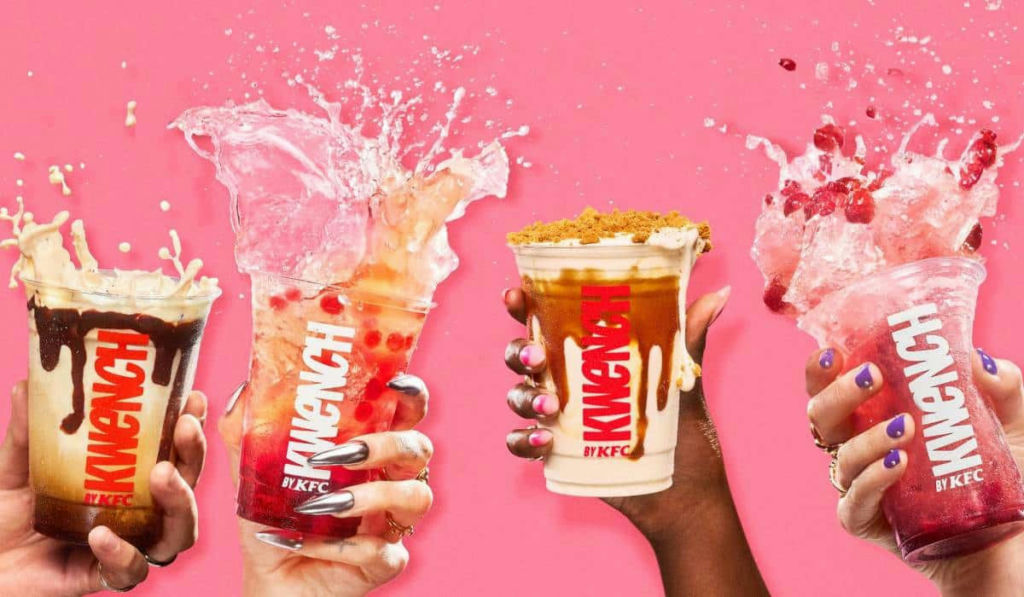
As Kwench matures, it’s broadening innovation. KFC added Matcha about a month ago, made with PerfectTed ceremonial grade tea and vanilla syrup, strawberry puree, and shortcake crumb.
Karnani says matcha has become a category, like iced coffee was for younger consumers, needed by brands to signal you’re a beverage destination, especially later in the day. It’s evolved toward less of a menu alternative and more of a complement.
Kwench, largely speaking, aims to “create the favorite version of the drink they already love,” Karnani says. With an item as buzzy as matcha, it meant partnering with a company like PerfectTed and delivering satisfaction on something familiar. “The reaction on social has been amazing,” he says. “People are like … ‘I can’t believe I am getting this matcha quality from KFC.’ And that’s exactly what we would want.”
Karnani adds Kwench will keep tinkering with categories—today the brand has shakes, lattes, like an Iced Tiramisu, sparkling lemonades, and boba.
A key, he explains, being to keep Kwench’s focus relatively narrow. “How do we really go deep in the categories where we have a clear right to play?” Karnani says.
Meanwhile, Kwench will create new news for categories people recognize. Currently, its Krunch Shake, caramel milkshake drizzled with caramel sauce, and topped with a krunchy speculoos crumb, is the brand’s top seller. Playing off a “Downright Dirty Meal” that arrived in the U.K. with “dirty items,” from loaded fries to a Louisiana burger, Kwench spun the item into a “Dirty Millionaire” version with chocolate cookie crumbs and chocolate and caramel sauces.
“That’s another way we’re bringing new news into the platform, where it’s fully integrated into the menu concepts,” Karnani says.
As for how trends are moving, he continues, Kwench saw a lot of a la carte purchases in the beginning. Trial driven by curiosity. Now, though, attachment is climbing. In Australia, one in every five visits comes with a Kwench drink.
And that, Karnani says, keeps lifting as Kwench rolls to more locations and supports with media.
The chain has also seen guests return for different drinks. The portfolio was designed to cover various need states and encourage frequency. “It’s not a one-off,” Karnani says. That same guest grabbing a shake can retap Kwench for coffee.
Sales and growth
While Kwench still over-indexes in the afternoon—an expected result—Karnani says orders are growing steadily. “It’s improving AUV for the brand,” he says. “And that’s what’s exciting for franchisees—that it’s not just a daypart play. We’re really seeing transactions throughout the day.”
Another reality of beverage, Karnani adds, is it’s easier to innovate than food. Kwench can swap flavors much quicker than adjusting menuboards, namely when it comes to calendar reactions. Kwench can be seasonal in a far more agile manner. Can it respond to summer? Fall? The answer, in plain terms, Karnani says, is “yes.”
“And start to create rituals around that,” he notes.
KFC developed Kwench so restaurants could move quickly as preferences do. It was ideated out of the gate to fit into every existing restaurant (of which there are 33,000-plus for KFC globally). Kwench mapped as a small footprint, high-yield opportunity, down to the equipment and automation included.
Karnani says KFC obsessed over ergonomics. It’s essentially a 2-and-a-half-foot space where employees create a suite of drinks in under 30 seconds apiece. Some take closer to 10. And employees need roughly 30 minutes to get trained. “Because we had those baked in,” Karnani says, “we’re getting great consistency.”
Omnichannel represents Kwench’s other layer. KFC used its scale and learnings to develop packaging ideal for travel. Karnani says there are plenty of stories in QSR of customers trying to get drinks and having them spill over. The refund rate with Kwench, he shares, is less than 1 percent.
Like the model itself, upfront investments for off-premises paid off on the backend. Couple that with what other peers chase via beverage—margins—and the KFC system is complying quickly. Not only that, Karnani says, but operators aren’t angling for shortcuts. “Everyone is really taking it full sail, which is amazing,” he says.
Brand transformation
Kwench is a central cog in KFC’s ongoing transformation. The brand in June unveiled a fresh chapter anchored by boneless chicken, sauces, a reworked brand identity, including a modern restaurant design (check out the U.S. update here), logo, and more. Kwench sales have more than doubled since the pilot. KFC told QSR magazine previously management believes there’s “enormous growth” in beverages. “We see it in the data,” the company said.
From a brand angle, it enables KFC to reach younger consumers. These guests love posting on social and don’t mind spending for specialty drinks.
“But the biggest beverage opportunity for us is it opens new occasions to use the brand,” the company explained. “People don’t often come to us for those snacking occasions. Having Kwench enables us to do that and we’ve been very intentional. We didn’t want to just create products; we wanted to create a new sub brand, which really signals that we are a serious beverage player.”
Karnani’s new role six months ago reflected this mindset as well. It expanded a position around food innovation to tack on “experience innovation.”
This marked the first time, he says, KFC structured a title where the two avenues intertwined. It made sense, Karnani notes, since “the way you experience the brand is through the food.”
“And how do we make sure we’re really thinking about that in our modernization efforts,” he says, adding it covers restaurant design, tone, culinary, and everything between the edges.
Overall, he finds the fact food is so central to KFC’s coming chapter a development worth amplifying. KFC has worked under CEO Scott Mezvinsky (the former Taco Bell president was promoted in January) to “build brilliance at scale.”
“We’re closer than ever now as a brand going after a similar direction,” Karnani says, “when we think about our commitment to the best tenders as our modern hero format; the sauce that’s we’re now rolling out across our top 20 markets.”
KFC still encourages local flair, he says, but it’s paying added attention to how it can adopt a win seen in one market and translate it to another, like Pickle Mania, which erupted in Canada and spread to the U.K., Australia, and France. “I think that’s what’s exciting,” Karnani says, “is we’re really behaving as one system without switching too much into a local platform.”
Kwench, like its thirst trap campaign with agency Courage, aligns with KFC’s ability to be bold and playful. The brand is a challenger in some markets and breaks through by being distinctive and relative (part of Yum!’s R.E.D. strategy; the “E” standing for “ease.”)
“That’s something we’re keeping really consistent about Kwench,” Karnani says. “The way we show up needs to be distinctive and cut through to match the amazing product lineup, because what we really need to resolve in consumers’ minds is, I’m coming to a chicken brand for beverages.”
In this story
This story was originally published by Danny Klein in QSR Magazine on October 14, 2026. Burnaze summarizes and links to the original reporting.
Read the full story at QSR MagazineLiked this? Get the week's franchise news, explained
- Sunday 8 AM ET weekly + a monthly deep dive
- Sections picked for the industries you follow
- Every claim linked to its source. Free.