TL;DR
Church's Chicken has achieved its first net domestic unit growth since 2010, with a 60% increase in average unit EBITDA since 2022, and is ready for its next growth phase with a significant investment from Golub Capital. The investment will provide capital to propel the brand's growth, including expanding its remodel program and opening new company-operated restaurants.
Church’s Chicken CEO Roland Gonzalez knows momentum can be tough to grab in this business. When you find it, you have to capitalize. “And that’s really what this is about,” he says.
The 74-year-old brand has “really been on fire the last few years,” says Gonzalez, who elevated from COO to CEO in February 2025, and previously served as EVP and COO of Virtual Dining Concepts and head of global operations standards and strategy with Burger King parent Restaurant Brands International.
Sales are up 6 percent so far this year. Traffic is 7 percent higher. Average unit EBITDA climbed 60 percent since 2022 and Church’s in 2025 posted its first net domestic growth result since 2010, lifting by 12 outlets (it grew by 25 that decade-plus ago). The brand retracted by 27, 25, and 72 stores in the prior three years, respectively, sliding from 1,000 at the start of 2022 to 873 before 2024. Church’s exited 2025 with 885 (163 company run and 722 franchised). Both its franchised (bump of eight) and corporate footprints (growth of four) expanded in 2025.
Gonzalez says Church’s will open 100-plus international stores this year as it builds on a 25-plus market base. But it’s the U.S. picture that’s hit an inflection.
Growth investment plans
And on Tuesday, the brand unveiled how it plans to further ignite that trajectory with a strategic equity investment from Golub Capital. The deal, Church’s said, will provide “significant” capital to propel its next growth phase.
Golub’s investment does not alter Church’s ownership structure. It remains directed by High Bluff Capital Partners, which bought the legacy chain in 2021 from FFL Partners, and Future Standard. High Bluff is the same firm that established REGO Restaurant Group in 2018 with the acquisition of Quiznos and Taco Del Mar.
What Golub—a company that’s provided financing to Church’s in connection with two separate transactions since 2024—will bring is kindling, Gonzalez says. Namely, with the ability to expand Church’s remodel program (known as Blaze) and jumpstart company-operated openings, including through markets with a proven track record of success, like a recent Philadelphia Metro reentry that set opening records.
Recent performance gains
Before getting into some of what’s in-store, Gonzalez outlined how Church’s got here.
From 2021 forward, average franchisee restaurant sales increased by more than $200,000, translating to north of $55,000 of additional profit per restaurant.
Church’s modernized its supply chain and tech platforms, refocused menu and marketing around core guests, and launched a proprietary digital app and loyalty program in 2024 that’s topped 2 million members. The brand is nearing completion of a chain-wide rollout of a single point-of-sale as well.
Church’s leaned further into George W. Church Sr.’s founding premise of serving quality food at great value for underserved communities. For instance, promotions like a $3.79 Texas 2 Piece Feast.
Last year, Church’s U.S. systemwide sales closed at $862 million on average-unit volumes of $1.138 million. That compared to $847 million and $1.097 million, respectively, in 2024.
Globally in 2025, Church’s clocked more than $1.6 billion.
From year-end 2021 through Q1 2026, Church’s U.S. same-store sales growth upped 19 percent on traffic expansion of 6 percent.
The remodeling corner of Church’s ascension can’t be understated, Gonzalez says. The company has upgraded more than 400 units over the last few years. Golub’s infusion opens the gates for more.
And as explained, it gives Church’s the chance to bring a lot of them forward in company-run restaurants, current and prospective. On one hand, Church’s can accelerate older assets and reap the benefit of improved operations and design. But additionally, Church’s expects to seed new markets.
Gonzalez says the goal will be for Church’s to open “three or four” restaurants and then have a franchisee come in and grow out the rest of the area.
The Philly Metro spot, in one case, was a market consumers anecdotally asked for since the brand left 14 years ago. The unit is tracking toward $2 million in annualized volume. Church’s is planning a second this August and a third by year’s end.
It’s also eyeing Cleveland and Baltimore. “All of these places don’t have Church’s,” Gonzalez says. “And we want to be able to go there and go there faster.
This [investment] helps us do that. That way, this will turn into more restaurants because the new franchisees will come in, purchase great assets, and we’ll give them what they need to grow the rest of the market out.”
One thing about Church’s Blaze program, Gonzalez says, is it’s been a stable effort. It doesn’t resemble some other iterations he’s seen where remodels cycle and recycle. Church’s has followed the Blaze path since 2020.
The update focuses on warmer first impressions with textured wood panels and red portals and gold tower accents. There are larger, “heritage murals,” and functional layouts with ordering and pickup areas built for customer flow. Church’s adds digital menuboards and offers Blaze in compact (1,000 square feet with no dining room), 1400 (1,400 square feet), conversion, and end cap models.
Gonzalez says it’s not uncommon to see 15 percent-plus lifts. “One of the reasons we’ve been able to do it so fast is not just because of compliance from franchisees but because it’s just good business,” he says. “So, when I look at that I’m like, we need to make sure that we continue to enhance but we don’t need to roll out a new program every couple of years. How do we build on the Blaze platform?”
A recent answer was to hyper localize openings with murals painted by nearby artists. That’s more of what you’ll see, along with optimized costs. Church’s will get smarter with small details like chairs and décor, lowering the cost for operators while getting the best ROI on experience. “I’m not changing things for the sake of changing things,” Gonzalez says. “Having consistency as we do these remodels is better.”
And truth is, given Church’s is a 74-year-old system, refreshing often carries an outsized impact.
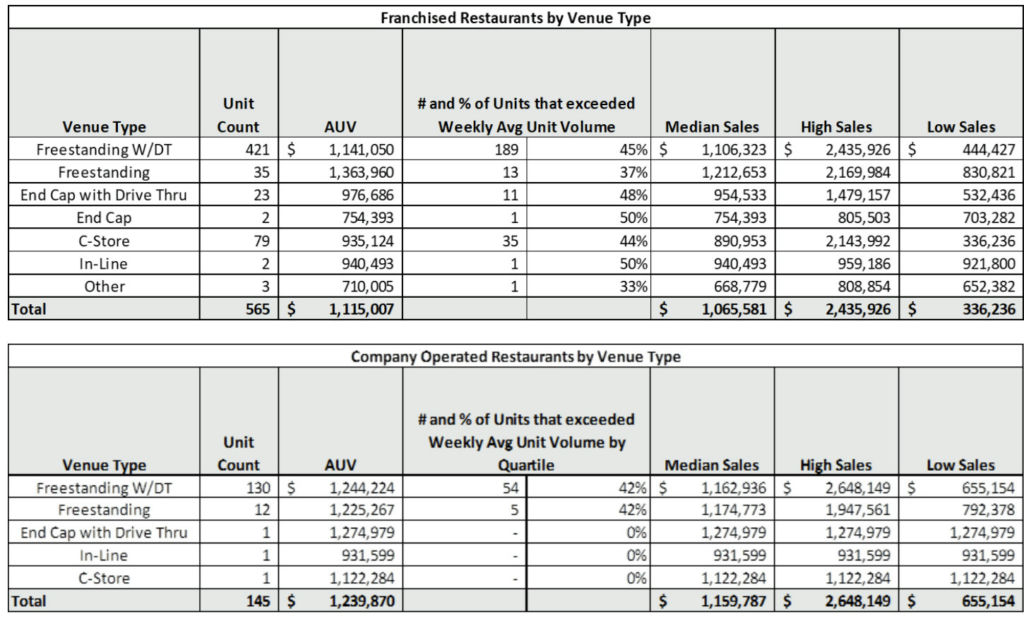
As of December, there were 722 franchised Church’s and 163 company. Below is a look at how 565 franchised and 145 corporate restaurants performed by venue type. “Other” is a distinction for food courts and conversions.
This breakdown shows historical average income statements for domestic freestanding company and franchised units, of which 752 were included.
And here’s a look at C-store venues, franchised and corporate. It’s a pool of 45 from 82 overall.
Now, into Blaze, which today covers about 60 percent of franchised restaurants and is expected to reach nearly 80 percent by year’s end.
Church’s shared financial performance for 44 reimaged to the full Blaze approach during 2024 or 2025. Excluded are 14 C-store, food court, and end cap locations. The baseline rub is average annual sales climbed about $80,000 post-change.
Church’s had 698 domestic freestanding drive-thrus by that date, too. This shows gross sales for 551 of them.
AUVs by region:
And how AUVs have tracked through recent developments. Church’s has grown AUVs for three straight years, or about 20 percent overall.
Church’s in 2025 opened 21 franchised restaurants (a material step-up from seven and six in 2024 and 2023, respectively) and terminated one (down from seven in 2024 and 16 in 2023). The chain also had 12 units cease operations for other reasons after 20 in 2024 and nine the year prior.
Church’s opened five corporate restaurants (four in 2024 and zero in 2023) and closed one (after two apiece in 2024 and 2023).
It’s projecting 23 new franchised outlets in 2026 alongside five company. Most of that growth is slated for its origin market of Texas (nine). The brand today is headquartered in Atlanta.
Value driven strategy
Since Gonzalez became CEO, he’s let Church’s value DNA guide decisions. That just so happened to coincide with a larger QSR frenzy in the face of inflationary pressure.
Church’s didn’t need to retreat on pricing like some. The brand’s value was embedded.
It gave leaders an opportunity to dig in versus search for an identity. So, with the aforementioned two-piece Feast, Church’s asked what might happen if it offered a three-piece version and upselled? The chain saw more than 50 percent of customers buying the former switch, which helped drive check.
Gonzalez then looked around the landscape and observed a bevy of $6 or $7 box price points. Church’s came in at $5 and loaded up on abundance. “Blew the doors off,” Gonzalez says. “And that’s why our traffic is so high.”
Church’s has kept this core-customer lens intact. In one instance, it realized the value of paper coupons despite media so often shifting toward digital.
When the brand launched rubs—an idea it borrowed from international LTOs—Church’s implemented the company’s first national coupon drop “in a very long time,” Gonzalez says.
It helped Church’s explain the product and how customers could put flavors like lemon pepper, buffalo, and Smokehouse “on anything.” But it also married the news with value and inspired trial. Gonzalez says the effort raised the “whole tide” because you had people coming in for different reasons.
In all, it’s been a mix of innovation, deals, reliable price points, and the strength of family meals reinforcing Church’s category positioning.
“You get to a point where you’re comping over some big numbers,” Gonzalez says, “and you ask, what are some things we haven’t done before. And when I learned about couponing, national coupon drops had been something we had gone away from in the past, I was like, we need to bring that back and it’s been a big success so far. Sometimes, the simplest things have the biggest impact.”
Church’s recent success is hardly a flash-by. Gonzalez sequenced the foundation before igniting marketing. First, operations had to run better. Then, stores had to look nicer. Employees needed to be better trained. Corporate had to build the right team.
Now, when guests arrive after, say, a massive coupon send, they’re entering an experience they’ll return to.
“Same thing with this investment from Golub,” he says. “We’re able to execute the seed market, or the remodels, or all the things we’re doing because we have the right executive team that can lead the way on that.”
“The sequencing of everything,” Gonzalez adds, “the way it’s happened for us, has been very intentional. But it’s worked out well in the way we’ve planned it because you’ve got to walk before you run and I’m happy to say we’re in this running stage now, finally, where it’s growth mode.”
On leadership, Church’s recruited industry vet Bobby Morena as CDO in November to focus on U.S. development. He was working in the same capacity at multi-brand giant GoTo Foods and previously served as director of franchise development at Inspire Brands (all Atlanta-based companies). Further, Morena clocked nearly 20 years at Jimmy John’s overseeing franchise expansion before the company was acquired by Inspire.
Morena’s early target was to foster a development team focused on data-driven site selection and market planning.
Tim Waddell, formerly VP and managing director of international development at Inspire, has directed Church’s overseas business for the past four or so years. The company has opened 60–70 new stores per year outside the U.S. during his tenure and claims a development pipeline of more than 1,500. Franchisees are growing across the Americas, Asia Pacific, and the Middle East.
That’s led to expanded commitments, including more than 1,000 globally over the past three years through Europe, the Middle East, Asia, and the Caribbean, as well as a 600-unit promise to enter China.
Operational improvements
Church’s has begun to roll a back-of-house smart kitchen Gonzalez says already improved speed of service by more than a minute. And that’s no mean feat, he adds, given the brand is doing so while also posting traffic growth in the mid-single digits.
It’s achieved gains through menu simplification, better procedures, and more of the blocking-and-tackling Gonzalez likes to champion as a CEO who came over with COO roots.
The company invested in AI through these fronts and when it comes to projections and demand. Internally, HQ is using AI to become more efficient with data and learning ways to query prompts so it can get information faster to franchisees and make better corporate decisions.
Personally, though, Gonzalez feels his career led up to this moment in Church’s history. He spent years working cross function and collaborating with leaders from supply chain to marketing to operators. Gonzalez has had to use all of those stops to inform growth from the top of the C-suite—his first CEO position.
A year-and-a-half in, Gonzalez isn’t a rookie anymore. He says the key has been support from colleagues and continuing to develop what he feels is as good a staff as any in the business. “It’s not an accident, the results that are being had with this team,” Gonzalez says.
“…I think I have a certain peace about me, even though there’s a lot of things moving fast and a lot of decisions to make,” he continues. “There’s a certain peace behind me that I’m exactly where I’m supposed to be at the right brand with the right people and with the right plan. That’s the best way to put it.”
And perhaps most importantly, Gonzalez feels Church’s has the foundation to keep lapping its own bar. “What gives me confidence is our operations are so sustainable now,” he says, adding the brand is setting records for guest satisfaction. “The people coming back are having better experiences.”
In this story
This story was originally published by Danny Klein in QSR Magazine on July 28, 2026. Burnaze summarizes and links to the original reporting.
Read the full story at QSR MagazineLiked this? Get the week's franchise news, explained
- Sunday 8 AM ET weekly + a monthly deep dive
- Sections picked for the industries you follow
- Every claim linked to its source. Free.