TL;DR
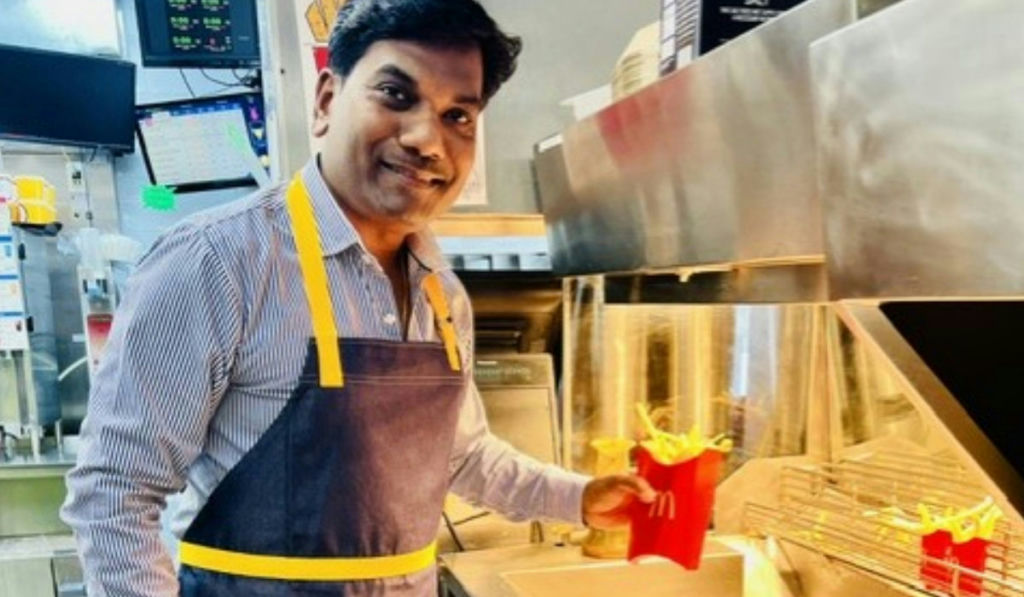
Andy Kumar, who arrived in the US in 2000 with limited funds, built a business portfolio of 22 McDonald's restaurants across North Texas. He started by working at a gas station, then owned convenience stores and eventually became a McDonald's franchisee, leveraging his experience to expand his business.
Andy Kumar arrived in the U.S. in 2000 with a law degree, a science degree, and roughly $380 from selling his motorcycle in India. He expected to visit his brother in Fort Worth, Texas, before returning home to pursue a legal career.
Instead, the trip changed his future.
Kumar explored attending law school in the U.S., but completing the necessary coursework would cost approximately $75,000. Without the money to continue his education, he took a job at a gas station where his brother worked.
The position was far from the career he envisioned. It also provided an education that would eventually help him build a portfolio of 22 McDonald’s restaurants across North Texas, with three additional locations under development.
Early business lessons
During his first five years in the country, Kumar learned how to operate a convenience store, communicate with customers, and navigate American culture. He learned Spanish, familiarized himself with football and baseball, and discovered how relationships with neighborhood customers could influence a business’s success.
He also came to appreciate the importance of supporting the communities where he worked.
“That five years was really good groundwork that happened to me, and I thank for myself being stuck in that position or being at the gas station because it really helped me with business skills,” Kumar says.
By 2005, Kumar was overseeing three convenience stores and had developed enough confidence to purchase a struggling location in a predominantly Hispanic neighborhood. He eventually grew its annual sales from approximately $380,000 to $1.6 million.
His business interests expanded to five gas stations by 2010. He also began purchasing single-family homes following the housing market collapse, eventually accumulating a portfolio of 80 properties.
But Kumar wanted another opportunity to build a business with greater expansion potential.
McDonald's franchise journey
Around 2013 and 2014, he began researching restaurant franchises. Sitting at a computer inside his gas station, he submitted applications to McDonald’s, Burger King, Jack in the Box, Chick-fil-A, and several other chains.
McDonald’s eventually invited him to interview in Arizona.
“I don’t know if I fit into the profile of a candidate you’re looking for or not, but I’ll tell you one thing. I am very happy at what I’m doing currently. If I don’t fit into your profile, there’s no problem, well and good,” he recalls telling the interviewer.
The selection process lasted more than a year and included a three-day restaurant evaluation. Kumar subsequently completed 17 months of part-time training, often working 16- to 18-hour days between McDonald’s and his convenience store business.
He qualified as an owner-operator and acquired his first McDonald’s in Dallas in 2017.
The restaurant was located in a challenging neighborhood, needed substantial reinvestment, and produced approximately $1.8 million in annual sales. Kumar accepted the opportunity despite the operational difficulties.
His early experience operating convenience stores had prepared him to work in demanding environments. The transition to McDonald’s, however, introduced a different level of complexity.
A gas station might employ four or five people. A McDonald’s restaurant could have 55 to 75 employees, requiring Kumar to develop new skills in communication, personnel development, and restaurant operations.
He also discovered the advantages of joining an established franchise system with standardized procedures and support from the franchisor.
“McDonald’s has a playbook. I don’t have to question too much on the playbook. The wheel’s been invented. I don’t have to go reinvent. I just have to read it and practice it and make sure it’s get followed in the restaurant,” Kumar says.
His first restaurant experienced approximately 22 percent sales growth over a period exceeding 20 months, helping establish his credibility as an operator.
Expansion followed. Kumar acquired four additional restaurants the following year, five more in his third year, and another six in 2021.
Many of the locations presented operational challenges, including low sales volumes, difficult neighborhoods, and significant capital improvement needs. Kumar viewed those circumstances as opportunities to apply the skills he developed during his convenience store career.
His involvement extended into the early morning hours. He recalls responding to broken windows, an armed robbery, and customer disputes that required his personal intervention.
During his earliest years as a franchisee, Kumar and his wife also worked restaurant shifts, taking orders and preparing sandwiches when staffing was insufficient.
Today, his responsibilities have expanded considerably, but he continues to prioritize regular restaurant visits and direct engagement with employees.
Expansion and leadership
That visibility is particularly important as Kumar prepares to open three additional McDonald’s restaurants, with openings targeted for November, December, and March, according to his development schedule.
He has already identified general managers and supervisory personnel to support those openings, accepting the additional payroll expense before the restaurants begin operating.
His preference is to promote existing employees who understand his expectations and have demonstrated the potential to advance.
Each restaurant’s general manager is expected to identify at least one employee who could eventually assume a larger role. Kumar evaluates candidates based on initiative, communication skills, and their willingness to accept additional responsibilities.
“You can make a best worker, the fastest one to make a sandwich, but other skills like people skill, the way they talk, the way they are willing to do things above and beyond—those are the things can only be observed,” he says.
One employee who began as a crew member now operates a restaurant producing more than $6 million in annual sales. Kumar says the location previously recorded approximately $4.7 million before reaching its sales target within two years.
He uses financial incentives to recognize employees who achieve ambitious performance goals, sometimes allowing recipients to choose between a lump-sum reward and monthly payments.
Developing talent internally also gives Kumar flexibility when restaurants experience turnover or new opportunities arise.
That operational preparation comes during a difficult period for restaurant operators, particularly those serving customers with limited discretionary income.
Kumar says consumer spending pressures, elevated borrowing costs, and household financial constraints have made affordability an essential consideration across the McDonald’s system.
He serves on the North Texas McDonald’s cooperative board, where franchisees participate in decisions concerning regional value promotions.
The company’s $5 meal offering and digital promotions have become important tools for attracting customers who might otherwise reduce their restaurant visits.
Kumar encourages employees to introduce guests to the McDonald’s app, which provides additional discounts and incentives. He also sees opportunities to increase average checks through add-on purchases.
His priority, however, is driving sufficient customer traffic to make discounted offerings economically worthwhile.
“I’m going to sell it for $5, but I want hundreds of them. So now the question is, are we able to drive those 100 transactions? Then only you’re going to see the value of the value in the books,” he says.
Growth and legacy
Kumar’s growth from one struggling restaurant to a 22-unit operation represents a substantial transformation from his early days in Fort Worth.
He now has a seven-person senior operating team and established systems to support his restaurant portfolio. Even so, he continues working long days, typically beginning around 7:30 a.m. and finishing at 6:30 p.m.
His experience has also influenced the advice he offers aspiring entrepreneurs, particularly immigrants who arrive in the U.S. with limited financial resources.
Kumar credits consistency, education, personal accountability, and the willingness to develop new skills as important contributors to his success.
He encourages employees to consider how improving their abilities can create opportunities for higher earnings and career advancement.
Looking back, Kumar says his accomplishments have exceeded anything he imagined when he first arrived in America.
He also believes recognition and advancement come from the quality of an individual’s work, even when that effort is not immediately rewarded.
“If you’re working hard, don’t just do it for the sake of showing it. Just do it silently—just because you believe in that. You will be noticed,” Kumar says.
In this story
This story was originally published by Ben Coley in QSR Magazine on October 23, 2026. Burnaze summarizes and links to the original reporting.
Read the full story at QSR MagazineLiked this? Get the week's franchise news, explained
- Sunday 8 AM ET weekly + a monthly deep dive
- Sections picked for the industries you follow
- Every claim linked to its source. Free.