TL;DR
Australian frozen yogurt chain Yo-Chi is set to make its US debut in Dallas in September, with a second location to follow by the end of the year. The chain, which has about 75 units in Australia, aims to grow across the US with its unique community hub concept.
Amid what appears to be a new wave of interest in frozen yogurt, the Australian chain Yo-Chi is scheduled to make its United States debut in Dallas next month.
Founded in 2012 in Melbourne, Australia, Yo-Chi has about 75 units in Australia, and moved into Singapore last year, followed by expansion to London earlier this month. The Dallas location is scheduled to open in mid-September, with a second soon to follow there, which is expected before the end of the year.
Ollie Allis, co-owner and chief brand officer, sees an opportunity to grow the brand across the U.S., especially given what he argues has been as a froyo revival globally.
New Yorkers are standing in long lines for new brands like Myka, a franchise concept from Madrid; Culture, a brand created by a former Bouchon Bakery pastry chef; Mythos (Greek-style with 15 units globally); and Mimi’s (founded by an Australian ex-pat).
Greek-style concepts are also popping up in Chicago. The chain Go Greek Yogurt has been growing its shops around the U.S., but also in the Middle East and London. And the premium ice cream shop Van Leeuwen earlier this year added frozen yogurt to its lineup.
Meanwhile, the picture is divided among legacy froyo shops in the U.S.
The 202-unit Yogurtland and 296-unit Menchie’s grew sales last year by 3% and 10% respectively, but their unit counts stayed flat. Pinkberry sales also were up more than 3% with an increase in units to 62, from 59 the prior year, according to Technomic data.
TCBY, however, saw sales decline by 9% last year, and the chain’s unit count shrank by 10% to 115. SweetFrog also contracted, with sales down 2% and the unit count dropping to 203 from 206.
Yo-Chi, however, brings something different to the froyo landscape, Allis said.
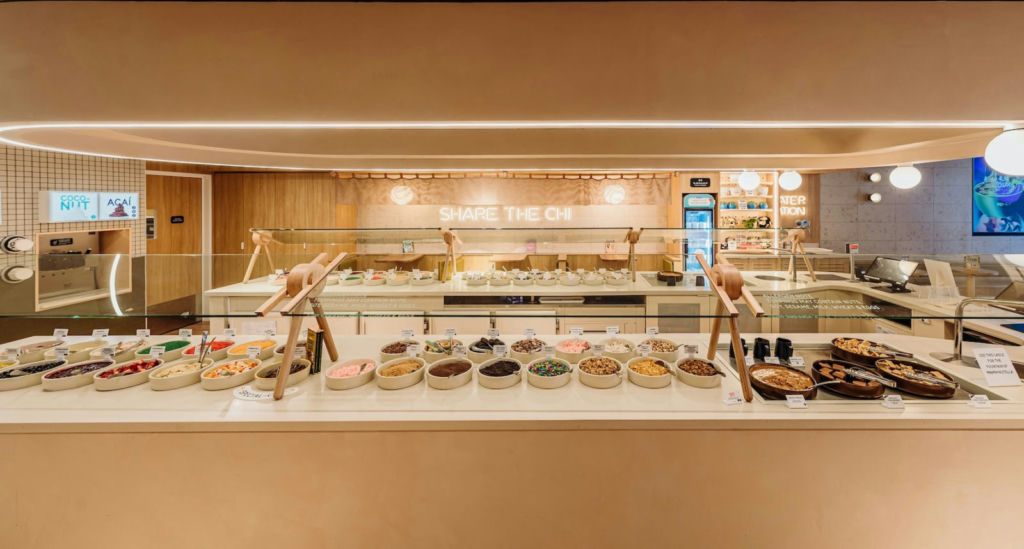
Yo-Chi units are designed to be community hubs, or alternatives to bars, where young people can gather and spend time with friends in a non-alcohol environment, he said.
“Unlike other frozen yogurt or dessert shops, we want to create huge venues where people can hang out,” said Allis. “We’re fulfilling a need for young people for a hangout spot that’s not a bar or café. It’s someplace you can sit, you can buy or spend as much or as little as you want, because it’s all self-service, and then you can sit there.
“We call it ‘Yo-Chi and yap,’” he added. “You can gossip away with your bestie for as long as you want. We find in Australia that people choose Yo-Chi as their night out on a Friday or Saturday night.”
In Australia, shops have DJs on the weekends, and disco balls, Allis said, and the plan is to bring a similar vibe to the U.S.
Yo-Chi units offer 10 flavors from five self-serve machines, with seasonally rotating flavors. The froyo is made from real California milk, rather than a powdered mix, though there are also non-dairy options and açaí.
There’s an extensive topping bar with more than 40 options, including ingredients like mini mochi, pistachio spread, fruit pearls, scoopable cookie dough, and a hot bar with warm brownies, premium sauces, and a Nutella fountain.
Customers pay by weight, ($1 per ounce), and Yo-Chi offers reusable bowls that guests can bring for a 10% discount to cut down on waste.
Yo-Chi was originally founded by Australian billionaire toy maker Manny Stul. But it was acquired by Allis and his father in 2019. Allis’ parents also founded and built the Boost Juice smoothie chain in Australia, which has more than 763 stores, according to its website, though Allis said the family has “sold down” to focus on Yo-Chi.
In Australia, all Yo-Chi locations are company owned. But Allis plans to look for local joint venture partners to continue to grow the Yo-Chi brand in the U.S.
“We want to prove the two in Dallas, which is super important for our brand, our confidence and everything,” he said. “And then once we feel comfortable, we’ll open in other markets. But we are very comfortable opening simultaneously in different markets.”
Members help make our journalism possible. Become a Restaurant Business member today and unlock exclusive benefits, including unlimited access to all of our content. Sign up here.
Lisa Jennings is a veteran restaurant industry reporter and editor who covers the fast-casual sector, independent restaurants and emerging chain concepts.
In this story
This story was originally published in Restaurant Business on August 28, 2026. Burnaze summarizes and links to the original reporting.
Read the full story at Restaurant BusinessLiked this? Get the week's franchise news, explained
- Sunday 8 AM ET weekly + a monthly deep dive
- Sections picked for the industries you follow
- Every claim linked to its source. Free.