TL;DR
Don Yurick, master franchisee of Hammer & Nails Grooming in the Northeast, discusses his unconventional path into franchising and the brand's unique approach to men's grooming. Yurick prioritizes strategic, multi-unit growth with operators who align with the brand's culture, aiming to double franchise openings year over year.
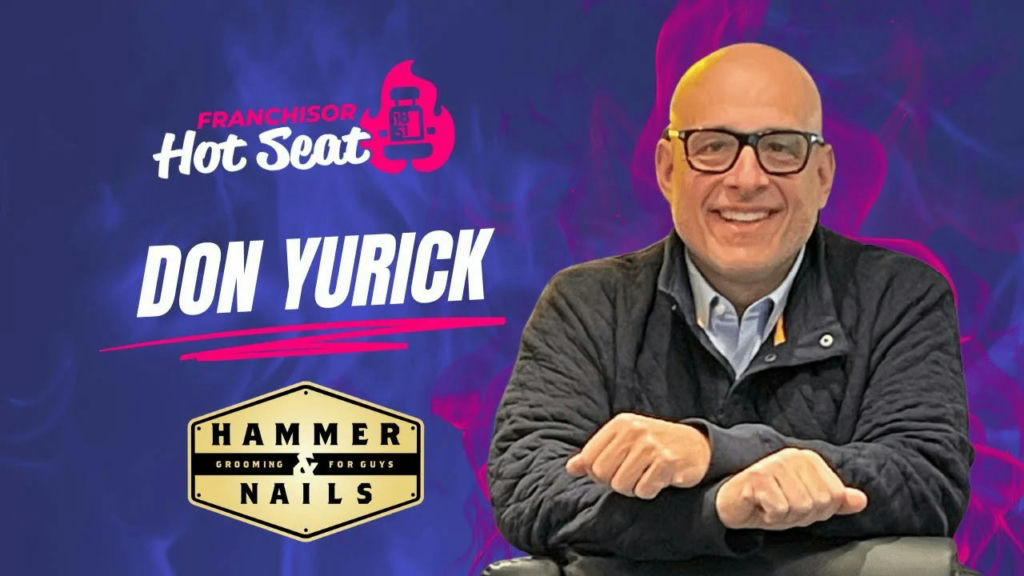
Don Yurick, franchise owner of Hammer & Nails Grooming (and head of franchising in the Northeast), recently joined Nick Powills on “The Franchisor Hot Seat” podcast to discuss his unconventional path into franchising, his experience with the master franchise mode, and how Hammer & Nails is reshaping the men’s grooming industry.
Yurick’s transition into franchising was anything but planned. Originally from the West Coast, he spent years in Silicon Valley as a chief revenue officer for early-stage tech companies. However, when his wife received a major promotion, he relocated to the Northeast and began re-evaluating his career path.
Initially skeptical about franchising, Yurick had a close friend involved with Hammer & Nails who encouraged him to take a closer look. He soon recognized the immense potential: the brand monetizes a lifelong routine habit — men’s grooming — through a membership model, ensuring a steady revenue stream. What especially resonated with him was the blend of high-end service and a subscription-based business model, similar to the SaaS (software-as-a-service) models he had worked with in tech.
Franchise development
Instead of just opening a single unit, Yurick took on a master franchise agreement for the Northeast, overseeing franchise growth in New York, New Jersey, Connecticut and Rhode Island. While this model is becoming rarer in franchising, it offers a dual opportunity: building local franchise support while growing the brand footprint.
At first, Yurick didn’t fully grasp the scale of the opportunity, but he quickly saw how his role extended beyond just running a franchise location. “You’re basically operating two businesses,” he said. “One is growing membership at the local level, and the other is providing operational support to franchisees in my region.”
Managing both franchise operations and development, Yurick learned firsthand how challenging it is to sell franchises, especially to the right people. “I didn’t realize how difficult it was to find and attract the best candidates,” he said. “We’ve turned away more people than we’ve accepted because we know this is a long-term partnership.”
Instead of rapid expansion, Yurick prioritizes strategic, multi-unit growth with operators who align with the brand’s culture. By the end of the year, he expects to have around 10 franchise partners in the Northeast, with a strong pipeline of multi-unit deals in Long Island and New Jersey.
Brand differentiation
Hammer & Nails differentiates itself from traditional barbershops by offering a luxury grooming experience tailored for men, including haircuts, shaves, and hand and foot care. The brand’s membership model provides recurring revenue and ensures customer retention.
With a leadership team led by Aaron Meyers, formerly of Massage Envy, Yurick is confident in the brand’s trajectory. “We have an experienced team that understands franchise growth and operations at scale,” he said.
Growth strategy
Looking ahead, Yurick’s goal is to double franchise openings year over year while maintaining high operational standards. He’s also focused on attracting experienced franchisees — many of whom have previously scaled brands like Massage Envy and OrangeTheory Fitness — to accelerate the company’s expansion.
His long-term vision? Continue to build a network of successful operators while ensuring Hammer & Nails maintains its premium positioning in the grooming industry. With growing demand and an increasing number of experienced franchisees joining the system, Yurick believes Hammer & Nails is on track to become a dominant force in the men’s grooming market.
A transcript of Powills’ interview with Yurick has been provided below. It has been edited for clarity, brevity and style.
Nick Powills: Don, we'll get into the complexities of the franchisee-franchisor relationship as we go, but I'd like to start with your accidental franchise story. How did you accidentally fall into franchising?
Don Yurick: My wife got a pretty big promotion about four years ago. I'm a West Coast guy through and through, but we recently moved to the Northeast because of her promotion. At the time, I was serving as a chief revenue officer and head of growth for early-stage technology companies in Silicon Valley.
Born and raised in San Francisco, I spent my entire career in the Bay Area, but I started feeling like I was getting a little older and grumpier. Meanwhile, the co-founders of these early-stage tech companies were getting younger, with more hustle, and I began thinking maybe it was time to do something on my own.
I have a very dear friend who was involved with Hammer & Nails. When we moved to the Northeast, he was talking to me about it, but my first thought was, "Franchising? That's not for me. I'm a tech guy through and through." But as I started to dig into Hammer & Nails and franchising as a whole, I realized there was a lot of opportunity — especially if you're coming out of corporate America with 15 to 20 years of experience and hard skills that can be applied depending on the franchise concept.
With Hammer & Nails specifically, I saw a unique opportunity. We’re monetizing a routine habit that most men have — getting haircuts and grooming services. Not every guy, but most. The irony isn’t lost on me — a bald guy selling a barbershop franchise! But most men, from the time they're four years old, learn from their dad or someone in their family that grooming is important.
It’s a social contract — you need to be well-groomed for work and social interactions. This habit sticks with men through retirement.
As I looked closer at Hammer & Nails, I saw that we were leveraging a recurring revenue model — memberships — to monetize this routine habit. Our shops cater to a broad range of customers, from young kids to men in their 60s and 70s still getting straight razor shaves. I also liked that it was a subscription model. Coming from early-stage tech, I love subscription and membership models. Plus, we're selling a disposable product — hair and nails grow back. On top of that, our pricing is luxury-based, so our margins are much higher compared to budget haircutting franchises.
Powills: That’s a great backdrop. A couple of follow-ups. You ended up buying a master franchise agreement, right?
Yurick: Yeah, that’s right.
Powills: That’s rare in franchising today. Did you recognize the opportunity right away?
Yurick: Not initially. Even now, almost four years in, I don’t consider myself a "franchise guy." There’s still a lot I’m learning from really smart people every day. But once I started to see the economics of the master franchise model — owning the rights for New York, New Jersey, Connecticut and Rhode Island — I quickly realized there was a big opportunity here.
If you simplify the master franchise model, it’s almost like two franchise opportunities in one.
One part is running and supporting an operational business — almost like franchising an operational center. The other part is franchising the haircut business itself. It’s like being a multi-brand franchisee because you have two objectives: signing up customers for memberships and providing direct support to franchisees under your system. You’ve basically bought the franchise rights to operationalize the business locally.
Powills: And with Hammer & Nails, franchisees get dual support — from corporate and from you locally. That’s unique.
Yurick: Exactly. The corporate team in California provides great support — supply chain, marketing and account management. But as a master franchisee, I also have my own team of four people in the Northeast to provide regional support. The home office team is fantastic, but sometimes you need localized solutions. What works in California doesn’t always work in the Northeast. Having boots on the ground makes a big difference.
Powills: One of the biggest franchisee complaints is lack of support. At minimum, your franchisees know they have four additional people supporting them locally. How many franchise owners do you currently have under your umbrella?
Yurick: Right now, we have about seven, and we opened three new shops last year. I'm in the process of closing a multi-unit deal in Long Island, which should be signed by next week and another multi-unit deal in New Jersey. By the end of the year, we’ll likely have around ten franchise partners in the Northeast.
Powills: Since you’re managing both franchise development and operations, did you realize how difficult it would be to sell franchises?
Yurick: Not at all! It’s way harder than I expected. The biggest challenge is finding the right people. We’ve turned away more candidates than we’ve accepted because I view this as a potential 20-year partnership — a 10-year agreement plus a 10-year renewal. I need to make sure we have the right people on board. We spend a lot of time interviewing and making sure candidates align with our core values and business philosophy.
Powills: That long-term mindset is key. Many brands set arbitrary growth targets like "50 new units this year," but they don’t prioritize culture. The best brands focus on developing franchise owners, not just selling franchises. If you build a strong system, royalty revenue will naturally follow.
Yurick: One hundred percent. We rarely focus on revenue during initial conversations. We look at character, values and long-term vision. Last year, we brought on a great family in New Jersey who now owns two units with an option for a third. He’s a construction executive, and we’re starting to bring in more franchisees with diverse skill sets — people with backgrounds in digital marketing, operations or real estate. It strengthens our network because franchisees can learn from each other.
Powills: As a tech guy, you’ve seen businesses scale through investment. Did you go into this thinking long-term, with an eye toward an eventual exit to private equity or a family office?
Yurick: Yes, absolutely. Spending time in Silicon Valley, I’ve been through multiple institutional funding rounds and learned a lot about scaling businesses. For me, the key is getting the right franchise partners in place. I prefer selling multi-unit deals to families or groups that have a long-term vision.
This year, my goal is to sell 12 to 14 new licenses, but I want to do that with just three or four new franchise partners. I don’t need to talk to 500 people to make that happen — if I meet the right 100, that’s enough.
Powills: That’s a strong approach. Multi-unit owners will scale naturally and experienced franchisees will attract others. What’s your long-term vision?
Yurick: Right now, we’re entering an exciting phase. We’ve had our "innovators" — the first wave of franchisees willing to take a risk on an emerging brand. Now we’re seeing the "early adopters" — franchisees who have exited from Massage Envy, OrangeTheory and other brands. They see the value in our business model and the scalability. As we approach 70-80 open units this year, we’re getting close to that 100-unit tipping point, which will generate even more momentum.
Powills: Final question. Given your tech background, have you thought about becoming a franchisor yourself?
Yurick: I’ve been approached by people asking me to invest in new concepts, but I still have a lot to learn. Maybe down the road, but for now, I’m focused on growing Hammer & Nails in the Northeast.
Powills: Well, Don, I love your story. Master franchise models are rare, but your focus on culture and quality control is what’s making it work. Thanks for sharing your insights.
Yurick: Thank you, Nick. And apologies for the dog barking — normally they’re out on a walk!
Powills: No need to apologize — it just proves you can live your life and run a business at the same time!
In this story
This story was originally published in 1851 Franchise on February 11, 2025. Burnaze summarizes and links to the original reporting.
Read the full story at 1851 FranchiseLiked this? Get the week's franchise news, explained
- Sunday 8 AM ET weekly + a monthly deep dive
- Sections picked for the industries you follow
- Every claim linked to its source. Free.