TL;DR
Newk's Eatery is a fast-casual franchise with strong average unit volumes and a focus on hospitality, making it a compelling investment opportunity in 2025. The company has adapted its business model to meet modern dining preferences, including reducing prototype size and utilizing third-party delivery as a marketing tool.
Newk’s Eatery is redefining what it means to be a fast-casual franchise, making it one of the most compelling investment opportunities heading into 2025. With strong average unit volumes, a broad menu featuring high-quality proteins and a focus on hospitality, Newk’s stands out in an increasingly competitive industry. Unlike many brands that rely heavily on drive-thru service, Newk’s prioritizes the in-store guest experience, which has proven to be a key differentiator.
“We have great average unit volumes because we offer a great experience,” said Newk’s CEO Frank Paci. “Our menu is broad, appealing to different demographics, and features high-quality proteins like salmon and shrimp that set us apart from competitors like Panera or McAlister’s. We also focus on hospitality. We aren’t a heavy drive-thru brand, so our model depends on creating a great guest experience.”
As consumer behavior continues to evolve, Newk’s has remained ahead of the curve by adapting its business model to meet modern dining preferences. The company has reduced its prototype size from 4,000 square feet to 2,500 square feet to optimize real estate efficiency while maximizing return on investment. Additionally, third-party delivery has become a core part of Newk’s strategy, not as a competitor but as a marketing tool that drives brand awareness and customer retention.
Business model adaptability
“I view third-party delivery as a marketing expense,” Paci said. “Traditionally, brands spend money for impressions, but with delivery apps, I only pay when an order is placed. That puts my food into customers’ homes, where I can include a bounce-back coupon to encourage them to return.”
Beyond operational efficiency, Newk’s continues to invest in menu innovation, ensuring its offerings remain fresh and appealing to customers. The brand is rolling out value-driven initiatives such as double meat sandwiches and a pick-three option, catering to customers looking for variety without sacrificing quality. With a well-balanced approach to dine-in and off-premise dining, a strong focus on guest experience and a leadership team committed to long-term growth, Newk’s Eatery presents an attractive opportunity for franchisees looking to invest in a proven, forward-thinking concept.
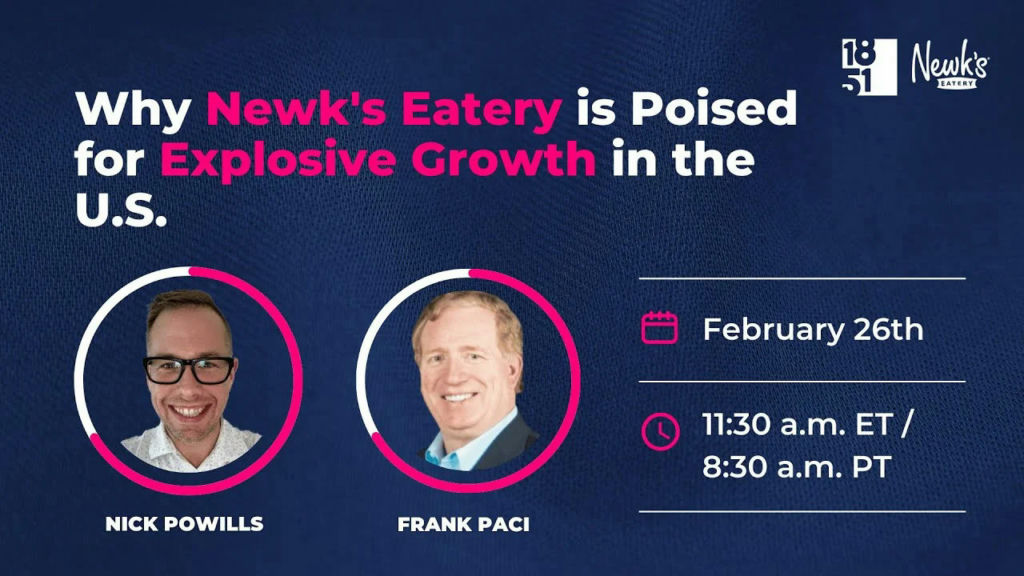
Paci was recently interviewed by 1851 Publisher and Chief Growth Officer Nick Powills on “Franchisor Hot Seat,” where the two discussed Newk’s growth potential in the fast-casual sector. A transcript of the interview has been included below. It has been edited for brevity, clarity and style.
Nick Powills: We're meeting Newk’s on the “Franchisor Hot Seat,” coming up next. Just like any good story, behind a brand is a human. So we're going to start with you, Frank, and then we'll get into the business. The only scripted question I ask, and it's always the fun one: What's your franchise story? How did you fall into franchising?
Frank Paci: I've been in the franchising business a long time. I started way back with Burger King and Pizza Hut then moved to McAlister's Deli, Einstein Bros. Bagels and now Newk’s. I've worked with a lot of great brands and have been very fortunate in my career.
Powills: You've been deeply involved in the food space. Looking back, what has changed for the good, the bad and the ugly?
Paci: The basic principles have always been the same: quality, value, service and convenience. What has changed is how those manifest. Third-party delivery, for example, has transformed convenience.
Now it’s closer to 45%. Customers can get their food in different ways — takeout, curbside, delivery, kiosks or even tableside ordering. The key is to meet the guest’s needs.
Real estate optimization
Powills: During COVID, consumer behavior shifted. Does that dictate a shift in vision too? If dining experiences are increasingly outside of the four walls, does it change how you look at real estate?
Paci: Absolutely. We used to look at 4,000-square-foot spaces. We don’t need that anymore. We’ve developed prototypes down to 2,500 square feet. In the Southeast, we also utilize patios for seating. While we can reduce square footage, inflation has driven up construction costs, so we balance these factors to ensure a strong return on investment for franchisees.
Powills: Looking at your career, there was a shift from simple menus to expansive ones then back to simplicity. Do you think consumer dining behavior will cycle back to more in-person experiences?
Paci: I think it’s occasion-based. Our dining rooms are busy on Sunday afternoons when families come from church. That’s a different occasion than a quick 30-minute lunch on a weekday. A single customer might behave differently on a Wednesday lunch than on a Saturday morning at a soccer game with their kids. We also have a strong catering business, which skews toward Tuesday through Thursday. Understanding these patterns helps us staff accordingly and cater to different occasions.
Powills: That’s a great point. Most brands view customers as a singular demographic, but behavior changes depending on the day and time.
Powills: Many restaurants see third-party delivery as a competitor because they offer everything to every customer. How do you see it?
Paci: I view third-party delivery as a marketing expense. Traditionally, brands spend money for impressions, but with delivery apps, I only pay when an order is placed. That puts my food into customers’ homes, where I can include a bounce-back coupon to encourage them to return. It’s also useful in markets where we don’t have enough density for traditional advertising. We’ve formed strategic partnerships with delivery providers because we rely on each other. We even fund some DoorDash promotions through our national ad fund instead of putting that cost on franchisees.
Paci: That’s a good point. We see it as an efficient use of marketing dollars. The target audience is already looking to order food, so it’s a high-value ad placement.
Paci: We haven’t used it as much for grand openings. In some markets, you can get too much business too quickly. I prefer a soft opening to ensure staff is fully prepared before a grand opening.
Paci: We have great average unit volumes because we offer a great experience. Our menu is broad, appealing to different demographics, and features high-quality proteins like salmon and shrimp that set us apart from competitors like Panera or McAlister’s. We also focus on hospitality. We aren’t a heavy drive-thru brand, so our model depends on creating a great guest experience. We also offer a strong work-life balance, operating from 10:30 a.m. to 9 p.m., with no late-night hours, alcohol or fryers.
Paci: That makes sense. When I visit a restaurant, I expect the manager to be out on the floor, engaging with guests. If they’re stuck in the kitchen, that’s a red flag. While 45% of our business is now off-premise, the in-store experience still matters, especially during peak occasions like Sunday lunch.
Paci: We’re leaning into value-driven offerings, like double meat sandwiches, which provide more for the customer while maintaining strong margins for franchisees. We’re also testing a pick-three option, allowing guests to combine a half sandwich, half salad and a cup of soup.
Powills: It sounds like you prioritize menu innovation to enhance customer experience and unit-level economics, which attracts new operators.
Paci: Absolutely. We’re a food-first brand. As off-premise dining grows, the focus shifts to ensuring the food travels well and orders are accurate. Our franchisees are passionate about the food, and we spend a lot of time refining our menu.
Paci: I encourage them to do their research. This is a big commitment, and talking to existing franchisees is crucial. They can provide real insights into the experience. If it’s not the right fit, that’s okay — it’s better for both sides to find the right match.
In this story
This story was originally published in 1851 Franchise on March 11, 2025. Burnaze summarizes and links to the original reporting.
Read the full story at 1851 FranchiseLiked this? Get the week's franchise news, explained
- Sunday 8 AM ET weekly + a monthly deep dive
- Sections picked for the industries you follow
- Every claim linked to its source. Free.