TL;DR
Bobby's Burgers and Shake Shack are incorporating global flavors into their menus through limited-time offers, with Bobby Flay using international influences to create new burger builds and Shake Shack leveraging Korean-inspired flavors to drive innovation. The brands are balancing flavor and familiarity to create approachable and buzzworthy menu items.
The menu at Bobby’s Burgers has been getting a global upgrade lately, but not in the way guests might expect.
Rather than introducing entirely new categories or unfamiliar dishes, the concept has been working international flavors into its core format. Recent limited-time offerings like the Little Italy and Greektown Burgers draw inspiration from iconic neighborhoods in New York City and Chicago known for their deep-rooted immigrant communities and culinary traditions.
Global flavor inspiration
“Bobby’s is a very American concept,” chef Bobby Flay tells QSR magazine, “and I like using some of the recipes to show the international influence and flavors that make sense on a burger.”
Ensuring those influences make sense goes beyond taste, he adds. As the brand’s sole culinary R&D force, Flay is focused on how each element comes together in the full eating experience.
“I’ve been a burger lover my whole life, so how a burger eats is as important to me as the flavor combinations,” he says.
The result is a pair of builds that nod to their namesake neighborhoods while still delivering the structure and balance guests expect. This year’s Little Italy Burger features mozzarella, spicy tomato sauce, parmesan, and arugula. Last year’s Greektown Burger leaned on housemade Greek yogurt sauce, crumbled feta, and a fresh tomato-cucumber relish.
The approach is resonating. Flay says guests have been “very supportive of new ideas,” and the strong response to globally inspired builds is encouraging further experimentation. But while global inspiration can come from anywhere, execution remains grounded in a single non-negotiable: quality.
“Ingredients are key,” Flay says. “Global flavor success is based on the quality of the global ingredients. If we don’t have access to the right quality, we scrap the idea and move on to the next.”
Scaling global flavors
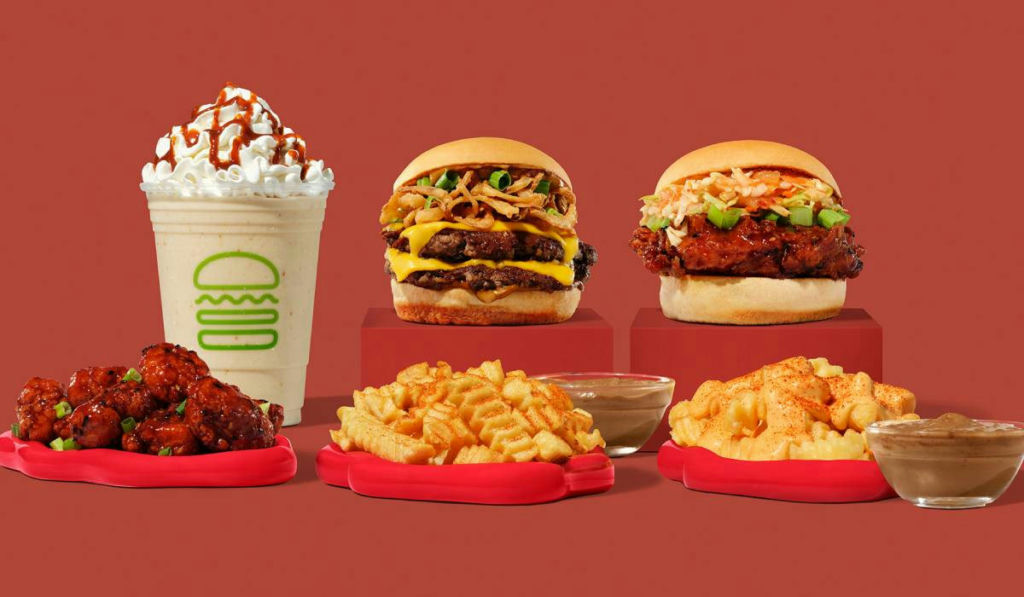
That standard gets harder to maintain at scale, where brands must align culinary ambition with consistency across hundreds of locations. At Shake Shack, that balancing act has turned global inspiration into a repeatable engine for buzzworthy, traffic-driving innovation. The brand’s Korean-inspired menu is built around ingredients like gochujang and kimchi. It returned for a third run as an LTO earlier this year, driven by strong guest demand and repeat purchases.
“Global and globally inspired foods really are not niche anymore,” says Nancy Combs, SVP of growth at Shake Shack. “When they’re done right, we’ve proven that there is definitely guest demand and that the flavors can drive real volume and repeat behavior, not just trial out of the gate.”
The platform traces back nearly a decade, when Shake Shack’s international culinary team spent time in Seoul ahead of the brand’s first location in South Korea. There, they immersed themselves in the city’s fried chicken culture, drawn to the interplay of crunch, heat, sweetness, and acidity, as well as the inherently social, shareable nature of the food.
Those learnings were translated for the U.S. market into a lineup that feels distinctly Shake Shack. The Korean fried chicken sandwich layers a spicy-sweet gochujang glaze with fresh scallions and kimchi slaw, delivering what Combs describes as a “flavor bomb” that still fits within an approachable framework.
That familiarity does the heavy lifting, she notes.
“Guests are increasingly interested in global flavors, especially when they’re delivered with familiar formats,” Combs says. “When the flavors are well balanced, it kind of feels like comfort food with a twist.”
For this year’s run, Shake Shack kept its “heavy hitters”—the Korean fried chicken sandwich and Korean barbecue burger, now branded as K-Shack Fried Chicken and K-Shack BBQ Burger—while also expanding beyond those core items. It introduced K-Shack Fried Chicken Bites, coated in the same sesame gochujang glaze and served with a choice of dipping sauces, marking its first fully sauced bites offering.
Combs says the move opens the door to future sauce-driven innovation, a category increasingly prioritized by younger, flavor-motivated consumers. She notes the bites deliver a sweet-and-spicy balance that creates “a more dynamic, sensory eating experience.” That same “swicy” profile has also made its way into desserts, with a limited-time spicy caramel shake.
Balancing flavor and familiarity
Sweet heat has become a popular on-ramp for global flavors, giving brands a way to introduce intensity without losing approachability. It’s a strategy that also underpins Rōti Modern Mediterranean’s latest menu innovation.
The brand’s Hot Honey Harissa platform, launched this spring, features grilled chicken in a sweet-and-spicy harissa sauce, paired with purple cabbage, pickles, and feta, with the option to add new crispy fries. For Angela Johnson, chief marketing officer at Edible Brands, Rōti’s parent company, the idea works because it builds on what’s already core to the brand.
“Just because it’s trending and somebody else is doing it doesn’t mean it’s right for Rōti,” she says. “It has to be within our culinary DNA.”
Instead of reworking the menu, Rōti layers new flavors into formats guests already know—bowls, salads, pitas, and wraps—keeping the experience intuitive while still offering something new. And like Shake Shack, the brand used the platform to introduce a new format it hasn’t offered before. In this case, it was a chicken sandwich.
The sandwich was inspired by an internal culinary competition and pairs grilled chicken with hot honey harissa, pickles, cabbage, and a brioche bun. Johnson describes it as a slightly more indulgent entry point that can attract new guests, while the same flavor profile across bowls and wraps gives existing customers a lower-risk way to engage.
Behind the scenes, that kind of innovation is guided by a clear set of guardrails. Johnson points to three key filters for any new product: it must be authentic to the brand, it must drive sales, and it must work operationally.
“If it doesn’t meet that number one thing, it’s not even worth the time and the resources,” she says. “And then from an operations standpoint, if it requires too many new SKUs, it starts to get complicated.”
Future of global flavors
Looking ahead, operators see global flavors continuing to evolve from trend to expectation. Flay points to several countries as potential targets for future growth on quick-service menus.
“I’m noticing in my travels that impactful cuisines like Indian and Sri Lankan spices are making their way across menus,” he says. “That could certainly be the next big wave.”
To Combs, the rise of global flavors—and especially Korean, Southeast Asian, and Middle Eastern flavors on menu boards—is less a passing fad than the new baseline. She expects these profiles to keep shifting from limited-time curiosities to everyday staples, while cross-category experiments like spicy shakes and globally inspired snacks become more common.
She believes the real battleground will be sauces and condiments, where brands can take big swings with relatively low operational risk. In that world, she argues, success hinges on more than just chasing the next viral flavor:
“I think ultimately, the brands that are going to win are the ones that can make these flavors feel exciting for the guests, but also authentic for the brand, and deliver it consistently,” Combs says.
In this story
This story was originally published by Ben Coley in QSR Magazine on July 6, 2026. Burnaze summarizes and links to the original reporting.
Read the full story at QSR MagazineLiked this? Get the week's franchise news, explained
- Sunday 8 AM ET weekly + a monthly deep dive
- Sections picked for the industries you follow
- Every claim linked to its source. Free.