TL;DR
The fast-food pizza sector has seen sales decline, with total sales flat last year and up less than 6% since 2021, according to Technomic data. Domino's is adapting to this new reality with a new marketing campaign targeting traditional fast-food customers, particularly for the lunch crowd.
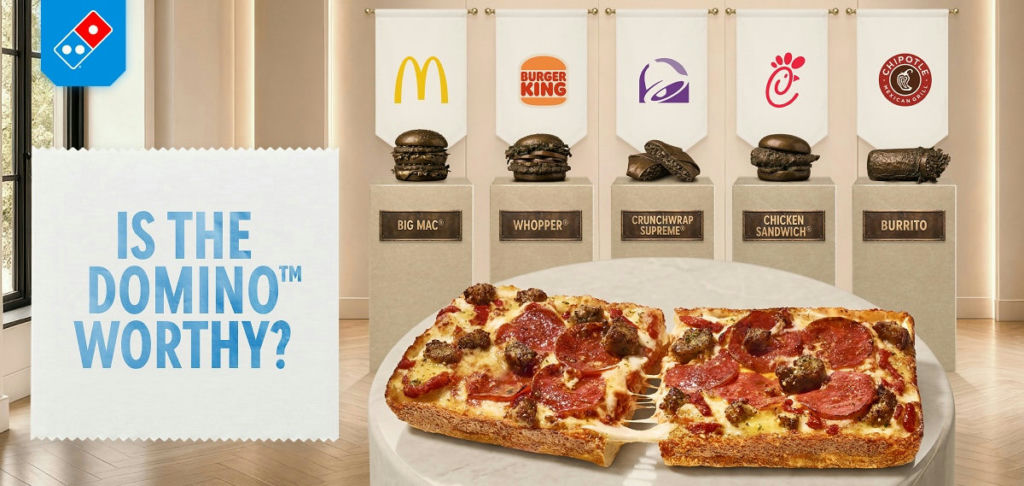
Domino's new marketing campaign shows who brands must compete with in a post-DoorDash world.| Image courtesy of Domino's.
In a recent analysis of credit card data, Bank of America noted that independents (and bars) were easily beating chain restaurants. Within that data was more bad news for the pizza sector.
That business, beset by an ugly pricing war and losing customers to third-party delivery apps, has seen its sales decline further this summer, down roughly 3% in the three months ended in July.
That continues a soft trend for the sector. Total sales for the entire fast-food pizza chain universe were flat last year. The typical pizza chain’s sales were up just 0.8% in 2025, according to Technomic data. Since 2021, total sales are up less than 6%. Given that menu price inflation is up about 25% over that period, that is not great.
It’s even worse when you remove the largest chain, Domino’s. Without the Ann Arbor, Michigan-based chain, the pizza business declined 2% last year and is up less than 2% over the past five years.
Some of the problem is rooted in the finances of pizza consumers, who have cut back on dining. But, as we’ve covered in these pages routinely, many higher-end consumers are opting to broaden their delivery horizons by using third-party delivery apps. That has effectively removed one of the sector’s key, competitive advantages, forcing a fundamental change on the business itself.
Illustrating this challenge is the meager price that Pizza Hut received after its sale by Yum Brands. A chain with 20,000 units, including a self-delivery operation and tech-heavy focus, could not even get a third of the price paid for the equally troubled Subway.
How do brands adapt to a post-DoorDash reality? Our first clue came this week from Domino’s, as my colleague Alicia Kelso wrote.
The chain is asking customers whether its new, single-serve Detroit-style pizza, The Domino, is worthy of being alongside major fast-food premium items, notably the Big Mac, the Whopper, Chick-fil-A’s Chicken Sandwich, the Crunchwrap Supreme and Chipotle’s burrito.
Domino’s is hardly the first pizza chain to try a single-serve item. Nor is it the first pizza chain to target traditional fast-food customers, especially for the much-coveted lunch crowd.
But it’s difficult to separate that marketing campaign from the sector’s current reality. In pushing its new pizza, and marketing it against major fast-food chains, Domino’s is doing exactly what it needs to do to thrive in the new environment.
Pizza chains will need to navigate the coming years carefully. They cannot move too far away from their core menu. Consumers still like pizza, after all. And chains that drift too far away from their foundation lose core customers. We remain convinced that this has been one of the key problems with Pizza Hut, for instance, even if we also think Pizza Hut would have struggled with the loss of dine-in, full-service consumers.
But they also need to find a way to get their pizzas into more consumers’ hands. Third-party delivery is not replacing the business they’ve lost, and even if it does that business would be less profitable.
Pushing innovative new items targeted at solo diners is one way to go. Rethinking the competitive set is another. Pizza chains are still competing with other pizza chains. But in a third-party delivery world, that competitive set is far broader. Domino’s isn’t just competing with Pizza Hut and Papa Johns. It has to get customers to opt for its Domino over a burrito. That’s a different world indeed.
In this story
This story was originally published in Restaurant Business on September 1, 2026. Burnaze summarizes and links to the original reporting.
Read the full story at Restaurant BusinessLiked this? Get the week's franchise news, explained
- Sunday 8 AM ET weekly + a monthly deep dive
- Sections picked for the industries you follow
- Every claim linked to its source. Free.