TL;DR
7-Eleven has upgraded its pizza crust, which could add pressure to the QSR pizza category, and Casey's General Stores has been taking market share from legacy quick-service pizza brands. Casey's General Stores grew its sales 10.5% to $1.5 billion in 2024.
A recent report from Bank of America showed that Casey’s General Stores has likely been taking market share from some legacy quick-service pizza brands, including and especially Pizza Hut.
The Iowa-based convenience store giant has grown its footprint by nearly 50% throughout the past 10 years and now counts roughly 2,900 locations in 19 states. In 2024, its year-over-year sales increased 10.5% to $1.5 billion, according to Technomic. On its website and elsewhere, Casey’s touts itself as the fifth largest pizza chain in the U.S. (behind Domino’s, Pizza Hut, Little Caesars, and Papa Johns).
The BofA report noted that Casey’s benefits from lower pricing, individual slices that generate incremental traffic, and a heavy presence in rural markets where it’s much cheaper to build and operate. These advantages could, at least in part, explain why the QSR pizza category’s sales have been soft — even negative in 2025 — as of late.
Market share impact
So, what happens to the category's market share equation when an even larger C-store chain sharpens its focus on its pizza offerings as well?
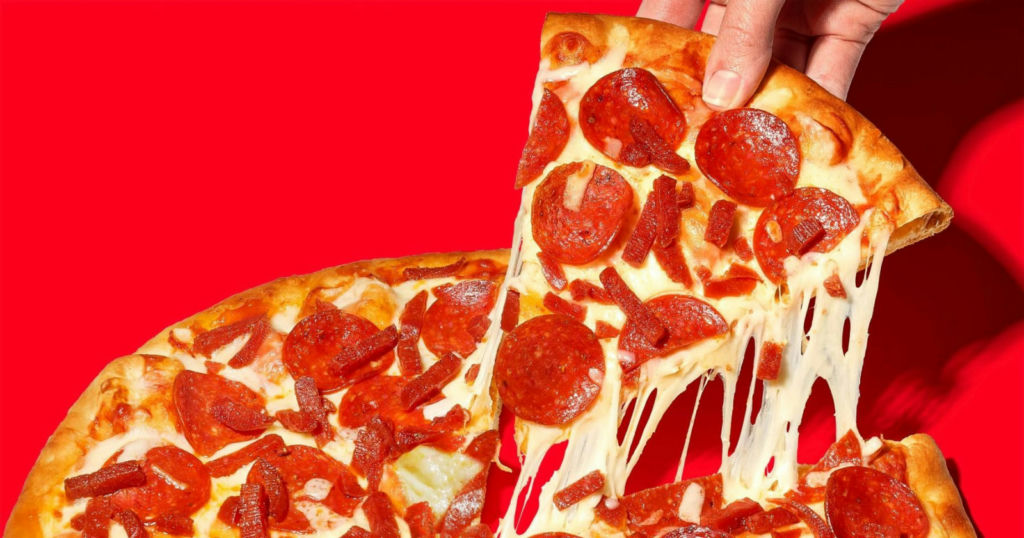
7-Eleven, which finished last year with approximately 12,700 domestic locations, just developed a new crust, described as “crisp outside and light and airy inside.”
Brandon Brown, senior vice president, Fresh Foods and Beverages at 7-Eleven, said the change was made because, “Every great pizza starts with the crust.” The company’s consumer insights show that it is the No. 1 attribute driving consumers’ pizza preference, and those consumers were asking for something lighter and “more bubbly.” So, the company spent the past year improving its product to ensure a balance between crispness and chewiness, Brown said.
New pizza offerings
Like Casey’s, 7-Eleven’s new pizza is available by the slice or as a whole pie, which Bank of America has also identified as a potential advantage, particularly for consumers on-the-go or groups who want to enjoy their own customizations. The increase in solo diners is a major impetus behind Domino’s launch of the Detroit-style Domino, for instance.
Brown said pizza is the company’s most popular hot food and that last year more than 218 million slices were sold at the company, which also owns Speedway and Stripes stores.
“That’s more than six slices every second, all year long,” he said.
Pizza has been a particular favorite among 7-Eleven’s Gen Z consumers, in which three out of every four say the offering provides a strong value proposition. To cater to this crowd, 7-Eleven offered a 2-slice-for-$5 deal, a $4 slice-and-soda deal, and a $6.99 large pizza delivery deal upon the launch of its updated crust. The company also recently introduced a BiG Flavor Bar, which gives customers more ways to customize their pizza slice with sauces and toppings.
“We’re continuing to find ways to make the pizza experience more satisfying for our guests,” Brown said.
Though he didn’t share specifically what 7-Eleven’s market share potential is amid the broader pizza category, he did say there is “an opportunity to continue delivering on what customers are looking for.”
“Pizza is an important part of that,” he said. “The new crust helps us deliver an even more satisfying pizza for our customers.”
Menu updates and growth
Of note, 7-Eleven’s pizza isn’t the only part of the menu that has been updated lately. The company has continued to invest across its food portfolio, from introducing new, larger boneless wings with seasoned breading, to adding new products like a chargrilled Angus Double Cheeseburger on a brioche bun. The company also just introduced a new seasonal coffee lineup that includes a Pumpkin Cappuccino and Pumpkin Brulé iced cold brew latte.
It’s likely these upgrades from the country’s largest C-store, as well as many of peers, are driving market share gains, and not just in pizza but across the board. During a recent presentation at the FSTEC conference, Rich Shank, senior principal and vice president of innovation at Technomic, said QSRs’ biggest competitors in 2026 are, indeed, convenience stores.
“Ninety-five percent of C-store operators confirm that foodservice is a strategic priority for their business,” Shank said. “Eighty percent agree that foodservice is vitally important to the success of their total store. … They’re coming aggressively for the restaurant space, because they see a pretty big opportunity to compete with all of us.”
For 7-Eleven, specifically, Brown assured more to come from the menu.
“Enhancing the customer experience through product innovation remains a key focus,” he said. “We’re continually evaluating opportunities to elevate our food offerings.”
Members help make our journalism possible. Become a Restaurant Business member today and unlock exclusive benefits, including unlimited access to all of our content. Sign up here.
In this story
This story was originally published in Restaurant Business on October 6, 2026. Burnaze summarizes and links to the original reporting.
Read the full story at Restaurant BusinessLiked this? Get the week's franchise news, explained
- Sunday 8 AM ET weekly + a monthly deep dive
- Sections picked for the industries you follow
- Every claim linked to its source. Free.