TL;DR
Fast food regained some of its value reputation in 2025 with deals, but perceptions were short lived. The segment's value perception has since fallen back due to current economic conditions and oversaturation of promotions.
New research from Morning Consult shows that fast food regained some of its value reputation in 2025 after a barrage of deals hit the market. That’s the good news.
The bad news is such perceptions were short lived.
The segment has been navigating a choppy consumer environment for years as inflation across the board has been hard to shake. As such, the share of the some-30,000 consumers surveyed by Morning Consult who said a brand has “good value” minus the share who said a brand has “poor value” fell from 46.6 in January 2022 to a series low of 41.3 in June 2024.
Indeed, we could pinpoint June 2024 as an inflection point in the category; that’s when the bellwether that is McDonald’s reported traffic losses from lower-income consumers. In response, the chain launched a $5 Meal Deal. As McDonald’s goes, so tends to go the industry, and in the ensuing months, nearly every chain across every segment jumped in with their own promotions.
By August 2025, the average net value for the top 15 fast-food brands jumped all the way back up to 47.1. By October 2025, Circana data found that nearly 30% of foodservice traffic was generated by a deal.
The heavy promotional environment was working, pushing the perception of “good value” back into pre-inflation territory. But that score has since fallen back to 45 and Morning Consult’s preliminary reading for August is even lower — 43.1. Granted, that’s still higher than June 2024, but it marks the largest single-month drop in eight years of tracking.
What gives?
Morning Consult analysts said that current economic conditions, including continued uncertainty in the Middle East and high gas prices, make value perceptions fragile, which is why its net value scores have been all over the map of late.
There is also the risk of oversaturation. As Technomic recently pointed out, for instance, tiered pricing options are no longer as effective as they were last year because everyone jumped onto the trend, cluttering the market, according to Senior Principal and Vice President of Innovation Rich Shank. He predicted a value proposition reset this year. Judging by recent second quarter earnings reports, that’s exactly what’s happening.
Wingstop, for instance, has begun testing single-eater entry points and price-per-person offerings for group occasions. The chain has also shifted its marketing approach, including a “call to action that shows quality and flavor (and) also breaks through with that value-per-person that exists on our menu,” CEO Michael Skipworth said.
“Consumers are still willing to spend on meaningful occasions. They simply want confidence they’re receiving compelling value for the group,” he said. “When we think about value, it's one simple question: Was the experience worth what I paid?”
Domino’s most recent quarter was slow (for the company) and so it is also making marketing adjustments for the rest of the year to bolster its value perception. As part of this adjustment, the chain is adding a premium Stuffed Crust option to its Best Deal Ever campaign. CEO Russell Weiner said the company is able to do this because it has supply chain and ad budget advantages over its competitors.
Meanwhile, Sweetgreen has started piloting a new Create Your Own pricing test to improve its value proposition. CEO Jonathan Neman told analysts that customers are happy with the model so far and the company is aiming to have it rolled out systemwide by the end of the year.
“It’s a much simpler way to order CYO without the price shock,” he said. “We’re encouraged about what we’re seeing in customer feedback and overall value perception.”
Then, there’s Wendy’s, which has had a rough few quarters (and four CEOs in three years). Its newest CEO, Bob Wright, joined in May and has major plans to boost the chain’s value proposition which, he said, “has slipped.” Its Biggie value platform — which included tiered pricing options — became increasingly complex and “value diluting,” he added.
“Customers today are extremely value conscious. We think about value differently; traditionally in the QSR space, you would think of value as that bottom right-hand side of the menu board, where value was compartmentalized,” Wright said. “Today’s consumers are looking for value everywhere. What you get for what you pay for must make sense to the consumer … The core menu has to be infused with intrinsic value.”
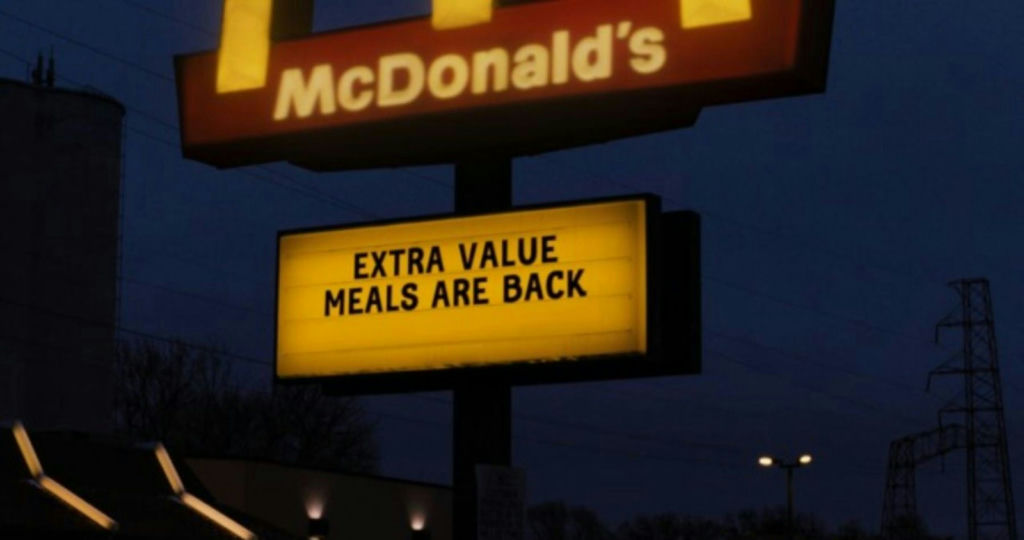
Even the bellwether McDonald’s is making adjustments following a flattish (0.8%) second quarter despite the continued evolution of its value programs since that June 2024 $5 Meal Deal launch. Its most recent 10 under $3 menu underperformed expectations and CEO Chris Kempczinski said the company is now reallocating its marketing dollars to increase support behind “proven value offerings” like Extra Value Meals.
“The world is changing and we need to change with it," he said.
In this story
This story was originally published in Restaurant Business on September 2, 2026. Burnaze summarizes and links to the original reporting.
Read the full story at Restaurant BusinessLiked this? Get the week's franchise news, explained
- Sunday 8 AM ET weekly + a monthly deep dive
- Sections picked for the industries you follow
- Every claim linked to its source. Free.