TL;DR
Casey's General Stores, with 2,900 locations, is likely stealing market share from Pizza Hut in the quick-service pizza category due to its convenience store advantage and competitive pricing. Casey's has grown its footprint by nearly 50% in the past 10 years and reported a 10.5% increase in year-over-year sales in 2024.
We’ve spent the past several months unpacking why the quick-service pizza category turned negative in 2025 and why some of the bigger players in that category, including and especially Pizza Hut, have lost a big chunk of market share.
We concluded that competition across segments is more intense, especially value competition, impacting the one-time leader in such offerings. Also, Domino’s has spent the past 10 or so years gobbling up much of the categorical market share as it fires on all cylinders — including digital, marketing, product innovation and, again, value.
We also concluded that the steady and sustained growth of third-party delivery has leveled the playing field in a space where pizza used to have a major convenience advantage.
Casey's market impact
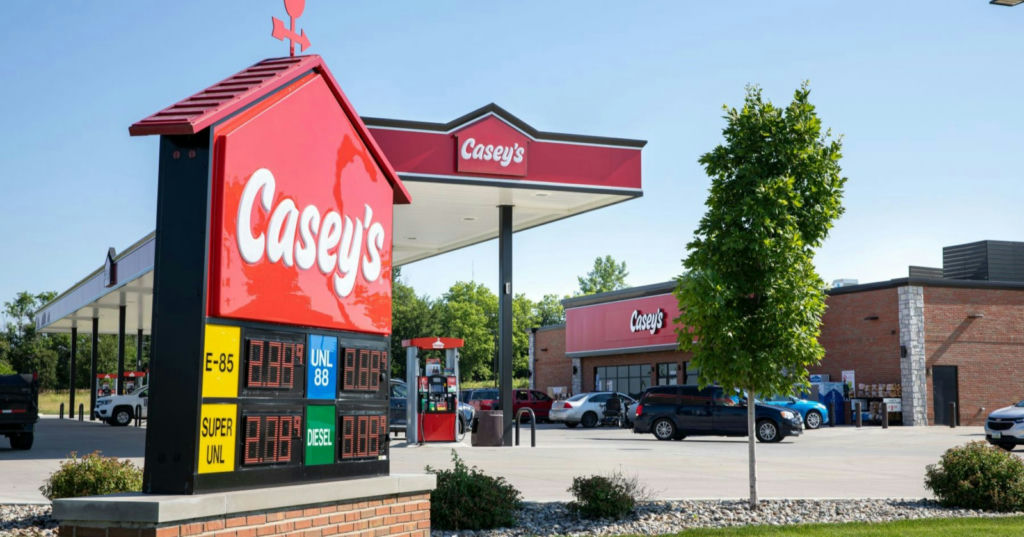
What wasn’t on our radar, however, is the impact Casey’s General Stores has had on the category. The Iowa-based convenience store giant has grown its footprint by nearly 50% throughout the past 10 years and now counts roughly 2,900 locations in 19 states. In 2024, its year-over-year sales increased 10.5% to $1.5 billion, according to Technomic.
This means it is around the same size as Wingstop based on unit count, and rakes in sales on par with Shake Shack and Tropical Smoothie Café.
Casey’s primary foodservice item is pizza and, as a new Bank of America report points out, that has been the case since 1984, though the company itself was founded in 1968.
On its website, Casey’s touts itself as the fifth largest pizza chain in the U.S. (behind Domino’s, Pizza Hut, Little Caesars, and Papa Johns), adding that it has grown by “staying focused on what matters most: handmade pizza, convenience, rewards, and making life better for the communities we serve every day.”’
Casey’s promotes the attributes and diversity of its pizza lineup, including made-from-scratch dough, breakfast pizza (introduced in 2001), taco pizza, thin crust (introduced in 2023), and gluten-free options.
Convenience store advantage
The BofA analysis notes that the QSR pizza category has long battled for share of stomach with convenience stores, as well as discounters such as Costco and Sam’s Club. However, it added that Casey’s has an advantage against those competitors because of the breadth of its offerings, “with a loyal customer base that comes for food and then picks up fuel and merchandise on their trip.” In other words, QSR pizza chains have fewer options to navigate through the persistent inflationary environment, while Casey’s can offset food pressures with fuel margins.
In March, Casey’s reported that its fuel margins widened to 41 cents per gallon. As such, it has barreled its way to the top of the consideration set for value seekers.
According to BofA, an unpromoted large pizza at Casey's averages $13.99, inclusive of double reward points, which is below the Midwest U.S. average of $17.10 for the same product and about $1 to $3 less than national competitors.
Another advantage is that about 50% of Casey’s sales mix is individual slices, which are rarely an option at national chains, even though they generate incremental traffic. Last year, Casey’s leveraged this differentiator by offering 40-cent Mega Slices to celebrate its 40th anniversary.
Also, Casey’s has an outsized presence in rural markets. In Fiscal Year 2025, 71% of Casey’s stores were in towns with less than 20,000 people. Executives have shared that the company is therefore able to provide a service generally not otherwise available and can therefore be profitable if it “stresses sales volume and competitive pricing.” Rural locations are also less expensive to build and operate.
A final advantage is that about three-fourths of Casey’s customer base is in the middle-income or higher-income demographic, insulating the chain from the current macroeconomic pressures that have disproportionately impacted low-income consumers throughout the past year-plus and that have driven the QSR pizza segment into an all-out value war, forcing many of them to lower the pricing limbo stick.
Because of its heavy concentration in the Midwest, Pizza Hut is its largest national competitor, though the two concepts are currently on different trajectories. Pizza Hut shed more than 8% of its domestic systemwide sales in 2025, according to Technomic, while Casey's delivered a record fiscal year.
“Geographic overlap suggests Casey’s is steering sales away from Pizza Hut,” BofA said.
It’s worth noting that Casey’s isn’t the only c-store pulling share away from fast-food restaurants. A recent study from Technomic found that 15% of customers who visited a convenience store would have considered going to a fast-food restaurant. That number increased to 39% during lunch.
Members help make our journalism possible. Become a Restaurant Business member today and unlock exclusive benefits, including unlimited access to all of our content. Sign up here.
In this story
This story was originally published in Restaurant Business on June 10, 2026. Burnaze summarizes and links to the original reporting.
Read the full story at Restaurant BusinessLiked this? Get the week's franchise news, explained
- Sunday 8 AM ET weekly + a monthly deep dive
- Sections picked for the industries you follow
- Every claim linked to its source. Free.