TL;DR
Restaurant owners need access to capital to launch new concepts, remodel existing locations, or expand into multi-unit systems. Financing options are available for nearly every stage of a restaurant's lifecycle, including startup, acquisition, equipment, and expansion financing.
Opening or growing a restaurant takes more than a great menu and strong customer service. It takes capital. Whether an operator is launching a new concept, purchasing an existing restaurant, remodeling a location, adding equipment, or expanding into multiple units, access to the right financing can often determine how quickly the business grows and how successful it becomes long term.
The restaurant industry remains one of the most competitive industries in the country. Margins are tight, labor and food costs fluctuate constantly, and operators are expected to create an experience that keeps customers coming back. In an environment like that, having the right financial structure is critical. Restaurant financing is not simply about getting approved for a loan. It is about creating enough flexibility and liquidity for the business to operate efficiently while still investing in growth.
Many restaurant owners initially underestimate how much capital is required beyond the buildout itself. Startup costs can include leasehold improvements, kitchen equipment, furniture, POS systems, inventory, signage, permits, working capital, payroll, and marketing. Even established restaurants pursuing expansion or renovations often need significant funding to stay competitive in today’s market.
Financing options available
The good news is that there are financing solutions available for nearly every stage of a restaurant’s lifecycle.
Restaurant startups are among the most capital-intensive small businesses to launch. Depending on the size and concept, startup costs can range from tens of thousands of dollars to several million. Fast casual concepts may require less upfront investment than a full-service restaurant with a custom buildout, liquor license, and high-end kitchen equipment, but both still require substantial planning and capital.
Lenders typically evaluate several factors when financing a restaurant startup. Experience is often one of the biggest. Operators with prior restaurant ownership or management experience generally have stronger approval odds because lenders view them as lower risk. A strong business plan, realistic financial projections, and sufficient liquidity also play a major role.
Restaurant startup financing can be used for:
Leasehold improvements
Construction and renovations
Kitchen equipment
Furniture and fixtures
Inventory and supplies
Payroll and working capital
Franchise fees
Marketing and grand opening expenses
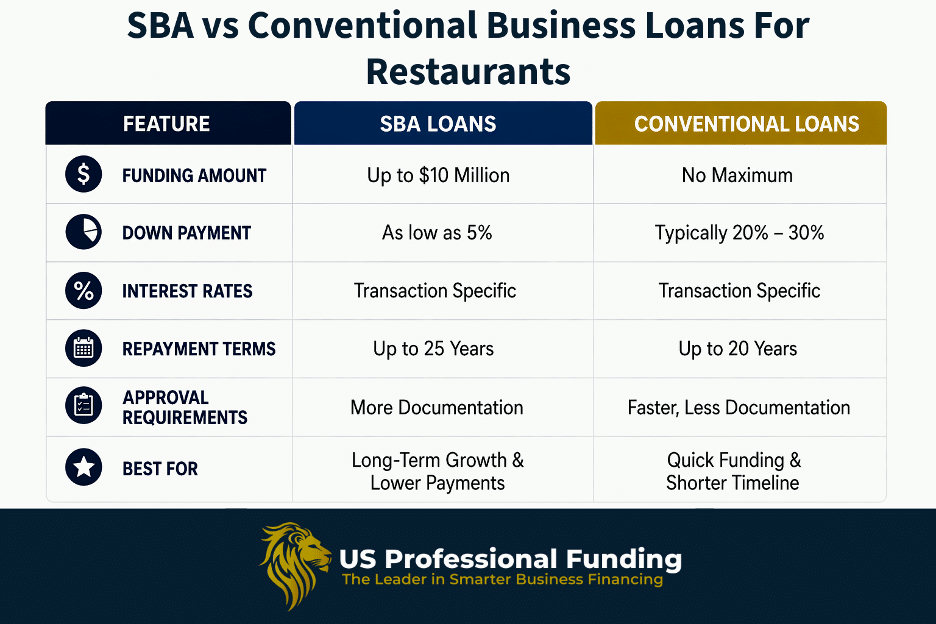
One of the most common financing options for restaurant startups is an SBA loan. SBA financing can provide long repayment terms and competitive rates, which helps preserve monthly cash flow during the early stages of operations. Conventional financing may also be available for strong borrowers with significant liquidity and industry experience.
Working capital is one area many startup owners fail to prioritize. Restaurants rarely become immediately profitable. It can take months for customer traffic and revenue to stabilize. Having sufficient working capital allows operators to cover payroll, inventory, rent, and unexpected expenses during the ramp-up period.
Acquisition financing
For many entrepreneurs, buying an existing restaurant can be less risky than starting from scratch. An established location may already have customers, staff, equipment, revenue history, and operational systems in place. Financing can be structured around both the business acquisition and the real estate if the property is owner-occupied.
Restaurant acquisition financing is commonly used for:
Purchasing an independent restaurant
Buying a franchise location
Partner buyouts
Multi-unit acquisitions
Real estate purchases tied to the business
Lenders evaluating a restaurant acquisition often focus heavily on historical cash flow. Tax returns, profit and loss statements, bank statements, and sales reports help determine whether the business generates enough income to support the debt.
A profitable restaurant with strong financials and consistent sales trends is generally easier to finance than a startup because there is already proven operating history. Buyers who bring restaurant management experience, strong credit, and liquidity to the transaction are usually positioned most favorably.
One major advantage of financing an acquisition is that buyers may be able to preserve liquidity instead of deploying all available cash into the purchase. Maintaining reserves is important in the restaurant industry because unexpected expenses can arise quickly, including equipment breakdowns, staffing shortages, or rising food costs.
Equipment is one of the largest expenses for restaurant owners. Commercial kitchens require significant investment in ovens, fryers, refrigeration systems, freezers, prep stations, dishwashers, HVAC systems, and more. Front-of-house equipment, POS systems, and furniture also add to total project costs.
Restaurant equipment financing allows operators to spread these costs over time instead of paying everything upfront. This can help preserve working capital while still allowing the business to acquire the equipment needed to operate efficiently.
Equipment financing is commonly used for:
Commercial ovens and ranges
Refrigeration systems
Walk-in coolers and freezers
POS systems
Tables, chairs, and furniture
Ice machines
Food trucks and mobile kitchen equipment
HVAC systems
Because the equipment itself often serves as collateral, approvals may be more flexible compared to traditional unsecured financing. Equipment financing can be particularly beneficial for restaurant owners undergoing remodels or replacing outdated systems that impact efficiency and customer experience.
New technology has also become increasingly important in the restaurant space. Online ordering systems, self-service kiosks, kitchen display systems, and delivery integrations all require investment. Financing allows operators to modernize without straining cash flow.
Growth and expansion financing
Successful restaurants eventually face growth opportunities. Some operators add additional locations, expand their dining area, build outdoor seating, or invest in larger kitchens to increase production capacity. Growth requires capital, and expansion financing helps restaurants scale while maintaining operational stability.
Restaurant expansion financing may be used for:
Opening additional locations
Franchise expansion
Remodeling or rebranding
Adding drive-thrus
Expanding kitchen capacity
Purchasing adjacent real estate
Hiring and staffing growth
Lenders reviewing expansion requests often want to see strong performance at the existing location or locations. Consistent revenue, profitability, and operational stability help demonstrate that the business model can successfully scale.
Multi-unit operators may also pursue financing structures designed specifically for portfolio growth. In many cases, maintaining sufficient liquidity during expansion is just as important as funding the expansion itself. Rapid growth without adequate working capital can create operational strain even for otherwise successful restaurants.
Restaurant franchises continue to be one of the most active areas within the industry. Franchise systems provide operators with established branding, operational support, marketing systems, and customer recognition, but franchise ownership still requires significant capital investment.
Financing for franchise restaurants may include:
Buildout costs
Equipment purchases
Real estate acquisition
Working capital
Multi-unit development
Lenders are often more comfortable financing established franchise brands because there is already proven operational data and brand recognition. However, franchise approvals still depend heavily on the borrower’s experience, liquidity, and overall financial profile.
Some franchise systems also have preferred lending programs or SBA-preferred structures that can streamline the approval process.
Refinancing can be an important financial strategy for restaurant owners looking to improve cash flow or restructure existing debt. Businesses that initially used short-term financing or high-payment structures may later refinance into longer-term loans with lower monthly obligations.
Restaurant refinancing may help operators:
Lower monthly payments
Consolidate debt
Improve cash flow
Access additional working capital
Replace high-interest financing
Fund renovations or upgrades
Cash flow management is critical in the restaurant industry, especially during slower seasons or periods of economic uncertainty. Refinancing can provide operators with greater financial flexibility while positioning the business for future growth.
Every lender evaluates restaurant financing differently, but several factors consistently influence approvals.
Experience matters significantly. Operators with restaurant ownership or management backgrounds are generally viewed more favorably because lenders know the industry has a steep learning curve.
Credit profile also plays an important role. Strong personal credit demonstrates financial responsibility and can improve both approval odds and loan terms.
Cash flow is another major factor. Existing restaurants are typically evaluated based on historical revenue and profitability. Startups rely more heavily on projections, liquidity, and borrower strength.
Liquidity is especially important in the restaurant industry. Restaurants often experience fluctuations in revenue, seasonal changes, and unexpected operating expenses. Businesses with adequate reserves are generally considered lower risk.
Location can also influence financing decisions. Restaurants in strong retail corridors, high-traffic areas, or growing markets may receive more favorable consideration.
Not all restaurant financing solutions are structured the same way. Some loans prioritize lower monthly payments through longer repayment terms, while others focus on faster approvals or flexibility. The right structure depends on the restaurant’s goals, stage of growth, and financial profile.
For example, a startup restaurant may prioritize preserving working capital during its first year of operations, while an established multi-unit operator may focus more on scaling quickly and maximizing leverage opportunities.
Restaurant owners should also consider how financing aligns with long-term business plans. Financing should support operational stability and growth rather than create unnecessary financial strain.
The restaurant industry is demanding, fast-paced, and highly competitive, but it also presents tremendous opportunity for experienced and well-capitalized operators. Access to financing allows restaurant owners to launch new concepts, acquire existing businesses, modernize operations, expand locations, and improve long-term cash flow.
Whether financing a startup, purchasing an established restaurant, upgrading equipment, or pursuing expansion, the right capital structure can help position a restaurant for long-term success. In many cases, financing is not just about funding a project. It is about creating the flexibility needed to operate efficiently, adapt to changing market conditions, and continue growing in an increasingly competitive industry.
As the restaurant landscape continues evolving, operators who combine strong operations with smart financial planning will remain best positioned to succeed.
Christopher Cornella is the Vice President of Business Development at US Medical Funding and US Professional Funding, where he specializes in commercial financing solutions for healthcare practices, medical spas, restaurants, franchises, and small businesses nationwide. He works closely with business owners on startup financing, acquisitions, expansion capital, equipment financing, SBA & Conventional lending and operational growth strategies. Through his industry insight and experience structuring financing across multiple sectors.
"*" indicates required fields
In this story
This story was originally published by Danny Klein in QSR Magazine on May 15, 2026. Burnaze summarizes and links to the original reporting.
Read the full story at QSR MagazineLiked this? Get the week's franchise news, explained
- Sunday 8 AM ET weekly + a monthly deep dive
- Sections picked for the industries you follow
- Every claim linked to its source. Free.