TL;DR
McDonald's has announced its 'McDonald's Next' plan, which includes a major training effort, menu upgrades, and restaurant modernization, but investors are skeptical due to the high cost of $16 billion in US upgrades. The company plans to help franchisees with $8.5 billion in assistance over the next decade.
McDonald’s held its Investor Day presentation on Wednesday to reveal its “McDonald’s Next” plan, and there’s little question that the strategies the company announced are ambitious.
The company is planning the biggest training effort in its history to improve hospitality, taste, and quality. It is also planning the biggest set of menu upgrades in its history. It believes it can increase market share in chicken and beverages by 1.5 percentage points by 2030. And its plans could make the chain’s restaurants more efficient.
Wall Street was not convinced. The company’s stock fell 4.8% on Wednesday. Shares are now down 22% so far in 2026.
Remodel costs and concerns
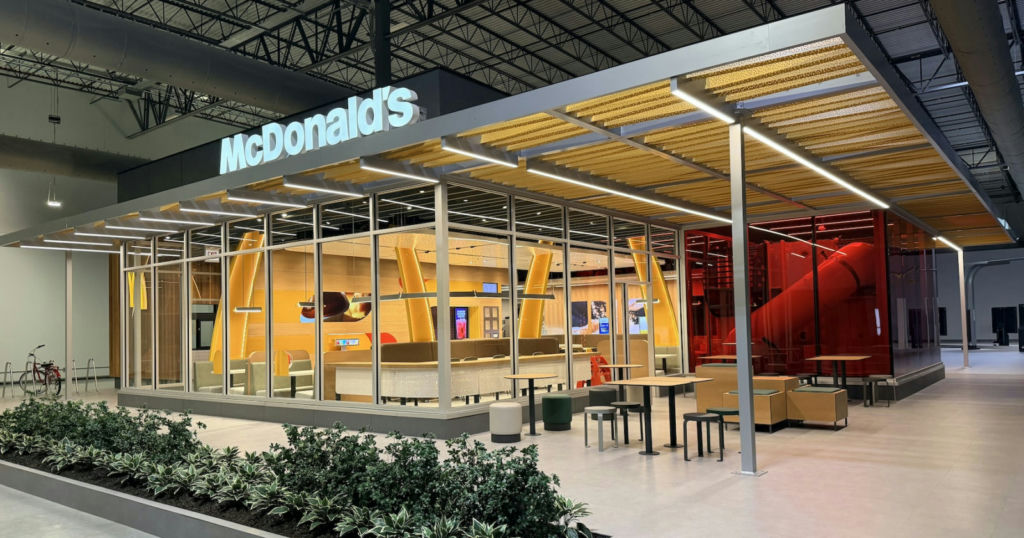
The concern, in reality, is the price tag. McDonald’s plan is not cheap, particularly for its franchisees. The company is about to ask franchisees to spend $800,000 per location on its “Next” modernization upgrades, including new technology and operations changes.
That is on top of $400,000 to $450,000 operators are expected to spend in the U.S. on normal remodels, which are due every 10 years. Those remodels start coming due next year.
At $1.2 million per location, that makes the restaurant upgrades McDonald’s wants, or requires in its franchise agreement, a $16 billion uplift in the U.S. alone. The company is planning to help. It pledged $8.5 billion in assistance over the next decade, globally, to help franchisees make the Next upgrades, including $5 billion by 2030.
But it is counting on the new technologies to pull their weight. McDonald’s key message to its operators is that the plan will improve their profits. The technology improvements will improve efficiency by 250 basis points, which translates into $100,000 in extra cash flow per store.
“We’re not just doing this for the sake of doing it,” CEO Chris Kempczinski said in an interview. “We’re doing it because this is ultimately going to drive growth for franchisees around cash flow. And we believe in it so much that we’re willing to put our own money against it as well.”
But what about the typical remodels? We’ve spoken with multiple franchisees who say they have not finished paying off their loans from the previous upgrade. And this is coming after a period in which rising costs have coupled with relatively weak sales and a discount war to thin profit margins.
Those regular remodels, Kempczinski said, are part of the business. “It starts with the conversation that we have with franchisees when they first join the system, which is we do 10-year remodels, and that’s the expectation of the business,” Kempczinski said. “You need to do that just as kind of keeping your restaurants fresh and relevant, and we know when we get behind, as we did in the U.S., that it’s painful to get caught up there.”
Executives presented data on franchisee finances, saying the typical operator generates $500,000 in cash flow per year on $4 million in average-unit volumes. Kempczinski said that average cash flow is up 50% compared with the last time the company went through a remodel strategy.
“I think franchisees have largely de-levered in the U.S.,” Kempczinski said. “In the event where a franchisee has not de-levered, in some cases that’s a choice. If there are other things (out of their control) that might affect their particular situation, we have the ability to step in and do something out of the ordinary to make sure they can participate in it.”
Industry competitiveness
There is no question that McDonald’s, not to mention just about every other restaurant chain in the U.S., needs to take steps to make its restaurants more competitive. The fast-food business, for a lot of reasons, is not growing traffic share in the U.S.
Generating those kinds of traffic will require effort. The company’s beverage expansion has worked better than expected. The chain is hell-bent on implementing hand-breaded chicken, a plan that echoes the 2018 shift to fresh beef Quarter Pounders that worked wonders for the product.
Those efforts take more people, which drives up costs. Taking some costs out of the system, in the form of AI-based technology that can count inventory, check orders for accuracy, determine whether the shake machine is broken, or even take orders in the drive-thru, can potentially offset those costs.
And McDonald’s last effort to remodel restaurants, which the company called BBV 2020, worked wonders. The company’s estate looks far superior than its competitors. Burger King expects to catch up to McDonald’s in the coming years, but brands like Wendy’s and Jack in the Box are far behind.
McDonald’s remodels provided a sales lift. The new ones could, too. “The U.S. has had since BBV 2020 a pretty good run,” Kempczinski said. “If you actually look at what we’ve shared with U.S. franchisees, we showed them what their cash flow would look like going through BBV 2020. And we delivered on that.”
McDonald’s will need to convince franchisees that this can happen again. And investors, too.
In this story
This story was originally published in Restaurant Business on September 23, 2026. Burnaze summarizes and links to the original reporting.
Read the full story at Restaurant BusinessLiked this? Get the week's franchise news, explained
- Sunday 8 AM ET weekly + a monthly deep dive
- Sections picked for the industries you follow
- Every claim linked to its source. Free.