TL;DR
Starbucks improved its service and sales with the Green Apron Service Model, which sets standards for baristas and increases labor hours in stores. The model has led to positive same-store sales in the past three quarters, including a 7.9% increase in the fiscal third quarter.
Amid all the talk of AI and other technologies, one of the biggest sales-driving initiatives over the past couple of years has involved something much simpler: workers behind the counter.
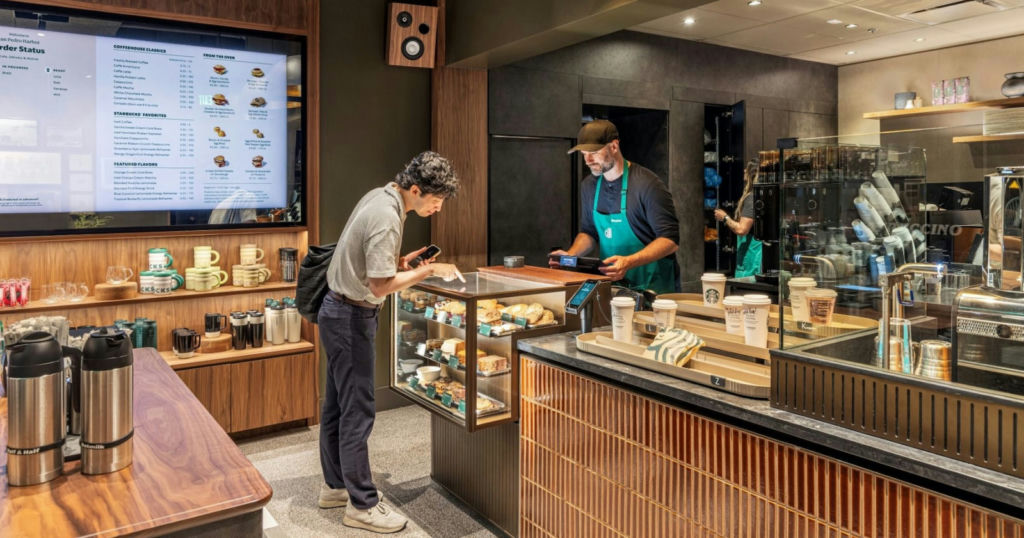
Starbucks more than a year ago instituted its Green Apron Service Model, which sets standards for the baristas while increasing the number of whom work in the chain’s coffee shops.
That move has been crucial to the company’s comeback from a two-year sales slump. The chain’s same-store sales improved almost immediately and have been positive in each of the past three quarters, including 7.9% in the company’s fiscal third quarter ended in June.
Sales and customer growth
Starbucks has also enjoyed a marked increase in customers’ willingness to recommend its coffee shops to family and friends, according to data from Technomic. Nearly three quarters of the chain’s customers are at least likely to recommend the chain, up from 69% before the company made those changes.
“Starbucks has to be something people look forward to,” Mike Grams, the company’s chief operating officer, said in a Q&A provided to Restaurant Business. “That comes to life in simple, personal moments: a warm welcome, a handwritten message on a customer’s cup, and eye contact and genuine appreciation at handoff.
“Technology should unlock the experience, not be the experience. We want customers to feel our service, and human connection has to remain at the center of it.”
The issues that drove customers away in 2023 and 2024 date back years.
Starbucks went all-in on takeout coming out of the pandemic. Customer orders through the mobile app took off, and the drive-thru became more popular, and the company leaned into those channels. It opened takeout-only Pickup stores. One such store, in downtown Seattle, replaced a fancier Reserve location. It wouldn’t repair outlets in shops.
Howard Schultz, who turned a small Seattle coffee bean shop into the second largest chain on the planet, sensed a problem and returned to the chain in 2022. But Schultz’s prescription for the problem, including his chosen CEO Laxman Narasimhan, wasn’t effective.
The company brought in Brian Niccol to be CEO in 2024 and he immediately recognized the conflict between the chain’s courting of mobile customers and its in-store service levels. Starbucks made quick changes, including writing messages on cups and bringing back self-service creamer stations.
Service model implementation
But Niccol then brought Grams out of retirement. Grams had spent decades with Taco Bell, where Niccol served as CEO, much of that time was as its chief operating officer. His task, in a nutshell: Fix that in-store service problem.
Great customer service, Grams said, is not a program, but how the business operates. He also said that operational execution and “human connection” are inseparable. “You can’t just train partners to behave differently and expect it to stick,” he said. “You have to hire differently, train differently, and reinforce it at every turn. You have to remove barriers and friction that get in the way.”
Green Apron Service, he said, is an operating system. The company improved its mobile app to add what it calls Smart Queue, which sequences orders across the shop, including the café, mobile ordering, drive-thru, and delivery. Those changes alone were designed to improve the flow of customers in and out of the shop.
Starbucks' service model combines clear standards with more labor hours.
Before, there was little in the way of anything to govern the way orders come in, so a big batch of mobile orders could back up the shops, creating crowds of people waiting for their Pumpkin Spice Lattes.
The model also combines service standards with more barista hours inside the shops. Green Apron Service gives store managers the ability to deploy the added hours when they are most needed.
That is a crucial part of the system. Managers know best when their store needs more help. Giving baristas clear service standards also ensures they know exactly what to do.
The combination of more workers in stores and better traffic direction of orders coming into the shops has improved the quality of service, so shops can serve more customers, and customers are more likely to come back.
“The goal isn’t to standardize human interaction,” Grams said. “The goal is to remove barriers that get in the way of it.”
“If we’re successful,” he added, “customers won’t talk about our operating model. They’ll simply say, ‘Starbucks feels like Starbucks again.’”
One of the crucial parts of this strategy involves leadership. Company leaders visiting shops don aprons and do a “Coffeehouse Walk” to engage with customers and workers and solve immediate problems.
Leadership and stability
Starbucks is also combining remodels with better service.
The company also focused on improving stability. One of the biggest opportunities at the company, and indeed in the restaurant business as a whole, is to increase tenure of workers. This is especially true among leadership. Starbucks has been able to improve stability among its shop leaders: The share of leaders who’ve been in their role for two or more years increased by seven points year over year last quarter.
“There is a strong relationship between leader stability and coffeehouse performance,” Grams said.
It helps that Starbucks is giving those leaders more ownership. For instance, Grams said, Starbucks is giving their shop leaders more power to order food based on their store needs. That has reduced a frustrating problem at the company: lack of supplies for key menu items.
“Food availability” was close to 99% last quarter, Grams said. The rate at which customers ordered food with their drinks also reached record levels. That was not a coincidence.
“Our coffeehouse leaders know their customers, partners, and communities best,” Grams said. “When we empower them and trust them to lead, great things happen.”
In this story
This story was originally published in Restaurant Business on October 19, 2026. Burnaze summarizes and links to the original reporting.
Read the full story at Restaurant BusinessLiked this? Get the week's franchise news, explained
- Sunday 8 AM ET weekly + a monthly deep dive
- Sections picked for the industries you follow
- Every claim linked to its source. Free.