TL;DR
Gnocchi on 9th, a New York-based Italian concept, has expanded to eight locations in under two years by focusing on portable pasta options. The chain, founded by Ariel Strizower and Mike Salzano, has achieved $4 million in annual sales and is planning further expansion in the tri-state market.
Eight stores in 20 months.
That’s how quickly Ariel Strizower and Mike Salzano built their New York City–based Italian chain Gnocchi on 9th.
This cuisine wasn’t even their initial goal.
In early 2024, Salzano, working as a realtor at the time, and Strizower found themselves on a train in NYC, pursuing Strizower’s long-standing dream of opening a fried chicken restaurant.
But that dream never happened. That’s because the duo couldn’t stop talking about pasta, with Salzano being Italian and Strizower loving the cuisine. They discussed the lack of on-the-go pasta options in NYC, and began brainstorming what could fill that demand.
Annual Sales: $4 million
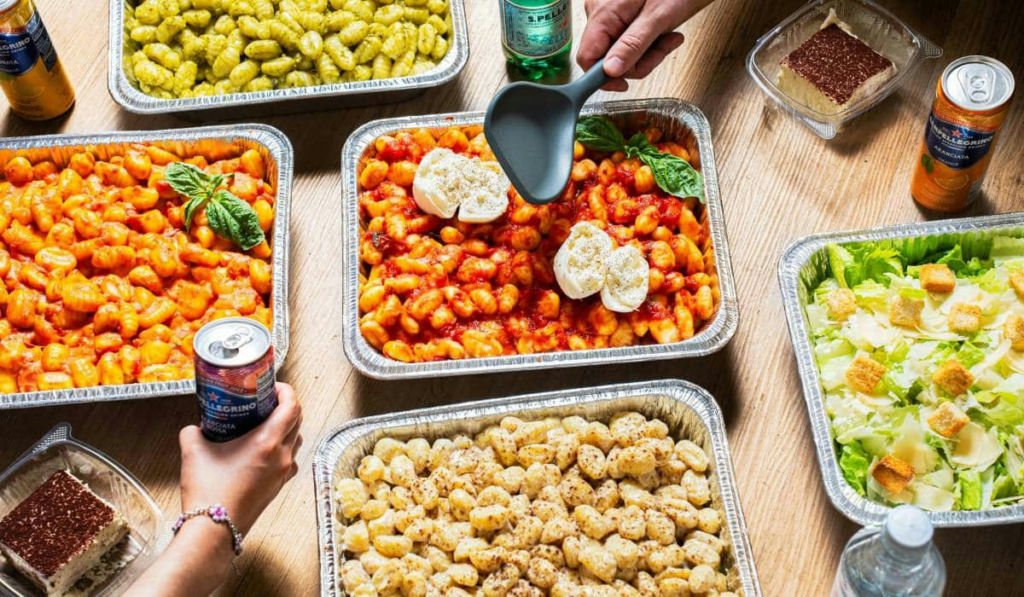
The two landed on gnocchi, which Strizower refers to as “a little niche and it’s fun and it’s always seen as a specialty pasta.” More importantly, the pasta style is easy to eat out of a container because of its size and shape, as opposed to spaghetti or any other long pasta. Also, as a fresh pasta, gnocchi takes around 90 seconds to boil, fitting squarely with the need for convenience and speed.
Once the two felt confident in their new idea, they cut short their list of fried chicken stops and immediately detoured to search for a small hole in the wall that could be suitable for a to-go pasta shop. Salzano and Strizower discovered a spot on East 9th Street in NYC’s East Village neighborhood.
About six weeks later, in April 2024, Gnocchi on 9th was officially opened.
“It was a very quick turnover,” Strizower says.
The two operators were in the store the day before it opened with their written recipes, testing them out, making notes, and adjusting. The concept began with pomodoro (classic tomato sauce) and vodka (tomato and cream sauce) options, but has since expanded to feature flavors like bolognese, pesto, and cheese and black pepper. The brand also offers Caesar salad and tiramisu as side items.
“I’ve been cooking red sauce since I could reach over the stove with my father, so probably like 7 or 8 years old,” Salzano says. “It’s a bit of family recipes and things like that.”
There were no plans for a second restaurant. Strizower and Salzano wanted to keep their jobs in restaurants and real estate, respectively, and have one employee manage the store. That was the extent of their expectations.
“We knew that the idea was to open the shop and make enough money where Ariel and I could have some side income,” Salzano says.
However, life took another detour.
Soon after opening, Gnocchi on 9th welcomed regular customers, including one that offered to make a TikTok. It didn’t take much. All she needed from Salzano was for him to smile and hand her the container full of gnocchi. By the next day, the social media clip had 500,000 views. By the end of the week, it had over a million.
“When that TikTok happened two weeks later [after opening], it turned everything upside down and completely changed the trajectory of the business and our expectations and plans,” Strizower says.
Expansion happened quickly, enabled by the fact that Gnocchi on 9th can fit into small footprints and doesn’t require venting. The chain is based across several NYC neighborhoods—East Village, Upper West Side, Greenwich Village, Lower East Side, Kips Bay, Midtown, and Upper East Side.
Salzano and Strizower were able to uncover spaces overlooked by most restaurateurs, such as barbershops and ice cream stores ranging from 140 to 450 square feet. Additionally, the brand requires only one to two employees to fully operate—three at the absolute maximum.
“Our biggest footprint would be an operational struggle for any restaurant to function in,” Strizower says. “I think what allowed us to find the locations that we did was because nobody else would be able to really look at them, especially not a restaurant. Maybe for a smaller retail situation, but because of how our concept operates, we’re really able to set up in an incredibly small space, and it doesn’t really inhibit us, whereas most other operators wouldn’t even be able to consider a space.”
In terms of business infrastructure, Salzano and Strizower have handled all of the high-level work, until recently when they hired one corporate employee. Before that, the two oversaw store scheduling and payroll, dealt with each of the 50 hourly workers one-on-one, and controlled all food and operational aspects. They are growing a loyalty program as well thanks to Salzano’s background selling marketing services to businesses.
“A huge factor behind us being able to grow isn’t just that the business was successful, but we were fortunate to find really talented, trustworthy, and happy people to work in our stores, which allowed Mike and I to step away from the stores to build out future stores and to build out operations,” Strizower says. “If we didn’t have really strong teams in the stores, Mike and I would have never had that freedom to remove ourselves and start looking at bigger picture problems and needs. So a lot of the credit does have to be given to the teams who are working really hard every day in our stores and doing a great job at it so that Mike and I can focus on other aspects of the business.”
More expansion is ahead. As of press time, Salzano and Strizower were negotiating leases in New Jersey and looking at spaces in Queens. The owners want to keep the brand within the tri-state market before venturing into more distant trade areas.
Gnocchi on 9th hasn’t taken on any debt either. All growth has been funded by the business.
“The idea is that people are showing us that they enjoy it and they want it and they’re asking for us to come to this neighborhood and this neighborhood,” Strizower says. “Let’s use the success of the business. Let’s put that money to opening more stores, and that was really the idea—that the success of the business drove the growth of the business.”
In this story
This story was originally published by Ben Coley in QSR Magazine on May 11, 2026. Burnaze summarizes and links to the original reporting.
Read the full story at QSR MagazineLiked this? Get the week's franchise news, explained
- Sunday 8 AM ET weekly + a monthly deep dive
- Sections picked for the industries you follow
- Every claim linked to its source. Free.