TL;DR
Restaurant loyalty programs are using personal data to decide which guests receive which offers, raising questions about personalized pricing and loyalty discounts. State lawmakers and the FTC are addressing these issues with laws and proposals that protect discounts and require disclosure of personalized pricing.
Restaurant loyalty programs increasingly use personal data to decide which guests receive which offers, and that raises a question many chains would find hard to answer from their own records: which guests pay more than the menu price, which pay less, and why. As Publicis Sapient’s Jagdish Ghanshani noted in a September Outside Insights column, AI is moving brands “toward decision-making at the individual and occasion level,” and the more individual those decisions become, the harder they are to explain.
State lawmakers working on personalized pricing have largely protected discounts while restricting higher prices based on personal data. Maryland, since October 1, has barred food retailers and third-party delivery services from using a consumer’s personal data to charge that consumer a higher price. Connecticut will prohibit surveillance pricing by retail sellers, including retail food establishments, from July 1, 2027, but its definition excludes discounts intended to retain a customer, win back a lapsed one, attract a new one or encourage cross-selling, as well as posted discounts offered on uniform terms through a loyalty program.
In Colorado, the governor vetoed a surveillance pricing bill in June after retail groups argued it could restrict coupons and loyalty rewards.
State laws and regulations
The federal approach so far centers on disclosure, with the FTC proposing that businesses tell consumers when a price is personalized, on what basis and using which types of data, while New York already requires a label on algorithmic prices set with personal data.
Personalized programs seldom move prices in only one direction, which is why the distinction between discounts and increases is harder to hold in practice than in law. In the FTC’s surveillance pricing study, companies described their tools as lifting revenue by 2 percent to 5 percent and margins by 1 percent to 4 percent, gains that are difficult to produce through discounts alone. As segments become finer, deeper offers to price-sensitive guests are often funded by smaller offers or higher effective prices for others.
FTC staff drew those figures from the companies’ own documents, and an internal analysis showing which guests pay above the menu price, without a clear reason, is exactly the kind of record that draws scrutiny.
Addressing the problem
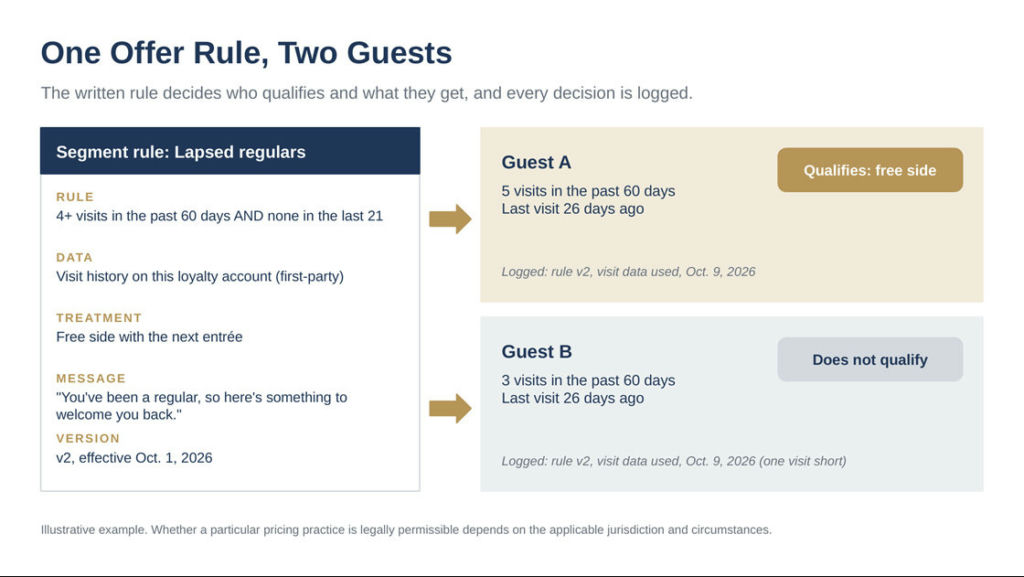
One way to address the problem is deterministic segmentation, which moves the offer decision out of the model and into a written eligibility rule, with each segment’s treatment recorded relative to the menu price. Models can still identify which groups of guests respond differently to offers, and a chain can choose to keep every segment at or below the menu price. A lapsed-regular segment, for example, might include members with four or more visits in the past 60 days and none in the last 21, who receive a complimentary side with their next entrée.
Figure 1. One written rule, two guests. The rule determines eligibility and treatment, and each decision is logged. Illustrative example.
Because the rule is the decision, the same record shows where the segment sits against the menu price, explains to a franchisee or a guest why an offer was made, and supplies the plain-language basis a disclosure requires.
Purchase history is the most defensible basis for these rules, and research by Priester, Robbert and Roth found that consumers judge prices based on purchase history fairer than prices based on location. A commitment to first-party data still needs a mechanism behind it, and when each rule names its data sources, a reviewer can see when a feature comes from outside the loyalty account, such as broker data on location or income, or when ordinary orders reveal something sensitive about a household.
Competition exposure
Competition is the less discussed exposure, because the FTC’s proposal says little about it even as algorithmic pricing moves into antitrust litigation. The FTC alleges that Amazon used an algorithm code-named Project Nessie to identify products where rivals were expected to follow its price increases, a claim Amazon disputes that survived a motion to dismiss in 2024, and in July the Third Circuit revived a price-fixing suit against Atlantic City casino hotels that fed non-public data into the same pricing software.xii For restaurant chains, that argues for segment rules that ignore competitors’ prices, data that is never pooled with other chains’, and caution toward any vendor whose pitch is that the whole category already uses it.
Whether a given chain falls under these laws is a matter for its counsel, particularly since Connecticut’s text names retail food establishments without mentioning restaurants. A practical first step is to review the offers already running, listing for each one the customer data that triggers it, the channels that apply it and whether the guest’s result is a discount, the menu price or something higher. The operational preparation is the same either way: a loyalty program should be able to show, from its own rules, which guests pay more than the menu price, which pay less and why, because that is the most basic question any inquiry into a pricing program is likely to ask.
In this story
This story was originally published by Ben Coley in QSR Magazine on October 29, 2026. Burnaze summarizes and links to the original reporting.
Read the full story at QSR MagazineLiked this? Get the week's franchise news, explained
- Sunday 8 AM ET weekly + a monthly deep dive
- Sections picked for the industries you follow
- Every claim linked to its source. Free.