TL;DR
McDonald's has a secret archive at its Chicago headquarters that stores and tracks items from throughout the company's 71-year history, including training manuals, advertisements, toys, and letters. The archive is a business resource that supports the company's owner operators, company people, and suppliers.
Deep inside McDonald’s Chicago headquarters is a nondescript room with glass doors that at first seems like a glorified storage room.
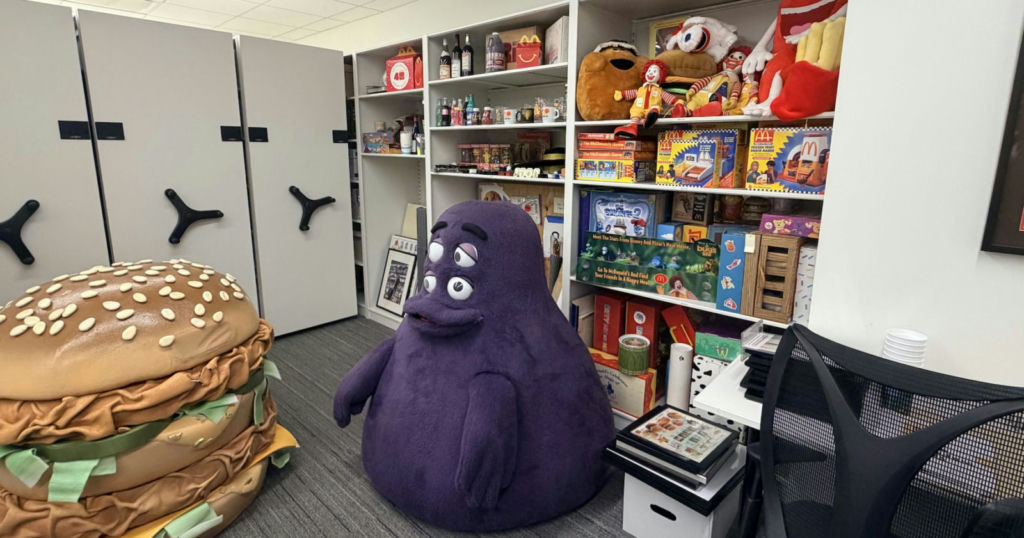
There are giant stuffed Big Macs, a giant spatula marking the 10,000th McDonald’s store, a large stuffed Grimace with four eyes, a McDonald’s band uniform, and shelves of items, such as Happy Meal toys from the Pixar movie “A Bug’s Life,” games such as McNugget Buddies BINGO and toys like a McDonald’s Frozen Fruit Snack Maker.
Go deeper, however, and it’s clear there’s more here. In a room to the side are Multimixers, the kind that Ray Kroc sold when he met the McDonald brothers in 1954 in San Bernadino, California. This is anything but a storage room.
The McDonald’s Archive carefully stores and tracks items from throughout the storied company’s 71-year history, including everything from training manuals to advertisements to toys to letters and every uniform the chain has used. There are five semi-loads worth of such items, much of which is kept in storage.
And it’s far more important than you think. CEOs have visited, including Chris Kempczinski. So has new McDonald’s USA President Skye Anderson. Teams come here to research initiatives. Franchisees and vendors from around the world bring families for tours to get a sense of the brand’s history, though the archive itself is not open to the public. But mostly it's a record of one of the most important companies in U.S. history.
“It’s not a closet of curiosities,” said Mike Bullington, McDonald’s senior archive manager. “This is a business resource that supports all three legs of the stool: our owner operators, our company people here at MHQ and around the world, and our suppliers.”
Bullington has a master’s degree in history and is a member of the Academy of Certified Archivists. He worked with Kraft Foods and Rush Medical Center before he was brought to McDonald’s to oversee the archive 21 years ago. He had never worked for the company before then. “I was a customer,” he said.
But he has as much of an appreciation for the brand and its history as anybody. And certainly for the company’s founder.
Bullington’s favorite piece is a note from 1957, on company letterhead with McDonald’s old “Speedee” logo at the top right corner. It’s a thank-you note, to “Fred” from “Ray,” in which Kroc expresses his appreciation to Fred Turner.
“I want you to know how much I appreciate your cooperative spirit,” the note began. Turner had only worked with McDonald’s for a year and a half. He would go onto become chairman and CEO and would prove crucial to the chain’s success.
“I got to know Fred pretty well, and when he passed away, his family had me go to his home and go through all his personal papers and we found that note,” Bullington said. “To me, it shows [Kroc’s] taking care of people.”
The most valuable, according to Bullington, is a 10-year anniversary ring that Kroc once wore. Bullington has Kroc’s birth certificate, and a letter from Kroc’s representative on the West Coast telling him about the McDonald brothers’ restaurant.
Keeping track of such things is crucial for a company with a history as extensive as McDonald’s. The McDonald brothers opened the first restaurant in San Bernadino in 1940. Eight years later they simplified the menu to focus primarily on burgers and created a self-service model and assembly line.
Kroc, a traveling salesman, became McDonald’s franchise agent in 1955 and that year opened a location in Des Plaines, Illinois, creating the modern corporation. The chain would go onto become the world’s largest restaurant chain, a fast-food pioneer and a huge part of American culture.
“I really believe it’s a brand advantage,” Bullington said. “It’s an advantage for us to have this. McDonald’s was built upon the shoulders of a lot of great people. We’re just continuing their legacy, and those stories are here to help spur on future growth and development for the company.”
“It’s relevant to the history of the world,” he added.
> @jonathandmaze I visited @McDonald’s headquarters during the #fastfood chain’s Investor Day presentation and got a rare look at the company’s archive. Mike Bullington, the company’s archivist, collects everything from Happy Meal toys to letters from Ray Kroc to uniforms to Kroc’s original Shake machine. The goal is to preserve the history of one of the most important businesses in US history. (He is looking for a 9-piece Chicken McNuggets box from 1983) In this video, we get to see the start of a training tape from 1972 on the Quarter Pounder. Enjoy! #fastfoodminute#restaurants#history♬ original sound - Jonathan Maze
When McDonald’s upgraded its burgers, a program the company called “Best Burger,” teams visited the archive and Bullington presented them with an old training tape on the Quarter Pounder from 1972 on an old La Belle Projector, a device that looks like an old tube television powered by an eight-track tape.
The tape starts with a customer gushing about the newly introduced burger. “That’s the voice of a McDonald’s customer who is more than satisfied with our new quarter-pound sandwiches,” the narrator says.
Marketing visited when the company was developing its McDonaldland Shake, which the company introduced last year. Franchisees will visit when their store has an anniversary, to see if there’s anything to reference that store’s history.
This summer, Bullington went to McDonald’s Worldwide Convention and saw the company’s new store design, which reminded him of the chain’s earliest restaurants, particularly with its visible kitchen. “I saw the new restaurant and said that’s the model, because you can see the crew freshly prepare food in front of you,” he said. “I was blown away when I saw that restaurant.”
McDonald's keeps many items, like a huge selection of Happy Meal toys, on display at its headquarters.
Some of the pieces are on display elsewhere at McDonald’s headquarters, including a letter from Dick McDonald to Ray Kroc, praising him for his leadership of the chain. A wall displays decades’ worth of Happy Meal toys. Another display shows boxes featuring the chain’s early attempts at a competitor to Burger King’s Onion Rings, including Onion Nuggets, which would lead to the development of Chicken McNuggets — currently a $15 billion brand.
Bullington gets items anywhere he can find them. Franchisees will provide items, and if operators come in from another country, he will sometimes ask them to bring stuff with them. Vendors are a crucial resources for items. And though he prefers not to, Bullington will sometimes buy them.
Bullington doesn’t take long to say what item he is still looking for. “I need a 1983 nine-piece Chicken McNugget box,” he said. McDonald’s changed from nine to 10 pieces in 1993. “I’ve got the 20. I’ve got the six. I don’t have the nine.”
In this story
This story was originally published in Restaurant Business on September 30, 2026. Burnaze summarizes and links to the original reporting.
Read the full story at Restaurant BusinessLiked this? Get the week's franchise news, explained
- Sunday 8 AM ET weekly + a monthly deep dive
- Sections picked for the industries you follow
- Every claim linked to its source. Free.