TL;DR
Chick-fil-A CEO Andrew Cathy focuses on fundamentals amidst intensifying chicken competition, while McDonald's aims to gain 1.5 points of chicken category share by 2030. Chicken chains grew sales by 5.3% in 2025, outpacing the overall industry.
At the end of September, McDonald’s CEO Chris Kempczinski outlined his company’s “Next” strategy — a massive, $8.5 billion initiative to modernize the brand and win the industry’s intensifying market share game.
One objective folded into that broader plan is to gain 1.5 points of additional share in the chicken category by 2030. McDonald’s has already created a dedicated category team to support this goal and is testing hand-breaded chicken in select locations in the U.S. and Ireland.
This is no surprise. For the past several years, the growth story in the industry has been written by chicken chains.
That story continued in 2025, as sales at such chains grew by 5.3% versus the overall industry, which was up 3%, according to Technomic’s Top 500 Restaurant Chains report. By comparison, the burger category, McDonald’s bailiwick, grew sales by just 1.5%, while pizza finished the year at -0.3% year-over-year.
Chick-fil-A's strategy
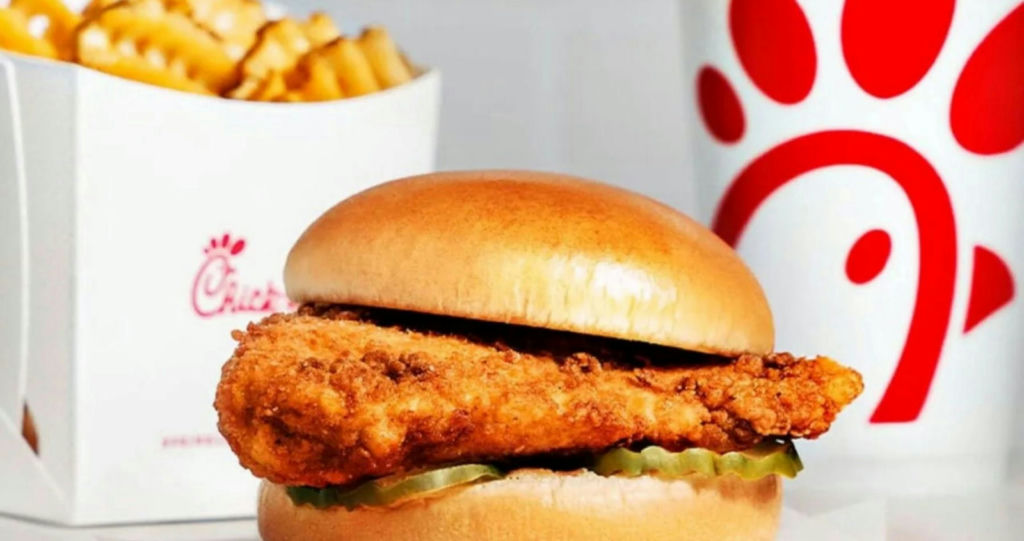
The chicken share leader is Chick-fil-A, but CEO Andrew Cathy hardly seems worried about a sharpened focus from his Golden Arches rival or others. Rather, he’s more motivated than ever.
“I grew up in sports and used to be a coach (high school football and track). I love competition. It just makes us better,” he said during a recent interview in New York City. “All aspects of competition just makes us refine and get better. It’s a great challenge.”
More players prioritizing and investing in chicken forces Chick-fil-A to continuously look at what it could be doing better in terms of service, food, branding, processes — everything, he added. He also embraces a rising-tide-lifts-all-boats optimism.
“We’re very grateful consumers want chicken. It's helpful since we're in the chicken business,” he said.
In addition to McDonald’s, the chicken category’s massive growth wave has been created by chains like Raising Cane’s, Dave’s Hot Chicken, Wingstop, and several other startups. Such competition wasn’t as intense when Cathy’s predecessors — father Dan and grandfather Truett — were running the company. But the third-generation Cathy leans on the lessons of author and management consultant Jim Collins — who wrote books such as "Good to Great," "Built to Last," and "Great by Choice" — to understand how to carry their legacy while forging his own path, or as Collins puts it, “preserve the core while stimulating progress.”
Leadership philosophy
Five years into his CEO role, he’s certainly been able to cultivate some leadership philosophies of his own.
“I look at business as driving a race car. The reason the windshield's bigger than the rearview mirror is you’ve got the rearview mirror to keep you grounded of where you’ve been, but you’ve got to evolve and change everything else,” he said. “As an organization, it’s important that we’re grounded in the core of who we are, which is timeless. But we’re taking in the surroundings of competition and consumers and what everybody wants to continue to drive to the future.”
Despite a larger windshield, however, it’s a challenge to evolve to meet ever-changing consumer needs, particularly when they’re more sophisticated about food and beverages and they’re more digitally native, he added.
“It's an environment that's ever changing; it's becoming so important to be agile — more than ever — based on all of the things happening with consumers,” he said.
Staying agile
Though Cathy recently held a companywide meeting and challenged employees to think about what capabilities they’re each growing individually to ensure such agility, he makes it a point to note that Chick-fil-A won’t stray from the fundamentals, no matter how much the world is changing. The company’s foundation, for instance, was built on hospitality, and a “Second Mile Service” playbook, and that will continue despite an industrywide push toward digital bells-and-whistles. This is why Cathy recently said the company has no plans to replace human order takers with artificial intelligence, despite several of the company’s quick-service peers rolling out the technology at the drive-thru.
That said, Cathy admits what keeps him up most at night is whether the chain is moving fast enough.
“Are we pushing the limits enough? Because the temptation for any organization is that you can get too comfortable,” he said. “I want to make sure we’re continuing to innovate and change and develop and grow so that we can meet customer needs in the future.”
To avoid such complacency, he encourages his team to make sure they have a “healthy dose of fear.”
“You don’t need to be consumed by it, but you do need to realize we’re susceptible to the same market forces as any other business and so what are we doing to get better? How can we serve customers better?” Cathy said.
His answer for now comes back to focusing on the fundamentals.
“As fun and exciting as it is to have new app features and new products, we have to be maniacal about the fundamentals,” he said. “At the end of the day, people want some basic things — they want to get what they ordered, some great food, warm hospitality, a great environment. We can't ever lose sight of those fundamentals to execute.”
Members help make our journalism possible. Become a Restaurant Business member today and unlock exclusive benefits, including unlimited access to all of our content. Sign up here.
In this story
This story was originally published in Restaurant Business on October 7, 2026. Burnaze summarizes and links to the original reporting.
Read the full story at Restaurant BusinessLiked this? Get the week's franchise news, explained
- Sunday 8 AM ET weekly + a monthly deep dive
- Sections picked for the industries you follow
- Every claim linked to its source. Free.