TL;DR
Zaxby's has surpassed 1,000 locations in the US, driven by strategic leadership changes and investment from Goldman Sachs. The chain has implemented a 'Grow to Win' strategy, which has led to improved profitability, digital sales, and new unit growth.
Zaxbys entered 2026 as a member of the 1,000-unit chicken club (U.S.) for the first time in its 36-year history, joining Chick-fil-A (3,287), KFC (3,523), Wingstop (2,586), and Popeyes (3,196).
VP of development Bert Lane, who spent 27 years with Arby’s and last served as senior director of franchise development at Inspire Brands, moved to the fellow-Atlanta-based chain in summer 2023. At the time, Lane outlined a path to eclipse four-digits in two years—a target Zaxbys made good on. When the company hit 1,000, Lane in a statement called it “a pivotal moment” in brand history.
But before getting into what’s next, Zaxbys was not exactly collecting momentum a few years ago. Goldman Sachs acquired the chain in late 2020 (here’s a look back at the sale) and announced former El Pollo Loco leader Bernard Acoca as CEO in 2021. He was just the second chief executive in Zaxbys’ timeline (following cofounder Zach McLeroy) and first outside the organization. Acoca officially grabbed the reins that January.
Zaxbys had the bones and equity needed to scale, but it was tracking in the wrong direction. The brand added a net of three restaurants from 2020 to 2021. That number was 65 in 2014, 91 in 2015, and 74 in 2016. It then slipped to 21 in 2017, six in 2018, 10 in 2019, and three the coming calendar (as mentioned). The line then began to slowly slope, with Zaxbys tacking on 11 restaurants in 2022, 20 in 2023, and 26 in 2024, before bumping to 36 this past year.
Turnaround strategy
It took about 18 months for Zaxbys to modernize and retrench before it could reaccelerate. Acoca’s “Grow to Win” strategy wrapped around five pillars. One involved reducing costs (the company lowered COGS by 7 percentage points) in an effort to boost profitability and encourage operators to invest in development. Zaxbys started by diversifying its supplier base. Namely, with chicken. The chain didn’t have many long-term contracts and wasn’t hedging. Pricing didn’t have floors or ceilings.
Register for the QSR Evolution Conference to network with the top brands in the country. Registration is now open here!
Today, there are more suppliers than ever. As much as anything, franchisees clamored for consistency.
Next, Zaxbys addressed “painfully slow” drive-thru times (70 percent of sales). The brand organized the back of house and worked on throughput processes, such as how it makes Zalads, and deployed Berry’s AI camera timers to layer visibility into the process and address bottlenecks. The brand also looked at order-taking tablets, better drive-thru station ergonomics, and training, among other fixes, like implementing experience-forward scorecards to evaluate performance.
Order accuracy increased 12 percent. And Zaxbys started using front-of-house monitors to distinguish between in-restaurant and digital customers. Speed of service improved more than 20 percent.
Outside of the drive-thru, digital sales doubled from a prior level of about 8 percent and popped north of 20 percent in 2025. There wasn’t a loyalty program when Acoca joined (he called it a “glorified email club” with about a million members and no customer data platform). Essentially, Zaxbys was sending blanket offers to everyone.
That’s progressed to a Zax Rewards system (launched in October 2022) with more than 7 million members. Before El Pollo Loco, Acoca spent seven years with Starbucks and lastly directed its Teavana brand. He helped refine the java giant’s famed program and carried some of those learnings over to Zaxbys. Loyalty users spend about 5 percent more and visit 3X compared to non-members.
Priority No. 4 was to stand out “in the sea of sameness”—a reference to the packing of boneless fried chicken concepts, which has seen brands from Raising Cane’s to Bojangles to, recently, KFC, plant flags in this particular poultry avenue. Zaxbys removed the apostrophe from its name and released a “Southern Hospitality 2.0” approach that focuses on accessibility and its 12 proprietary sauces. Zaxbys outlined all of it in a “brand book” that serves as the company’s strategic filter.
In one manifestation, Zaxbys’ “Who’s Got the Sauce?” campaign launched in 2025 with actor Omar Epps as the “Sauce Boss.” The chain expanded through LTOs like Lemon Pepper Dry Rub and piloted fresh dayparts, including “Late-Night Zax.”
Chicken fingers mix upward of 65 percent of sales for the brand (sandwiches are 12–15 percent).
New unit growth plans
And the final pillar concerned new unit growth. The goal for Zaxbys is to bump its recent 5–6 percent annualized push to 7–8 percent and, ultimately, 10 percent. Franchisee profitability has hiked 40 percent since 2021.
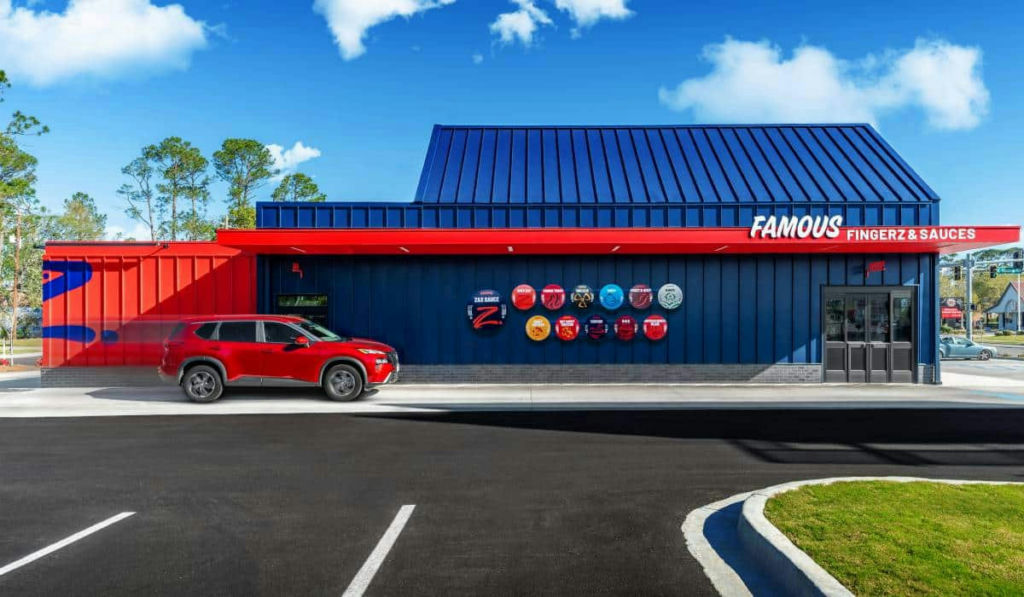
Part of the road forward involved redefining the company’s assets. The prior 3,000-square-foot freestanding Zaxbys wasn’t optimized. Presently, there are six types under a “Modern Farmhouse” umbrella, from full sized to drive-thru-only to dual-lanes to traditional and non-trad targets, and a fleet value-engineered to run 30–75 percent less in costs. Zaxbys wants to get to 20–25 percent unlevered cash-on-cash returns for operators.
The brand’s 1,000-unit marker included debuts into metros such as Las Vegas and Phoenix, as well as growth across Illinois, Maryland, New Jersey, and Pennsylvania. Earlier in the year, it signed a non-trad deal to launch on a military base. This coming year circles Florida, Illinois, Indiana, Kentucky, Michigan, Ohio, Tennessee, Texas, and Virginia.
Additionally, Zaxbys will look into runway on campuses, military bases, and travel hubs.
It’s an effort led today by chief development officer Russell Holland, who shed the interim CDO tag in June. The former Inspire Brands VP, head of real estate, acted in the capacity since February. He also previously aided growth at Waffle House.
Unpacking 2025’s performance, Zaxbys’ net growth of 36 included 39 on the franchised side (affiliate-owned, or company run, declined by three). The mix year-end was 865 franchises and 140 affiliate-owned for a total of 1,005 restaurants.
Zaxbys opened 41 franchised stores, terminated six (a number that has been the same for three straight years), had a non-renewal, and acquired six locations. One also ceased for other reasons.
The growth chart built off 37 and 26 openings in 2024 and 2023, respectively.
Zaxbys remains centralized around its Southern core, with future whitespace webbing out. Georgia (211), Florida (117), North Carolina (99), Tennessee (92), Alabama (89), and South Carolina (72) comprise about 78 percent of the franchise portfolio.
That’s even more the case with corporate units (see below).
But, for 2026, Zaxbys has 62 projected new gross franchised stores on deck alongside seven company and claims to have 149 franchise agreements signed without an outlet opened yet, laying the pipeline ahead. And it’s a spread-out bubble. Florida, South Carolina, and North Carolina have the most expected growth slated for 2026 with eight apiece. Georgia and Maryland (a market with only two stores currently) each tout five. Alabama and Arizona are looking at four openings, while Kentucky, Indiana, and Tennessee project three apiece.
Illinois, New Jersey, New York, Ohio, Pennsylvania, Texas, and Virginia all plan to open Zaxbys this year as well.
And for agreements signed, Arizona has 13, Florida 19, Georgia 15, North Carolina 13, South Carolina, 10, Tennessee 11, and Virginia 12. It scatters then through Alabama (seven), Delaware (one), Illinois (one), Indiana (four), Kentucky (five), Maryland (nine), Mississippi (four), Missouri (one), Nevada (three), New Jersey (three), New York (two), Ohio (four), Oklahoma (one), Pennsylvania (three), and Texas (eight).
Into performance, Zaxbys shares average gross revenues for 809 franchised restaurants opened and operating last year on its FDD.
It also reports the figures alongside certain operating costs for 563 franchises stores that submitted data.
And average EBITDA from operations.
Also, sales running on a three-year basis, where Zaxbys has posted about 2.5 percent expansion over the stretch.
Zaxbys has said it wants to get its AUVs into the $3 million orbit.
The total investment necessary to begin operation of a franchised Zaxbys Restaurant is $1.460 million–$3.810 million. This includes $40,200–$45,000 paid to the franchisor.
U.S. systemwide sales for Zaxbys year-end 2025 were $2.754 billion. That was sixth among chicken chains in the top 50 overall of grossing QSR brands, behind Chick-fil-A ($23.9 billion), Popeyes ($5.7 billion), Raising Cane’s ($5.48 billion), Wingstop ($5.34 billion), and KFC ($4.682 billion).
In this story
This story was originally published by Danny Klein in QSR Magazine on July 6, 2026. Burnaze summarizes and links to the original reporting.
Read the full story at QSR MagazineLiked this? Get the week's franchise news, explained
- Sunday 8 AM ET weekly + a monthly deep dive
- Sections picked for the industries you follow
- Every claim linked to its source. Free.