TL;DR
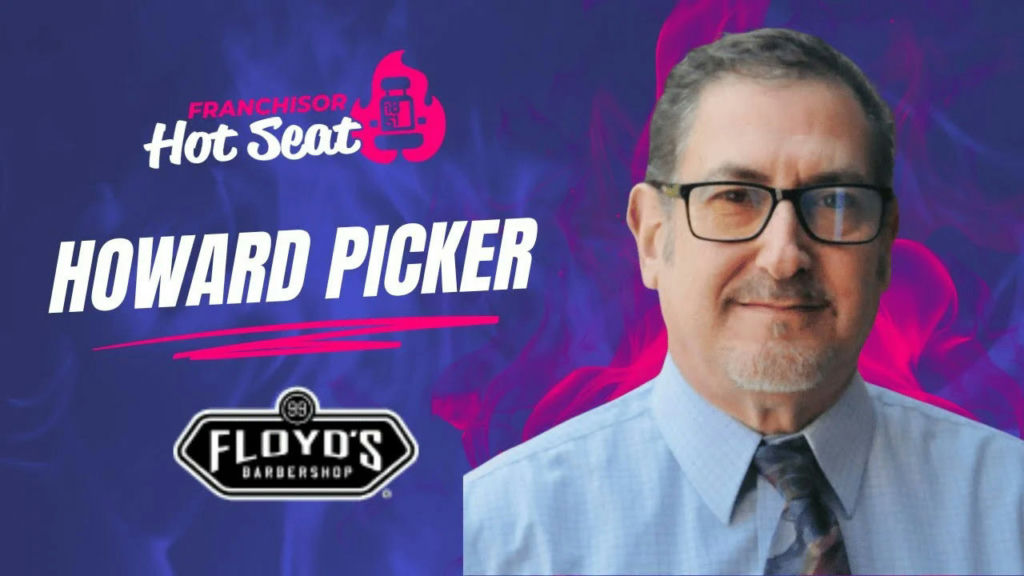
Floyd's 99 Barbershop Chief Growth Officer Howard Picker is focusing on building strong, multi-unit operators to drive the brand's growth. Picker has over two decades of franchise experience and is using his insider perspective to develop the brand.
With more than two decades of franchise experience under his belt, Floyd’s 99 Barbershop Chief Growth Officer Howard Picker is bringing a rare insider perspective to brand development — and his strategy centers on building strong, multi-unit operators, not just selling more licenses.
“I absolutely love what I do,” Picker said. “I get to share with people what business has done for me — and help them find the right opportunity for their goals.”
In this episode of “Franchisor Hot Seat,” Picker joins 1851 Franchise publisher Nick Powills to talk about his journey from aerospace engineer to multi-unit franchisee, franchisor and now executive team member at Floyd’s 99 Barbershop. Founded 25 years ago, Floyd’s blends a classic barbershop vibe with a music-fueled, modern experience, and has grown into a national brand with 65 open franchise locations, 52 more in development and a uniquely intimate roster of just 12 franchise groups.
Floyd's 99 Barbershop history
“At its core, Floyd’s is authentic,” Picker said. “It has a great culture, and we’ve proven the model over the last 25 years — including through COVID. Our locations have more chairs than the typical barbershop, which drives higher average unit volumes. And because we started as a family business, we’ve kept that mindset — but now with a strong, scalable franchise model.”
Rather than trying to sell hundreds of units overnight, Picker is focused on finding the right operators who share that mindset. His goal is sustainable expansion, supported by new field staff, carefully planned territories and a deep commitment to franchisee success.
Picker knows firsthand the stress of walking away from a stable corporate paycheck and betting on yourself as a business owner — and he uses that experience to guide candidates through the decision. “I don’t think the entrepreneur in me will ever go away,” he said. “That’s why I love this role. I’ve been the guy on the truck, doing the marketing and running the business. I can look someone in the eye and say, ‘I’ve walked a day in your shoes.’”
For Picker, that empathy translates into a clear mission: to help each franchise partner grow and win in their own market. With a brand rooted in authenticity, supported by a proven system and led by someone who’s lived every phase of the franchise journey, Floyd’s is positioned to scale — one strong operator at a time.
A transcript of Powills’ interview with Picker has been provided below. It has been edited for brevity, clarity and style.
Howard Picker: Well, thanks, Nick. You know, it’s interesting. I probably, like most folks — I was out of college, in the corporate world. I was a mechanical engineer for an aerospace company for about 14 years. Then I decided, you know, I’m just not achieving the goals I want. So I actually ended up leaving the aerospace industry and went to the tech industry, believe it or not.
I was very blessed to have a really great early career with IBM Global Services. And you know, IBM stands for “I’ve Been Moved,” because they were moving me all over the world, and I hadn’t had enough time with my family. So I started looking into options — what kind of businesses I could do. I ended up buying a mitigation business in franchising.
The interesting thing is, being in the corporate world really taught me a lot about networking and talking with folks in and out of your supply chain. It was a great foundation. My wife and I actually ran one brand, and then we expanded to a brand in a different industry — actually very similar to what Floyd’s is. We achieved our financial goals, we achieved our personal goals. It was one of those great things. And later I realized I needed to spread the word. I had to tell other people how to achieve their goals as well.
So through franchising — as a franchisee and then, at one point, becoming a franchisor — I created my own brand and expanded that across the U.S., then sold it successfully. It’s been a whirlwind. But I remember the early days of starting a franchise — being the guy on the truck, doing the marketing, and doing all the work as well. Starting out very small. But it was a great experience. I guess if you look at it as an accident, it was meant to be. I could never have achieved what I have in the corporate world as I did in the franchise world.
Powills: When you were at IBM — out of curiosity — how much time went from, “Obviously I need to make a change for my family,” to “I need to go investigate what franchising is,” to “I’m becoming a franchise owner”?
Picker: For me, it was a thought that I had early on, but the entire process was probably decided within a year. I would go off on assignment for IBM 10 months out of the year. I’d be in a different location than my wife and my young son at the time. I just thought, “This is getting a little tiresome. I miss my family.”
I even talked with management. I said, “Hey, could I do anything to get my family here with me?” They said, “No, but we can help you pay your bills remotely.” I just thought, “That’s not what I’m looking for.”
I checked around a lot of brands. I was looking for something recession-proof, obviously. I came across a friend of my sister’s. Every day for a year, I spoke with him — this was for the mitigation business. He was an area manager and had done quite well in the brand. Every day, I’d get on the phone with him and ask a few more questions.
Finally, I remember sitting in a hotel room in Minneapolis, on the edge of the bed. I called my wife and said, “I just quit. I’m coming home, and I’m buying a franchise.” She said, “Great. See you soon.” I don’t know that we really knew what we were in for at that time. My first franchise was an existing business, kind of run-down. We had our work cut out for us. But the best partner I ever had was my wife, and we just took it up from there.
Powills: Was there a new stress level when you go from getting a paycheck to now it’s all your money being bled out?
Picker: That’s a great question. When you’re standing on the edge of the cliff looking at the abyss — knowing you have a guaranteed paycheck — yeah, you question whether you’re making the right decision.
That’s why, when I go through conversations with franchisees or prospects, I absolutely love it. I remember thinking, “If I don’t take this leap, I’ll never know.” And I did it. I was very successful because I had success in mind. I had the right mindset.
When you’re looking at your break-even in the beginning, it’s a great deal of money you have to collect every month. But I didn’t look back. We started growing 30% from the second month for the next two years. It was unbelievable. And it was nothing more than being a better service provider and doing what I do best — talking to people. It was a great experience and a long journey.
Powills: You’ve exited two times as a franchisee, once as a franchisor. What made you know it was time to exit? Or did you go in thinking you’d build it to sell?
Picker: I think you always have to have an exit plan. We never know what’s in store. When I came into a brand, no one really talked to me about the particulars of the business itself. I knew this would lift me where I needed to go, but it wasn’t the end all.
I had an exit in mind for one or two brands. Then I didn’t really know what was next, but I knew I’d find out. I kind of fell into being a franchisor with a brand I created. It was wonderful — everything I had envisioned. Then one day you put it up for sale, get an offer, and say, “Wow, this allows me to do the next thing I want.” Life is about choices. I picked what was best for me and my family.
Powills: This is going to be a weird, complex question. I saw this Instagram reel about how life works. It shows childhood, then working until you’re 65, then maybe 10–15 years left. It made me think — if you’re enjoying what you do, it’s part of the puzzle. But if you dislike it, that’s when people go into franchising. So what is “winning” to you? Does your definition of winning give you a different lens — like not selling franchises, but developing franchisees? And do you still feel pressure, or is the scoreboard different now?
Picker: That’s a really great question. As we go through our careers and get a little gray — and of course, stress leads to that — at Floyd’s we have great blending, so you can’t really tell!
Everything I’ve done in my career provided for where I am today. I can’t look back and say nothing contributed. But the difference between working a job and loving what you do is huge.
If you don’t feel like you’re contributing, it’s probably time to go. And yeah, there’s stress, but I do what I love. When Floyd’s came around, I knew I wanted to be here. Now, I absolutely love what I do — talking to folks, explaining why business ownership is so important.
People know if you’re smiling on the phone or excited on video. I am excited. I get to share what business has done for me. So I don’t get stressed like I did in aerospace or IBM. Sure, there are stresses, but it’s how you deal with them. In sales, everyone’s looking at your numbers. But I focus on the good and positive things. I don’t let the stress get to me.
Picker: I think I’ll always be an entrepreneur. That never leaves you. What I’ve encountered — not just here, but with other brands — is helping people transition from a corporate understanding to a franchise model. Corporate business is different than franchise business in many ways.
How we support people is how we help them succeed. Sometimes I have to put myself in the franchisee’s shoes, and having that experience really helps. In corporate, everyone’s moving in the same direction, but at their own pace. I’m always the guy who’s early at the office, late at the office. That’s just who I am.
Change is inevitable — that’s hard to explain, but it’s true. The franchisee in me is always there. I don’t think I’ll ever get rid of that.
Brand growth strategy
Powills: Let’s get into the brand. What’s special about Floyd’s?
Picker: I looked at coming to work here almost like I would when buying a franchise. Did it meet my requirements? Brand, support, longevity, business model? Floyd’s checked every box.
At its core, Floyd’s is authentic. It has a great culture and 25 years of experience. We’ve been through COVID and survived well. We’ve got a solid corporate and franchise business. We’re refocusing corporate into franchise. Floyd’s brings the community into each location. That’s a big differentiator.
Powills: How many current franchisees?
Picker: We have a small, intimate group — 12 groups, 65 franchise locations, with another 52 sold but not yet built. All of our franchise partners are multi-unit owners. Some have been with us since 2007. The business didn’t start out as a franchise — it was a mom-and-pop operation. COVID changed that. The family wanted to reconnect with employees, and franchising allowed for that. Now we’re a 25-year-old emerging brand.
Powills: The secret sauce is 12 groups, 65 locations. That shows alignment. Franchisees know there’s a secret — that’s why they keep expanding. Does that connect?
Picker: Absolutely. When I came on board, I was focused on helping franchisees plan for growth. As I bring new people in, it’s OK to say no if they’re not the right fit. I look for positive people who are growth-minded, even if they don’t know exactly what they want to do. Through my six steps of due diligence, we have those conversations.
The very first one is, “Tell me who you are, what you’re doing, and why you’re looking.” Most people have the right reasons. As a salesperson, I shut my mouth and listen.
Powills: Let’s hit the investment. What’s the cost to get in? What’s disclosed in Item 19?
Picker: Our investment is similar to others in this vertical — $399,500 to about $762,000. The higher end is for unique locations — gas stations, special structures — but most buildouts are at the lower end.
Our average unit volume is $967,000. Some units make more, very few make less. Compared to others, we’re about 55% higher in AUV than our next closest competitor. That’s because we typically have more chairs — 10 to 14 versus 6 to 8 — which brings in more business.
Powills: Let’s hit the vision. What’s winning this year?
Picker: Focusing on expansion. We’re looking for the right players. Not trying to grow 500 locations fast — we want proper growth. We’re scaling the internal team as well, adding FBCs and sales staff. We want to bring Floyd’s to markets that lack what we offer.
Powills: One of my favorite stories — Slim Chickens. They said they wanted 25 franchisees who each own five locations. Now they’re a billion-dollar brand. The key was finding people who could scale and giving them time.
IBM didn’t match you culturally. Floyd’s does. You’re building enterprise culture. And if I were betting on a business, I’d bet on this one. You’ve walked a day in the franchisee’s shoes, and that means a lot.
Picker: Thanks, Nick. I appreciate that. It’s great to be here and love working with you. We support our franchisees in every aspect. They’re true partners. We wouldn’t be successful without them, and that’s where our focus is.
Powills: For you to say that — that’s exactly what you were looking for in your own career as a franchisee. You evaluated Floyd’s as a buyer, made sure it aligned with your values. That means a lot.
Picker: Exactly.
In this story
This story was originally published in 1851 Franchise on June 9, 2025. Burnaze summarizes and links to the original reporting.
Read the full story at 1851 FranchiseLiked this? Get the week's franchise news, explained
- Sunday 8 AM ET weekly + a monthly deep dive
- Sections picked for the industries you follow
- Every claim linked to its source. Free.