TL;DR
Scooter's Coffee has surpassed 900 locations following a rapid expansion phase, with the vast majority of its drive-thru-focused units operated by franchisees. The company is planning to add 79 new franchised outlets across fiscal 2026 and has a pipeline of 242 agreements signed without a store opened yet.
As Dutch Bros and 7 Brew bid over sites, Black Rock Coffee Bar navigates publicly traded life, and Starbucks regains traction after years of choppiness, Scooter’s Coffee has steadily expanded in a category suddenly flush with growth brands.
Scooter’s had 555 of its drive-thru-focused stores at the start of 2023. But that calendar proved a major catapult, with the company adding a net of 195 venues to exit at 650 (729 of which were franchised). Then, in 2024, Scooter’s grew by net 99 locations (96 franchised) and followed with development of 57 this past year, finishing at 906 (882 franchised and 24 affiliate run).
It shouldn’t be long before the 1998-founded brand, which sprung up in Bellevue, Nebraska—the state’s oldest continuous settlement, dating back as a fur-trading post in the early 19th Century—eclipses the 1,000-unit mark to join Dutch Bros (1,225 shops end of Q2), Starbucks (about 17,000 U.S.), and Dunkin’ (roughly 10,000) as four-digit beverage brands. 7 Brew, at 800 or so today, is headed there, too, and should break through before the year turns over.
Scooter’s likely will pass 1,000 sometime in 2027. According to its recent FDD, it’s planning 79 gross new franchised outlets across fiscal 2026 (and one company) and touts a pipeline of 242 agreements signed without a store opened yet. That includes 25 in Illinois, 22 in Florida, 20 in Texas, and double-digit deals inked in Georgia (11), Indiana (12), Michigan (11), Minnesota (15), and Missouri (11).
This year’s growth webs out across a host of states, with a concentration of 12 planned for Illinois, seven in Indiana, and six apiece in Florida and Tennessee.
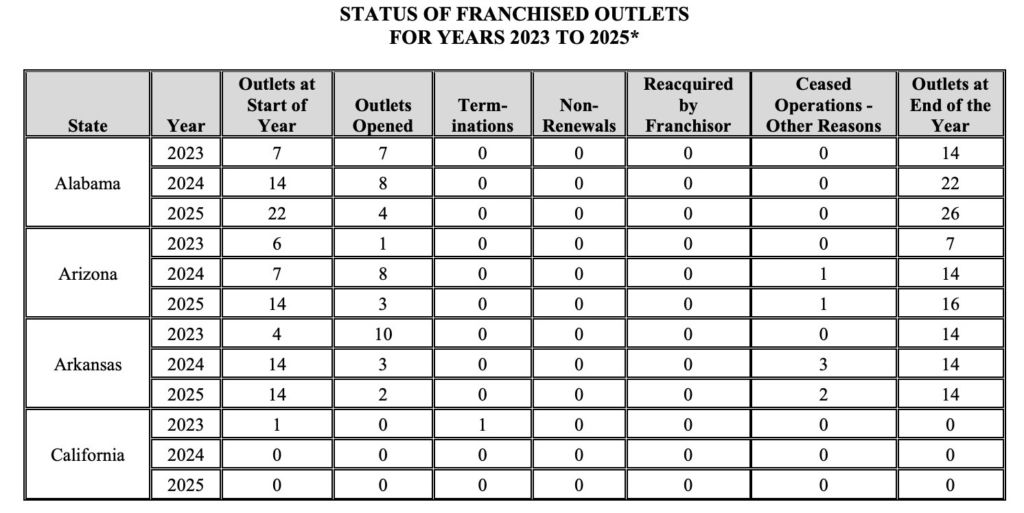
That outline does not include potential closures. Scooter’s in 2025 opened 85 franchised restaurants, terminated two, had a non-renewal, and reacquired a location from a franchisee. Twenty-four Scooter’s ceased operations for “other reasons.” That number was 20 last year and two the year prior. Franchise openings have trended from 209 in 2023’s spurt (a year it sold 12 restaurants to franchisees) to 121 in 2024 and the noted 85 last calendar.
Barring a material slide in trajectory, Scooter’s should be well within the 1,000-store orbit as 2027 comes into focus.
As for how it compares by unit-level performance, Scooter’s finished 2025 with U.S. systemwide sales of $859 million and average-unit volumes just under $1 million. It marked the brand’s debut on the annual QSR 50.
Dutch Bros was at $2.2 billion systemwide sales and $2.1 million AUV, while 7 Brew reported $1.2 billion and $2.6 million, respectively. Starbucks was second only to McDonald’s overall in systemwide sales at $30.2 billion and generated AUVs hovering around $1.8 million. Dunkin’ hit $13.1 billion and $1.4 million.
Black Rock, which had 181 restaurants year-end (it recently crossed 200) achieved $200 million on AUVs of $1.3 million.
Scooter’s unravels an extensive Item 19 on its FDD. The brand reports results for “kiosk drive-thru stores” and franchised “end-cap drive-thrus.” On average, the kiosk definition applies to a location 650–700 square feet, while end-caps are 800–1,400.
And to note regarding the term “kiosk,” this is what Scooter’s uses to illustrate a drive-thru-only standalone box that’s not attached to other real estate. There is generally no seating and sales primarily owe to drinks and associated food products through drive-up windows. They are located in parking lots near other retail shopping.
End-caps are housed in strip centers with indoor ordering and a drive-thru window. The “other” moniker comprises restaurants in hospitals, malls, schools, airports, sporting venues, free-standing buildings, and sometimes includes “substantial” indoor seating with a drive-thru and public restrooms, or stores with only a site-specific service counter.
As of December 31, there were 768 franchised kiosk units and 13 affiliate-owned for a total of 781. Scooter’s had 62 end-cap (one affiliate as well) and 51 “other” restaurants, of which 11 were owned by affiliates. That adds up to the 906 mentioned before.
The financial data below applies to just franchised units of the first two measures.
Scooter’s kiosk footprint has grown significantly over the years. It was 275 in 2021, 421 in 2022, 618 in 2023, 717 in 2024, and 768 as 2026 arrived.
End-cap growth, though, has been more measured. It stood at 53 from 2021–2023 before bumping to 55 in 2024 and 62 this past year.
Included in the breakdown for kiosks were 761 of 768 units.
Alongside growth, average gross sales have come up more than $200,000 per restaurant.
For end-caps, a similar bump to a loftier ceiling (larger units).
Scooter’s also shares average-ticket data across the two.
And a wider view at what’s happening at the ground level.
Same with end-caps.
Scooter’s had a positive report on the top line. The brand’s comp base includes 525 restaurants. That collective posted same-store sales of 8.9 percent building off the prior year’s 5.22 percent.
Scooter’s was up more than 7 percent with end-caps after growth of nearly 4 percent.
This following breakdown shows performance of new openings, or gross sales during the first calendar month a location debuts.
And with a much-smaller end-cap pool:
Scooter’s recently picked up the No. 1 best coffee chain ranking from Newsweek’s 2026 Readers’ Choice Award out of 20 brands. Additionally, it made an executive move in August, bringing in Anna Faktorovich as chief marketing officer, effective September 8. She came over from KFC U.S. and prior, CAVA.
Scooter’s had an inaugural $375 million whole business securitization in June. The collateral included substantially all existing and future revenue-generating assets of the Scooter’s system.
The total investment necessary to begin operation of a franchise is from $658,898 to $1.3 million. This includes $220,000–$286,000 paid to the franchisor or an affiliate. The total investment necessary to begin operation under a multiple store development agreement is from $678,898–$1.466 million depending on number of stores opened (this range is for the purchase of two to five Stores). This includes $240,000–$366,000 paid to the franchisor or an affiliate.
In this story
This story was originally published by Danny Klein in QSR Magazine on September 7, 2026. Burnaze summarizes and links to the original reporting.
Read the full story at QSR MagazineLiked this? Get the week's franchise news, explained
- Sunday 8 AM ET weekly + a monthly deep dive
- Sections picked for the industries you follow
- Every claim linked to its source. Free.