TL;DR
McDonald's has announced the end of its FIFA World Cup sponsorship and is shifting its marketing approach to focus on customer relationships and its own iconic IP. The company's new marketing model will prioritize direct customer relationships and feature fewer but bigger ideas, with a reduced reliance on external IP and partnerships.
McDonald’s just announced the end of its FIFA World Cup sponsorship, which is a pretty big deal given the global scale and interest of the event, let alone the longevity of the marriage between the two entities.
The company has been involved with the World Cup since 1994, and the most recent tournament was the largest global marketing effort in its history, involving roughly 100 different markets around the world.
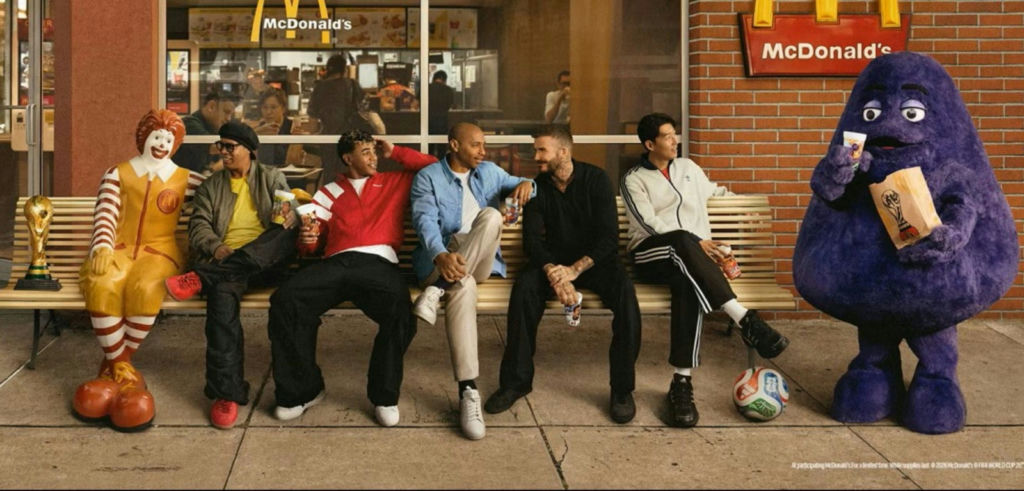
But the campaign didn’t yield much of a bump for the company in the second quarter, when the tournament was in full swing. U.S. same-store sales rose just 0.8% despite a dedicated World Cup adult meal and Happy Meal, collectible cups, and promotional assists from soccer heavyweights like David Beckham, Thierry Henry, Christian Pulisic, and others.
Marketing strategy shift
Such lackluster results haven’t always been the case. In 2022, the chain strengthened its global activation behind the World Cup with its “Wanna Go to McDonald’s?” campaign spanning more than 76 markets.
The company’s goal was to “support fans watching the FIFA World Cup at home through relevant and meaningful McDelivery promotions, regardless of the time zone their team was playing in,” CEO Chris Kempczinski said at the time. In the fourth quarter of 2022, during the throes of the tournament, McDonald’s reported double-digit increases in delivery sales across its 10 global markets. U.
S. same-store sales were up 10.3%.
Granted, the company had a bevy of home runs during that timeframe, including the Cactus Plant Flea Market Happy Meal, but it’s hard not to conclude at least some correlation between the World Cup campaign and those results.
For the 2018 World Cup event, McDonald’s launched “The Breakfast Game,” encouraging Americans to watch matches (held in Russia) over breakfast, despite the U.S. men’s team’s failure to qualify. The company reported its first increase in breakfast traffic in five years, as well as a 4% global same-store sales lift and a 2.6% U.S. same-store sales lift during the coinciding quarter.
Still, it would be too simple to read this breakup purely as a referendum on the World Cup’s ROI. The real story is bigger: McDonald’s is fundamentally rethinking its marketing approach in an increasingly pressured and increasingly cluttered environment.
New marketing approach
We got a look at what that shift entails during the company’s investor day last month in which Kempczinski said, “marketing is becoming more personal, more participatory and more driven by direct customer relationships.”
Morgan Flatley, global chief marketing officer, put a finer point on it, stating that customers will be the foundation of the company’s new marketing model. This means “big, globally scaled campaigns that are purposefully designed to be carried by fans and creators.” Fans’ voices, she added, are more trusted.
New campaigns will also be “built on McDonald’s collection of iconic IP, not someone else’s,” Flatley said. To align with these two objectives, McDonald’s marketing calendar will be simplified with “fewer but bigger ideas.” The company is roughly doubling its investment in longer-running “baseline building programs” forced on brand, taste, quality, and value, while reducing the number of short-term promotional campaigns.
To say this is a massive shift is an understatement. McDonald’s has long had success from “someone else’s IP,” including Super Mario Bros. in the early 1990s, Pokémon, Space Jam, and Disney. The company outperformed its biggest competitors during the pandemic in large part because of wildly successful partnerships like the Travis Scott Meal and the BTS Meal. Just last year, the Minecraft Meal generated a double-digit lift in traffic following its launch.
But seemingly every chain now has a celebrity meal, movie or entertainment tie-in, collectible cup or squishy toy, or nostalgic character promotion. The landscape has become awfully busy and, by extension, less distinctive.
Further, though IP can generate attention, there is more pressure in a cost-conscious environment to prove that such partnerships drive visits, as well as repeat business and profitable growth. McDonald’s softness during the height of this summer’s World Cup fell short of doing those things.
For an industry that's increasingly dependent on borrowed cultural cachet to manufacture buzz, McDonald's marketing shift should be a wake-up call. The company that has spent decades proving that “someone else's IP” could move the needle is now betting the opposite is true: The loudest voice in a noisy category now belongs to the customer.
In this story
This story was originally published in Restaurant Business on October 27, 2026. Burnaze summarizes and links to the original reporting.
Read the full story at Restaurant BusinessLiked this? Get the week's franchise news, explained
- Sunday 8 AM ET weekly + a monthly deep dive
- Sections picked for the industries you follow
- Every claim linked to its source. Free.