TL;DR
Burger King is winning back customers through improved product quality and marketing sincerity, with CEO Josh Kobza highlighting the brand's turnaround strategy. The brand has invested over $2 billion in its Reclaim the Flame strategy, resulting in consistent outperformance of the quick-service burger category in same-store sales for four straight years.
On April 20, at 11:43 a.m., RBI CEO Josh Kobza received an email that changed the rest of his day.
It was from a customer named Jim. After watching a recent Burger King commercial, he stopped at a restaurant to try a Whopper, something he hadn’t done in decades. Admittedly, he had given up on the fast-food giant. In this message, Jim explained that he felt the company no longer cared based on what it was presenting to him as a guest. The Whopper was “OK,” he added, but well short of its potential. But with this new commercial, Jim felt Burger King was sincere in its approach, so he decided to give the chain another try.
His verdict? Burger King nailed it. To his pleasant surprise, the brand has “one of the best burgers in the market,” also noting that “the care in which I felt this burger was made floored me.”
Since this visit, Jim has been back a number of times and continues to be satisfied with what he described as well-presented burgers that taste “incredible and delicious.” He was just happy that Burger King was finally delivering on what it had promised.
Turnaround strategy
“This made my day,” Kobza says. “I get these emails reasonably regularly, and I’ll tell you, if there would be one barometer of whether we’re moving in the right direction, whether we’re getting it more right, it’s getting emails like that from your customers.”
What Jim experienced is the result of years of work from RBI and the Burger King leadership team under the Reclaim the Flame turnaround framework. Positioning the Whopper as a premium, desirable experience—instead of discounting the hero burger—was a priority. As was marketing (advertising and digital), restaurant upgrades, operational execution, and franchisee profitability.
Burger King has injected more than $2 billion into making the strategy work. And the results are showing, placing the brand on a trajectory it hasn’t seen in quite some time.
Since 2022, the chain has consistently outperformed the quick-service burger category in same-store sales for four straight years. During that stretch, the brand also climbed from 10th to 6th place in guest experience rankings and significantly expanded its share of modernized restaurants—from 37 percent in 2021 to 58 percent in 2025.
Kobza attributes the results to efforts across the C-suite, franchisees, and store-level teams.
He regularly attends general manager rallies nationwide to outline Burger King’s annual priorities, ensuring operators understand what’s ahead and why it matters. Operational simplicity has been a focus too, so that restaurant teams’ lives become easier. One specific example was the removal of Burger King’s previous iteration of the chicken sandwich.
The brand settled on an improved Royal Crispy Chicken Sandwich lineup, with original, spicy, and bacon and Swiss flavors. Additionally, Burger King roughly doubled the size of its field teams to provide enhanced, on-the-ground support to franchisees.
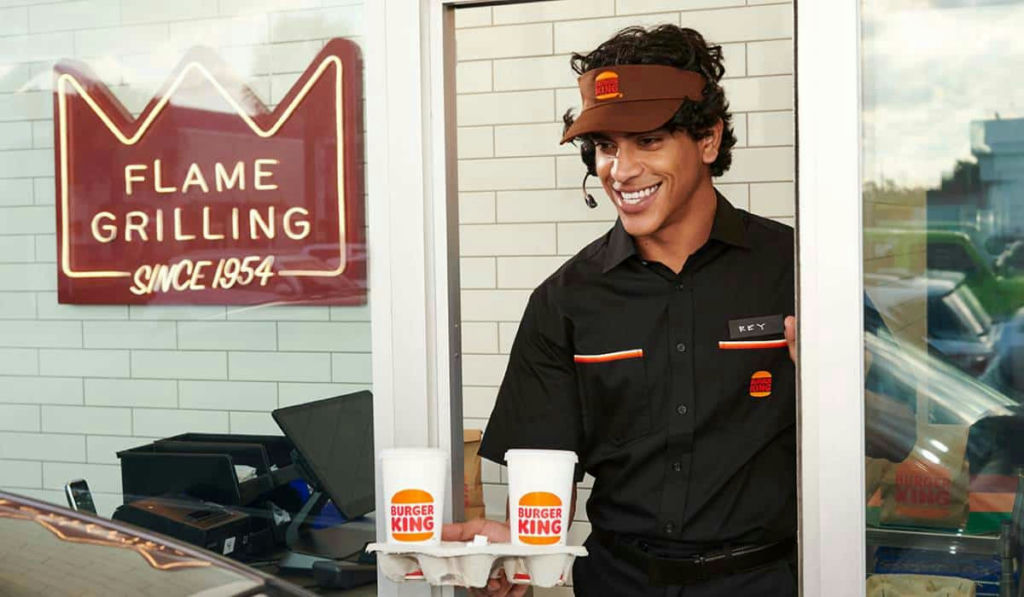
Burger King’s new Sizzle image is a big hit too. Remodeled U.S. restaurants are earning $2.2 million in AUV; for perspective, the system average was $1.66 million in 2025.
Come hear the Burger King story in person at QSR Evolution! Register today as brand president Tom Curtis takes the keynote stage.
“We need to keep making progress,” Kobza says. “I don’t think we’re going to be done in six months, one year, two years. I want it to be a constant evolution of getting better and better and better until we’re the number one player in the burger business. And then we still have to keep getting better. I think that’s going to take a long time. And that’s the beauty of what we’re trying to do.”
Tom Curtis, president of Burger King U.S. and Canada, remembers his parents taking him to Burger King to celebrate special occasions and receiving a crown and Whopper.
“That was the bomb,” he recalls. “That was the ultimate reward for some accomplishment.”
As he got older and had kids of his own, he too took them to Burger King. But because of a string of bad experiences, letdowns, and aging assets, Curtis stopped visiting. He lost his connection with the brand, despite the strong affiliation from his youth.
Curtis went on to work in restaurants, most notably 35 years at Domino’s. There, he was part of a turnaround that eventually lifted the chain to No. 1 status in the global pizza segment. At one point, he received a call about leading Burger King’s U.S. business.
The role intrigued him. At Domino’s, becoming No. 1 had already been accomplished. It was now about staying there. Curtis was attracted to the Burger King job because of his love for the journey to the top—and because of the chain’s heritage and nostalgia.
“But like millions and millions of Americans, I had fallen out of love with it,” Curtis says. “And the idea of coming here and helping to do something similar with such an iconic brand as what I had been a part of at Domino’s was part of the appeal and the allure of coming here to Burger King.”
Curtis knew Burger King was his future. What he didn’t understand was how deep the issues were. The brand president uses the words “deteriorating” and “decay” to paint the state of restaurants, guest experience, culture, and operations. It took him about six months to really comprehend what he was leading.
He isn’t shy about the process. Initially it was more than he had bargained for.
“I thought that I could come here and make a huge difference in the operational culture and the focus of what we were doing and that would take us to the promised land. That we would build a team and we would just motivate people to treat people nicer and that would reverse the cycle—the vicious cycle that Burger King was in. But I was wrong. The problems were much more deep-rooted and the vicious cycle was much more firmly in place than I gave it credit for,” Curtis says.
Curtis joined as COO in April 2021 before leaping to his current role four months later.
In these early days, Curtis built a team who analyzed the severity of the situation. The group learned that operators were pulling back on labor, equipment, and remodels, which all made matters worse. But it was because franchisees didn’t have as much money.
Curtis’ group worked with operators on creating a plan that would stop the cycle. To kick matters off, Burger King corporate recognized it needed to invest first. Franchisees were on board with the idea. If investments in marketing, reimaging, digital, and operations proved profitable and a tailwind for restaurant-level cash flow, then they were more than happy to put their own money into the bucket.
“Investing more as time went on was really the key component, if you will, of the plan,” Curtis says. “So it wasn’t necessarily the elements of the plan. The elements of the plan are almost always similar from brand to brand, but the sequencing and the timing of the plan was what was far more important in actually getting the brand to get into a virtuous cycle.”
Reclaim the flame plan
Burger King first announced its Reclaim the Flame transformation plan on September 9, 2022. The brand allocated $400 million, including $200 million toward remodels, followed by $120 million for advertising, $50 million for restaurant refreshes, and $30 million for digital.
One of the biggest—and most public-facing—steps was releasing a series of commercials, highlighted by a catchy jingle and new tagline, “You Rule.”
It’s not that Burger King wanted to move on from its well-known “Have It Your Way” mantra. The brand has an unbreakable association with those words. However, over time, Curtis says the phrase became “white noise.” Sure, you can utter the tagline and customers will immediately know who you are referring to, but it didn’t change how customers felt about the chain.
To Curtis, “You Rule” reinvigorates the idea that the guest is king and they drive where Burger King heads next.
“‘Have it Your Way’ was something that we said all of those years where we weren’t really letting people have it their way and we weren’t really doing things for our guests like improving our operations and improving our restaurants, so it was an unfulfilled promise,” Curtis says. “And by making that pivot, it modernized the notion and also re-energized us internally and re-energized guests around the idea that at Burger King you get to choose.”
Another major move was the $1 billion acquisition of publicly traded Carrols Restaurant Group, Burger King’s largest franchisee. Before this purchase in 2024, the franchisor worked closely with Carrols’ management team, and Curtis served on the board of directors. The brand struggled to get the franchisee to invest when it also needed to return capital to shareholders as well—a competition for cash.
By acquiring Carrols, Burger King accomplished several things, according to Curtis. First, the chain could take all of the restaurant earnings and pile that back into remodels. Also, it accelerated the remodeling process. Beforehand, Burger King only had a small contingent of corporate locations in Miami and didn’t have the capability to understand how new innovations and products would impact the greater landscape. But with Carrols, which had locations in 23 states, Burger King had a more diverse and informed view of impact.
Thirdly—and arguably most important for the future—the chain now had a large enough company-owned footprint to properly grow talent.
“If we’re going to have great franchisees and great operators running this business, and this does need to be an operations-led brand, then we have to have a platform. We have to have a place where we can grow talent,” Curtis says. “And now that we have 25,000 employees of our own in all of these company restaurants that we own, those will become the future franchisees of this brand.
Those will become the future operators of the restaurants that we own. And we can also share that talent with our franchisees, and those will become people who work on our operations field teams, not people that we have to take from other brands that maybe don’t even sell burgers, but they’ll be people who are born and raised in the Burger King system and they will understand it better than no other.”
Burger King added a $500 million remodel commitment for these Carrols restaurants and an incremental $300 million co-investment in remodels alongside franchisees.
A year before in 2023, Burger King announced its Sizzle prototype, equipped with a modern exterior and tech-forward operations, like kiosk and in-store mobile order and pickup and mobile order and pickup at the drive-thru. Typically, the box cuts about 200 square feet.
Curtis says the Sizzle remodel is not a top-down directive, but the result of years of listening to customers and testing ideas before asking franchisees to invest.
The changes began with direct guest feedback. By bringing customers into existing restaurants and asking what they wanted from a modern Burger King, a clear pattern emerged. People valued digital convenience, but they didn’t want a fully automated experience. Many still preferred the option of interacting with a person. The challenge, then, was to design a space that could serve both preferences seamlessly.
That balance became a hallmark feature of the Sizzle design. The remodel combines digital touchpoints with traditional service, giving guests flexibility in how they order and interact. At the same time, it rethinks the in-restaurant experience. Customers said that when they chose to dine in, they wanted a space that felt more comfortable and social and somewhere they could sit with friends or family. In response, the prototype introduced more intimate seating, including wraparound “King’s booths.”
Corporate-owned locations were remodeled first, allowing the team to improve the design, test performance, and understand the economics before rolling it out.
“When we’ve seen the returns, we’ll support the investment, then we tell the franchisee we’re ready, and this is now our expectation,” Curtis says.
Leadership changes
In addition to significant investments in restaurants, Burger King upped its leadership team. Patrick Doyle, the former Domino’s CEO who led the aforementioned turnaround with Curtis, joined as RBI chairman in the fall of 2022. It was not too long after Reclaim the Flame had started.
Doyle immediately showed his commitment. The executive bought 500,000 shares, equaling $30 million. He handed out that cash because he saw Burger King’s potential.
“People continue to give Burger King tremendous credit for the Whopper,” he says. “And that’s central to it, and that has not changed. And so even though we’ve gone out and elevated the Whopper and made it a little bit better based on feedback, part of what gave me confidence that it was doable was there was still real love around that burger, around the Whopper and how good it is.”
Doyle felt there was real demand from customers for Burger King to succeed. People have been cheering for the chain to get better.
RBI brought on Doyle for his experience at Domino’s, where he successfully balanced a long-term turnaround strategy with the demands of delivering consistent near-term growth as a public company.
His philosophy is that “ultimately, you have to do the right thing for the business.” Doyle’s priority is to communicate clearly with shareholders and instill confidence that the brand can achieve its objectives on a defined timeline.
He emphasizes that this balancing act isn’t just for investors. It’s also for guests. One of the most notable changes he’s seen in the past few decades is that restaurant-consumer relations is no longer a one-way conversation.
“The consumer and their perceptions of the brands have at least as much power in the relationship as the theoretical brand owner does,” Doyle says. “And the takeaway from that is the actual experience has to be great.”
And you can’t shorten the process for getting there.
“At the end of the day, you have to believe that the experience that your guests are having in your restaurants are better today than they were a year ago, that the food is better, that the service and hospitality is better on average, that the restaurants look better on average,” Doyle adds. “And if that’s true, you’re going to be able to communicate that and grow sales, and you can’t just come up with some promotion that’s going to fix what is a broken underlying reality.”
Improving franchisee profitability is one of Doyle’s long-term goals.
Burger King has triumphed in this area. Average franchisee profitability per store rose from a low of $125,000 to $205,000 in 2023 and 2024. The figure sank to $185,000 in 2025 because of rising beef costs. But, RBI noted that if external factors were removed, operators made more money last year, proving that its turnaround strategies are taking the intended effect.
After Doyle arrived, RBI began publicly reporting franchisee profitability—for Burger King and its sister concepts, Tim Hortons, Firehouse Subs, and Popeyes. He calls it the single-most important metric for predicting long-term success for a brand and its system.
“Are the returns there? Are the profits there for the franchisees? And if you believe that to be true, and I clearly do, and everybody here clearly does, then why would you not publish that?”
Doyle says. “And I continue to be stunned by restaurant systems that don’t do it. If I was an investor, I would demand it.
Because it is the best predictor of long-term success. If you’re committed to that and you believe that, then why would you not publish it? And there’s really only one answer, which is that there might be bad news in there, and I don’t want people to know it.
It’s like, well, that’s not very transparent. That’s not building trust with your franchisees. It’s not building trust with your investors.
You have to do it. So we do it.”
Doyle, RBI, and Burger King also want to refranchise the Carrols restaurants and put them in the hands of smaller operators who can be closer to the day-to-day operations of the business.
Carrols had more than 1,000 locations, and at that scale, Doyle argues it lost many of the advantages of a franchisee-run system. He contends the footprint functioned more like company-owned restaurants, given how dispersed it was and how many units were operated by non-owners.
Despite this, Carrols managed to run stores better than Burger King’s system average. That doesn’t change the fact that Doyle believes the local owner-operator is the preferred circumstance.
Because Burger King has momentum, he says more restaurateurs are approaching the brand about becoming franchisees, including home-grown employees working at Carrols restaurants.
“The process that we’re working through with these restaurants, as we refranchise them, is to find those great people who want to own and run restaurants, and that’s the magic,” Doyle says. “And look, we’ve got big operators in our system as well who do a terrific job. And great.
We love them also. If you’re able to do that, that’s fantastic. But it’s always going to be a little easier for the person who is smaller and closer to each of their restaurants.
You will see that even with larger franchisees, the further the restaurants are away from where the franchisee lives, generally, the less well they perform. And it’s just a truism in the restaurant industry.”
This pursuit also means having direct conversations with other underperforming franchisees as to whether they can carry forward with better standards, need to sell to a more well-equipped operator, or shutter some units.
In Q2 2022, around the time Reclaim the Flame began, Burger King had 7,058 U.S. restaurants. It finished 2025 with 6,649 locations.
Hundreds of closures have occurred. And more are on the way. Doyle says talks with franchisees always go better when both sides are transparent and honest.
“You sit down over a meal, and you talk through and say, look, I know what you’ve accomplished before, and you’re not accomplishing it now,” Doyle says. “Let’s have an open conversation about it because it feels like if you did it in the past, and you’re not doing it today, we know that you can do it, but you’re choosing not to. And so maybe you’re just not as excited about it anymore, and maybe some of that’s our fault because we went through a rough patch.
And if you want to go after it, and you want to lift the experience that your guests are having again, and that’s going to drive results, we are with you to get that done. If you’re not, then probably the best time for you to sell is now. Because if you’re really not, two years from now, your restaurants are probably going to be worse than they are today.”
Marketing efforts
When CMO Joel Yashinsky entered Burger King in April 2025, he found himself stepping into what felt like a pivotal moment for the brand. In the years before his arrival, teams had been quietly laying the groundwork—remodeling restaurants, refining operations, upgrading technology, and rethinking the guest experience. To him, it was clear that all of that effort had built a new foundation, and the company was on the verge of something bigger.
What was missing, he realized, was a way to bring customers into that story. From a marketing standpoint, the opportunity wasn’t just to advertise, but to elevate the brand by focusing on what matters most in the restaurant business, which is the food and experience. Everything that had been done behind the scenes needed to be translated into something guests could see, feel, and understand.
The most symbolic change was also the simplest. For years, even as the company had moved away from using the King mascot in its advertising, the character still lingered in the public’s perception of the brand.
So the team made a deliberate decision to move on from it, marking a clear break from the past. In its place, they introduced a new idea, which is that the guest is “king.”
“So everything we do now is really about how we action against what our guests are looking for to create that better experience, to create that food that they’re looking for, for us to provide for them and to really elevate everything we do as a brand,” Yashinsky says.
The CMO adds that the more Burger King listens to customers, the more relevant it will become.
That idea has already started to take form. Campaigns like the Million Dollar Whopper and its evolution into “Whopper by You” invite customers to suggest flavors and ideas, turning the menu into something more collaborative. The same approach is expanding beyond food. The brand is asking guests what kinds of promotions, partnerships, and experiences they actually want to see. The chain is moving away from industry trends like celebrity-driven campaigns and instead putting the spotlight on everyday customers.
For Yashinsky, this isn’t just about collecting user-generated content; it’s about creating a user-influenced brand. Customer input is meant to guide everything—from menu improvements to marketing ideas—building on a sustainable effort within the company to actively listen and respond to feedback.
“Let us know how Burger King can evolve for you that will keep you excited, and again, as a brand that likes to think we’re for everybody, it doesn’t matter what age, what background you have, where you live, rural, urban, suburban, we want to be the brand that provides and caters to the needs of our guests and do that in a really authentic manner,” Yashinsky says. “And if we can communicate and live that way, we’ll certainly, I think, succeed in this effort to really be a brand in the hands of our fans.”
The Whopper has been a key part. Yashinsky frames it as nothing less than the heart of the brand.
He explains that it isn’t just another menu item. Rather, it’s an icon, arguably one of the most recognizable hamburgers in the world, and a core piece of what defines Burger King.
Even during periods when the business itself struggled, the Whopper’s reputation never really wavered, he says. Customers still believed in the product; they simply had other reasons for not coming in. That distinction, he notes, is important. It meant the company didn’t need to reinvent the Whopper. It needed to protect it, invest in it, and remind people why it mattered.
Although Burger King has evolved, the Whopper has remained a constant. Instead of cutting corners, the brand doubled down on that strength by maintaining the size and quality of the burger, but folding in small, but deliberate upgrades to how it’s prepared and presented.
The chain announced in February that it had elevated the Whopper for the first time in nearly 10 years, including a better tasting bun.
“It’s more than a quarter pound of beef. It’s 4.4 ounces,” Yashinsky says. “There’s no shrinkflation going on at Burger King. We’re investing in the Whopper. The franchisees in our restaurants, it costs money to put that Whopper in a box. That’s an investment. It was an investment to put this new glaze on the crown of the bun. That makes it look even better than it did beforehand, and that investment only shows how important the Whopper is from a brand perspective.”
Burger King has also put more of a focus on family dining. Yashinsky says that years ago, the introduction of the King mascot unintentionally alienated a key audience—parents, especially mothers—and the company saw a noticeable decline in its kids and family business. That shows Yashinsky that if the brand truly wants to be for everyone, it has to win back families.
He sees a clear opportunity to do that by creating experiences that resonate with kids and parents. Recent partnerships and promotions have proved this can work. Campaigns tied to popular franchises like “How to Train Your Dragon,” “SpongeBob SquarePants,” “The Addams Family,” and “The Mandalorian & Grogu,” have demonstrated that families will respond when the experience feels thoughtful, fun, and complete.
“It’s all tied together in terms of our investment that we’re trying to make for our guests, so that when they come to Burger King on any given day, we raise their day by a point or two, and that’s who we are as a brand,” Yashinsky says. “We’re just giving kids and families or teenagers, or retirees, whoever it is, everybody who comes to Burger King, they get a great Whopper, they get a great kids meal or a great dessert. Everything we want to do right now is on behalf of them, and that’s what’s exciting about us.”
Job is Far From Over
Curtis says there are millions of people who still love Burger King and want to see it succeed, but many haven’t been coming back.
Through direct outreach and feedback, it became clear that the issue wasn’t a lack of affection. Instead, there were barriers, including frustrations or perceptions that had kept both former and potential customers away. A common theme emerged, and it’s that people felt large brands weren’t really listening to them.
The company made an effort to change that. By opening up direct lines of communication—including a widely publicized phone number—the team invited customers to share their thoughts. Tens of thousands of calls poured in and have continued well beyond the initial campaign window. The real impact wasn’t just the volume, but what the company did with that feedback, Curtis says.
Listening, he says, only matters if it leads to action.
“The act of listening and really listening with the intent to learn and make change is what’s inspiring people to come back to Burger King, and so we intend to continue with that practice,” Curtis says. “My entire leadership team now listens to calls, responds to guests, reaches back out to stores and says, ‘Nice job,’ or says, ‘Can you fix this?’ And then the guests know that we did that, and so they feel heard. They feel like they’re a part of where this brand is going.”
Kobza says what Burger King has achieved is especially notable given its size and history.
With thousands of locations and decades behind it, turning around the day-to-day consistency of the guest experience is an incredibly difficult task. It’s one that few brands have managed at this scale. Yet, over the past few years, he’s seen the brand move from lagging behind its peers to steadily climbing toward the front of the pack. The improvement shows up not only in internal metrics, but also in third-party data and, just as importantly, in feedback from customers themselves.
Kobza credits much of that progress to the work of the leadership team and their ability to match closely with franchisees. In a system that has experienced its share of ups and downs, building trust hasn’t been easy. But he describes how the company has worked to bring operators together around a shared vision, ensuring they stay in step through both challenges and successes. That collaboration, he says, has been critical to advancing everything from operations to brand image.
One recent example underscores that alignment. An overwhelming majority of franchisees—97 percent—voted to support increased investment in the advertising fund. For Kobza, that level of consensus is rare in a franchise system and signals strong confidence in the company’s direction, particularly in how marketing dollars are being used and the results they’re beginning to generate.
He also acknowledges that some of the most important work ahead is also the most demanding. The company’s large-scale remodel initiative is essential to staying competitive, especially in an industry where customers have plenty of modern, visually appealing options.
While the plan to modernize the vast majority of restaurants by 2028 requires significant time and investment—and has faced some headwinds—it’s a necessary step.
Guests like Jim continue to tell Burger King that the plan is working.
So the brand will keep at it, never relenting.
“I think we’re headed absolutely in the right direction,” Kobza says.
"*" indicates required fields
In this story
This story was originally published by Ben Coley in QSR Magazine on July 1, 2026. Burnaze summarizes and links to the original reporting.
Read the full story at QSR MagazineLiked this? Get the week's franchise news, explained
- Sunday 8 AM ET weekly + a monthly deep dive
- Sections picked for the industries you follow
- Every claim linked to its source. Free.